Early micronutrient supplementation was associated with different behavioral scores in school-aged children in Nepal
Prenatal and preschool micronutrient supplementation and behavioral outcomes in school-aged children in Nepal-a cohort study
Cohort follow-up study of two randomized trialsBenefit found
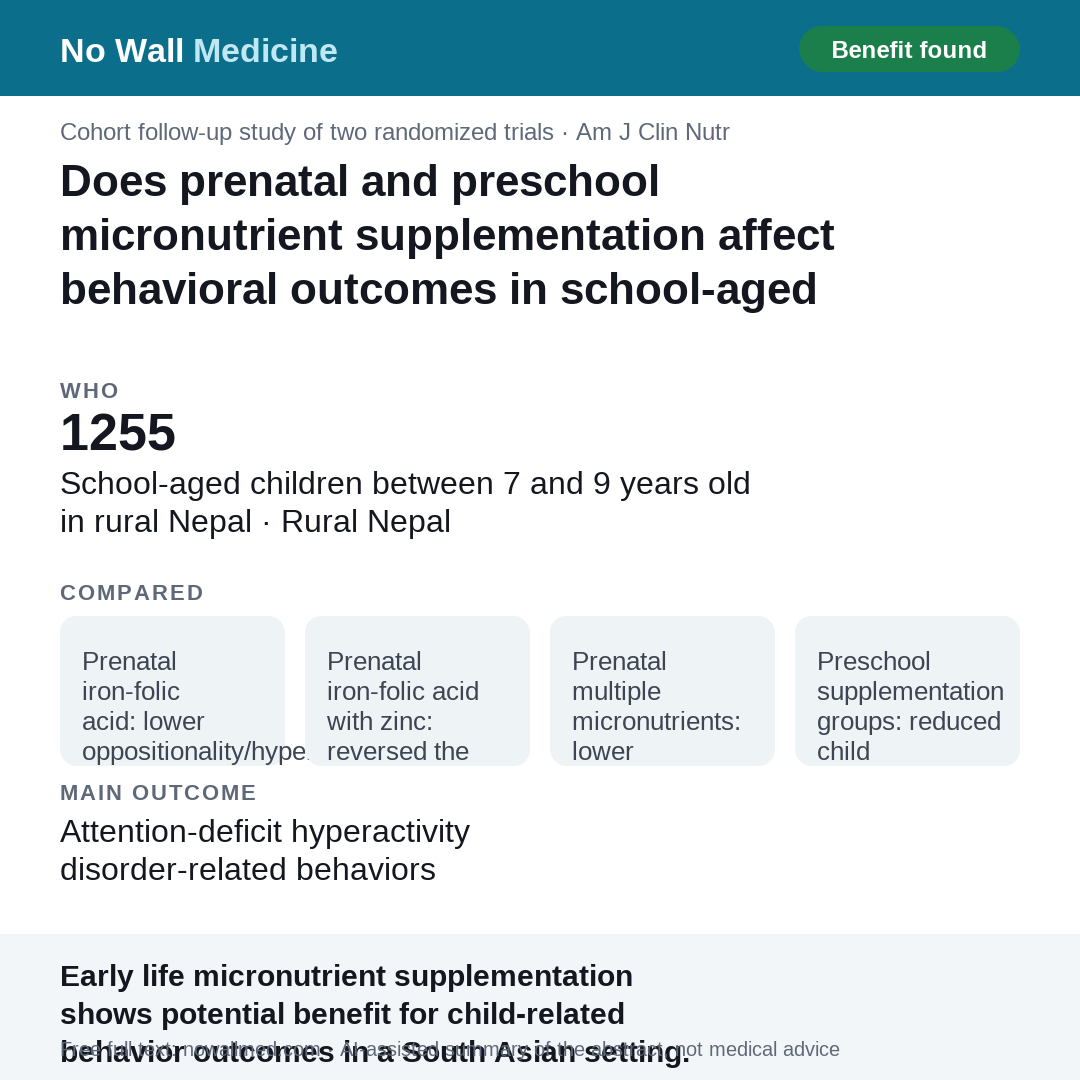
Does prenatal and preschool micronutrient supplementation affect behavioral outcomes in school-aged children?
Who
1255
School-aged children between 7 and 9 years old in rural Nepal · Rural Nepal
Compared
Prenatal iron-folic acid: lower oppositionality/hyperactivity and inattention scores
Prenatal iron-folic acid with zinc: reversed the positive effect seen with iron-folic acid
Prenatal multiple micronutrients: lower oppositionality and/or hyperactivity score
Preschool supplementation groups: reduced child inattention when assessed by parents
Main outcome
Attention-deficit hyperactivity disorder-related behaviors
Bottom line: Early life micronutrient supplementation shows potential benefit for child-related behavior outcomes in a South Asian setting.
Am J Clin Nutr · 2025-10-13Download image
Clinical question: Does prenatal and preschool micronutrient supplementation affect behavioral outcomes in school-aged children?
Why it matters: The influence of early life nutrition interventions on behavioral difficulties among children in low-income countries is not well understood.
Key points
- Researchers followed 1255 children aged 7 to 9 years in rural Nepal who were part of previous randomized trials during pregnancy or preschool years.
- Prenatal iron-folic acid was associated with lower oppositionality/hyperactivity and inattention scores in parental ratings, while multiple micronutrients were associated with lower oppositionality and/or hyperactivity scores.
- In the preschool trial, all 3 supplement groups were associated with reduced inattention in parental ratings, and iron-folic acid alone or with zinc was associated with reduced hyperactivity in teacher ratings.
Headline and key points written with AI from the paper’s abstract, with every number checked against it. Read the paper before relying on them.
Was this summary helpful?
Subject terms
Cite this article
Christian P, Zavala E, Hurley KM, Khatry SK, LeClerq SC, Fune Wu LS. Prenatal and preschool micronutrient supplementation and behavioral outcomes in school-aged children in Nepal-a cohort study. Am J Clin Nutr. 2025. doi:10.1016/j.ajcnut.2025.10.006
Spotted a mistake? Suggest a correction
Top studies every Monday
The week’s key trials and guidelines in your specialties, plus any topics you follow. By email, free.
Get the weekly digest