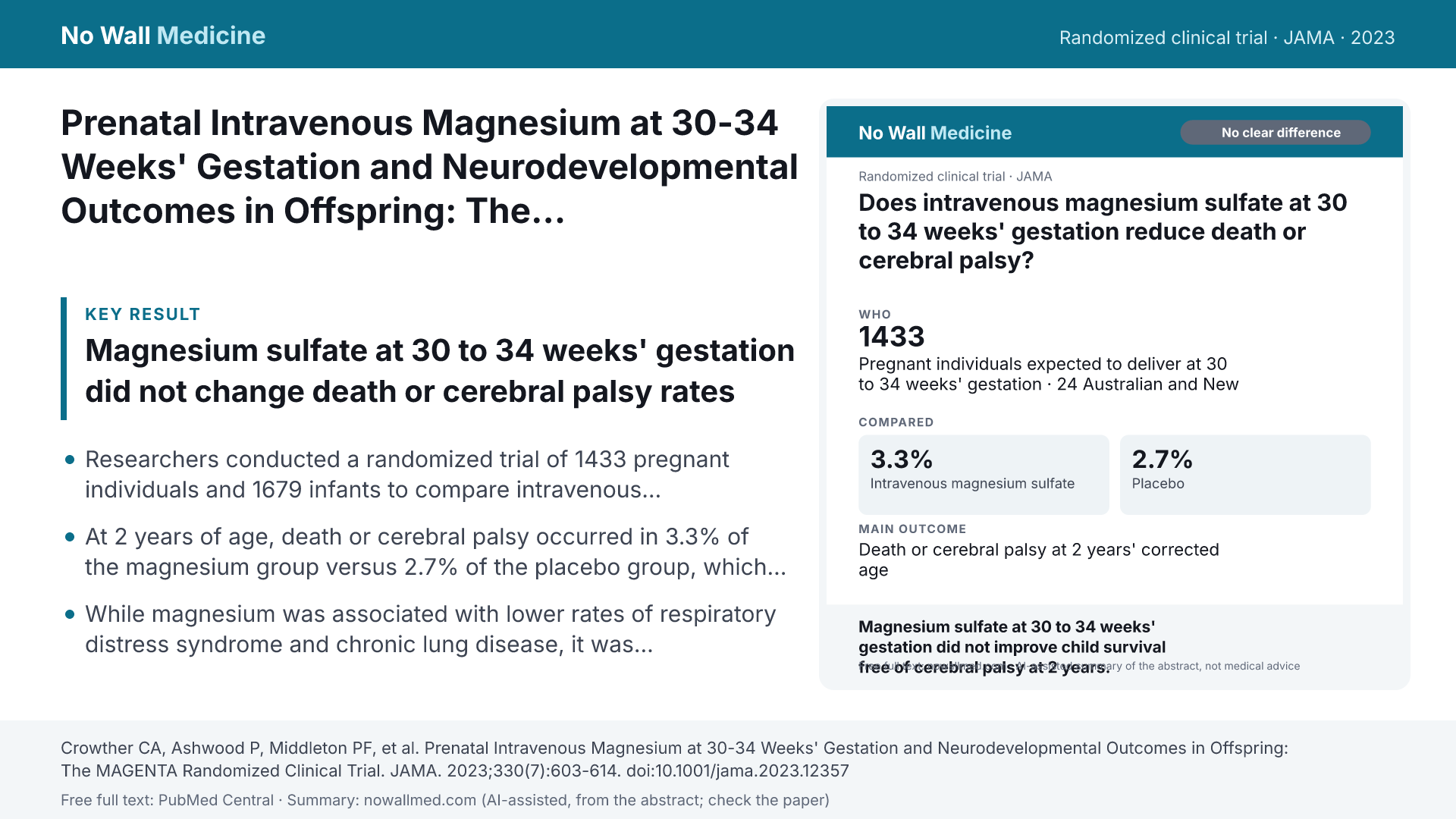
Magnesium sulfate at 30 to 34 weeks' gestation did not change death or cerebral palsy rates
Prenatal Intravenous Magnesium at 30-34 Weeks' Gestation and Neurodevelopmental Outcomes in Offspring: The MAGENTA Randomized Clinical Trial
Randomized clinical trialNo clear difference
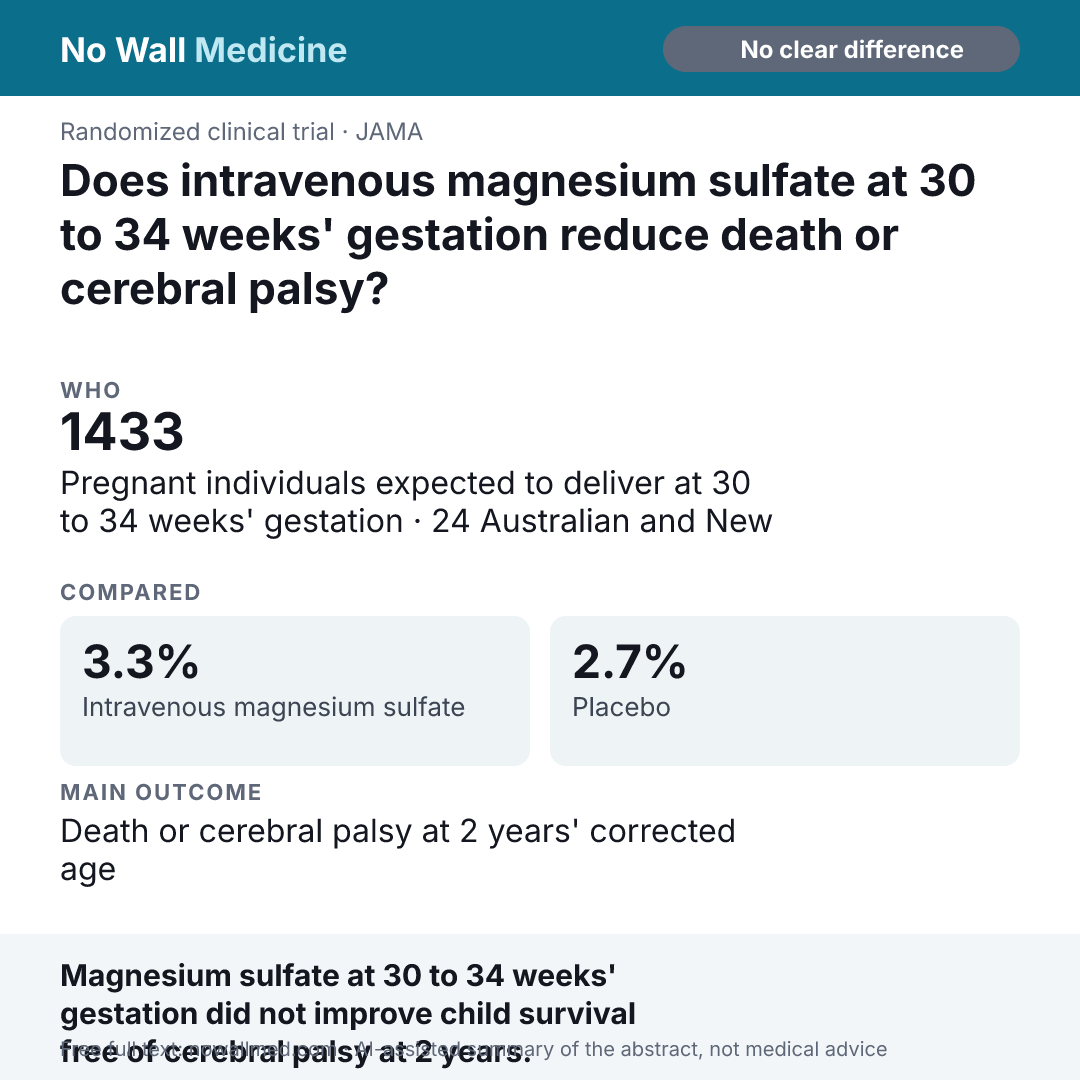
Does intravenous magnesium sulfate at 30 to 34 weeks' gestation reduce death or cerebral palsy?
Who
1433
Pregnant individuals expected to deliver at 30 to 34 weeks' gestation · 24 Australian and New Zealand hospitals
Compared
3.3%Intravenous magnesium sulfate (23 of 691 children)
2.7%Placebo (18 of 674 children)
Main outcome
Death or cerebral palsy at 2 years' corrected age
Result: risk difference 0.61% (95% CI -1.27% to 2.50%)
Bottom line: Magnesium sulfate at 30 to 34 weeks' gestation did not improve child survival free of cerebral palsy at 2 years.
Limitation: The study had limited power to detect small between-group differences.
JAMA · 2023-08-15 · Save PNG
Clinical question: Does intravenous magnesium sulfate at 30 to 34 weeks' gestation reduce death or cerebral palsy?
Key points
- Researchers conducted a randomized trial of 1433 pregnant individuals and 1679 infants to compare intravenous magnesium sulfate with a placebo.
- At 2 years of age, death or cerebral palsy occurred in 3.3% of the magnesium group versus 2.7% of the placebo group, which was not a significant difference.
- While magnesium was associated with lower rates of respiratory distress syndrome and chronic lung disease, it was also associated with more adverse events in pregnant individuals.
Limitation the authors note: The study had limited power to detect small between-group differences.
Headline and key points written with AI from the paper’s abstract, with every number checked against it. Read the paper before relying on them.
Was this summary helpful?
Subject terms
Headline, design, result, key points, caveat and citation as plain text.
Cite this article
Crowther CA, Ashwood P, Middleton PF, et al. Prenatal Intravenous Magnesium at 30-34 Weeks' Gestation and Neurodevelopmental Outcomes in Offspring: The MAGENTA Randomized Clinical Trial. JAMA. 2023;330(7):603-614. doi:10.1001/jama.2023.12357
Spotted a mistake? Suggest a correction