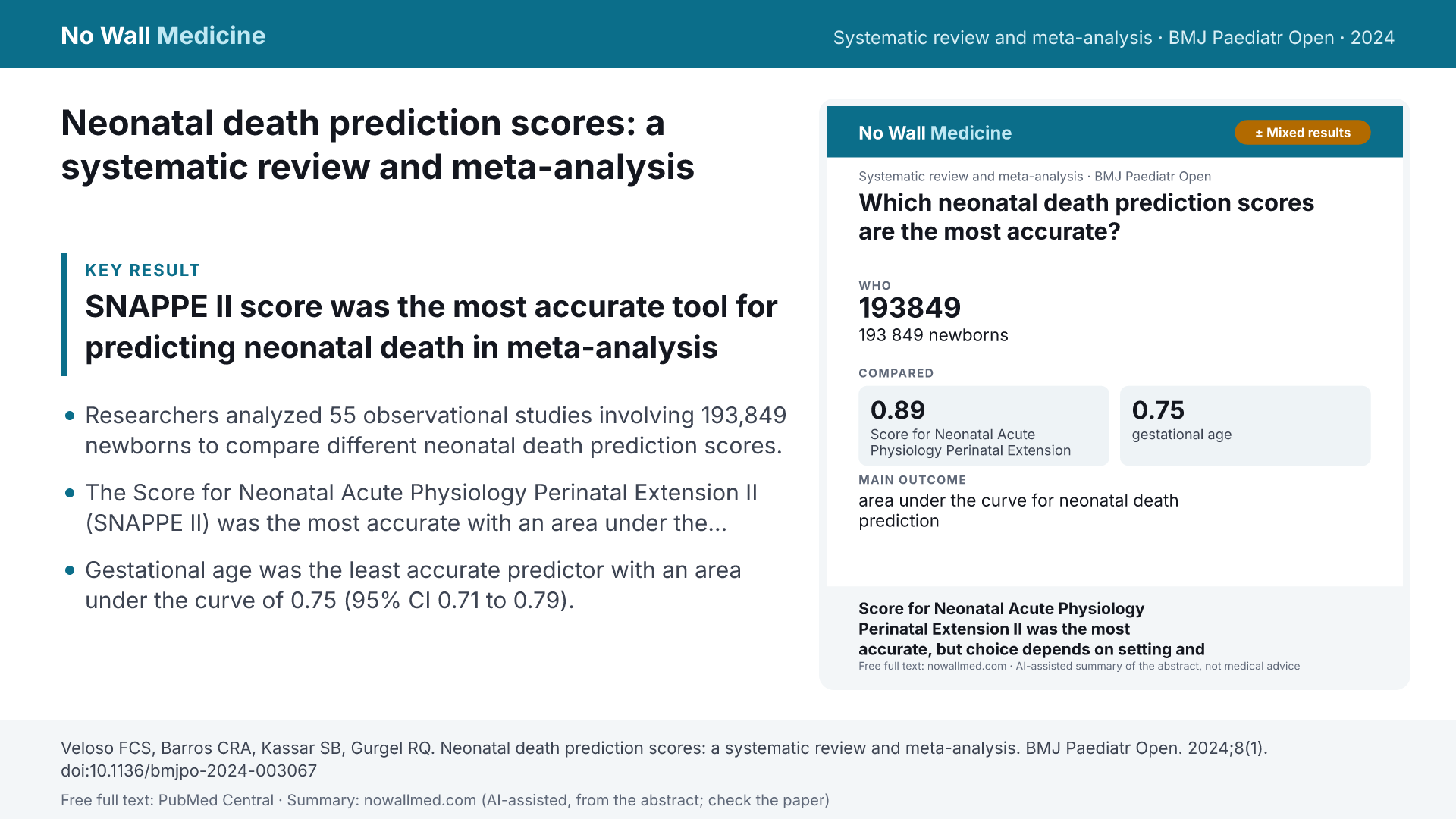
SNAPPE II score was the most accurate tool for predicting neonatal death in meta-analysis
Neonatal death prediction scores: a systematic review and meta-analysis
Systematic review and meta-analysisMixed results
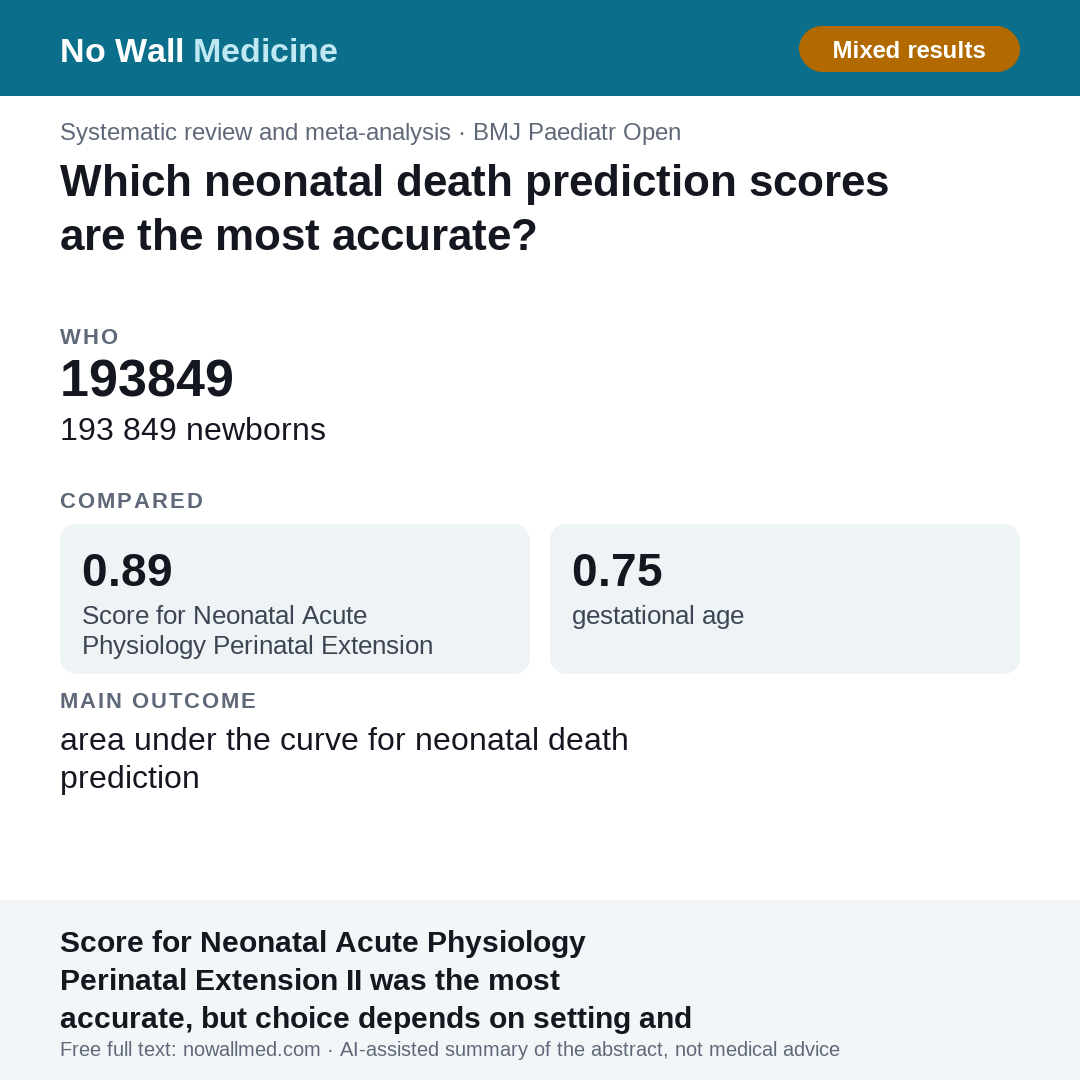
Which neonatal death prediction scores are the most accurate?
Who
193849
193 849 newborns
Compared
0.89Score for Neonatal Acute Physiology Perinatal Extension II (95% CI 0.86 to 0.92)
0.75gestational age (95% CI 0.71 to 0.79)
Main outcome
area under the curve for neonatal death prediction
Bottom line: Score for Neonatal Acute Physiology Perinatal Extension II was the most accurate, but choice depends on setting and practicality.
BMJ Paediatr Open · 2024-12-24Download image
Clinical question: Which neonatal death prediction scores are the most accurate?
Why it matters: It was unknown which existing prediction scores are most accurate for identifying newborns at risk of death.
Key points
- Researchers analyzed 55 observational studies involving 193,849 newborns to compare different neonatal death prediction scores.
- The Score for Neonatal Acute Physiology Perinatal Extension II (SNAPPE II) was the most accurate with an area under the curve of 0.89 (95% CI 0.86 to 0.92).
- Gestational age was the least accurate predictor with an area under the curve of 0.75 (95% CI 0.71 to 0.79).
Headline and key points written with AI from the paper’s abstract, with every number checked against it. Read the paper before relying on them.
Was this summary helpful?
Abstract
Objective
To compare, through a systematic review and meta-analysis of observational accuracy studies, the main existing neonatal death prediction scores. Method
Systematic review and meta-analysis of observational accuracy studies. The databases accessed were MEDLINE, ELSEVIER, LILACS, SciELO, OpenGrey, Open Access Thesis and Dissertations, EMBASE, Web of Science, SCOPUS and Cochrane Library. For qualitative analysis, Quality Assessment of Diagnostic Accuracy Studies 2 was used. For the quantitative analysis, the area under the curve and the SE were used, as well as the inverse of the variance as a weight measure, DerSimonian and Laird as a measure of random effects, Higgins' I² as an estimate of heterogeneity, Z as a final measure with a 95% confidence level. Results
55 studies were analysed, 8 scores were compared in a total of 193 849 newborns included. The most accurate neonatal death prediction score was Score for Neonatal Acute Physiology Perinatal Extension II (SNAPPE II) (0.89 (95% CI 0.86 to 0.92)) and the least accurate was gestational age (0.75 (95% CI 0.71 to 0.79)). Conclusion
SNAPPE II was the most accurate score found in this study. Despite this, the choice of score depends on the situation and setting in which the newborn is inserted, and it is up to the researcher to analyse and decide which one to use based on practicality and the possibility of local implementation. Given this, it is interesting to carry out new prospective studies to improve the prediction of neonatal deaths around the world. Prospero registration number
CRD42023462425.
Abstract reproduced under the article’s CC BY NC licence.
Subject terms
Cite this article
Veloso FCS, Barros CRA, Kassar SB, Gurgel RQ. Neonatal death prediction scores: a systematic review and meta-analysis. BMJ Paediatr Open. 2024. doi:10.1136/bmjpo-2024-003067
Spotted a mistake? Suggest a correction