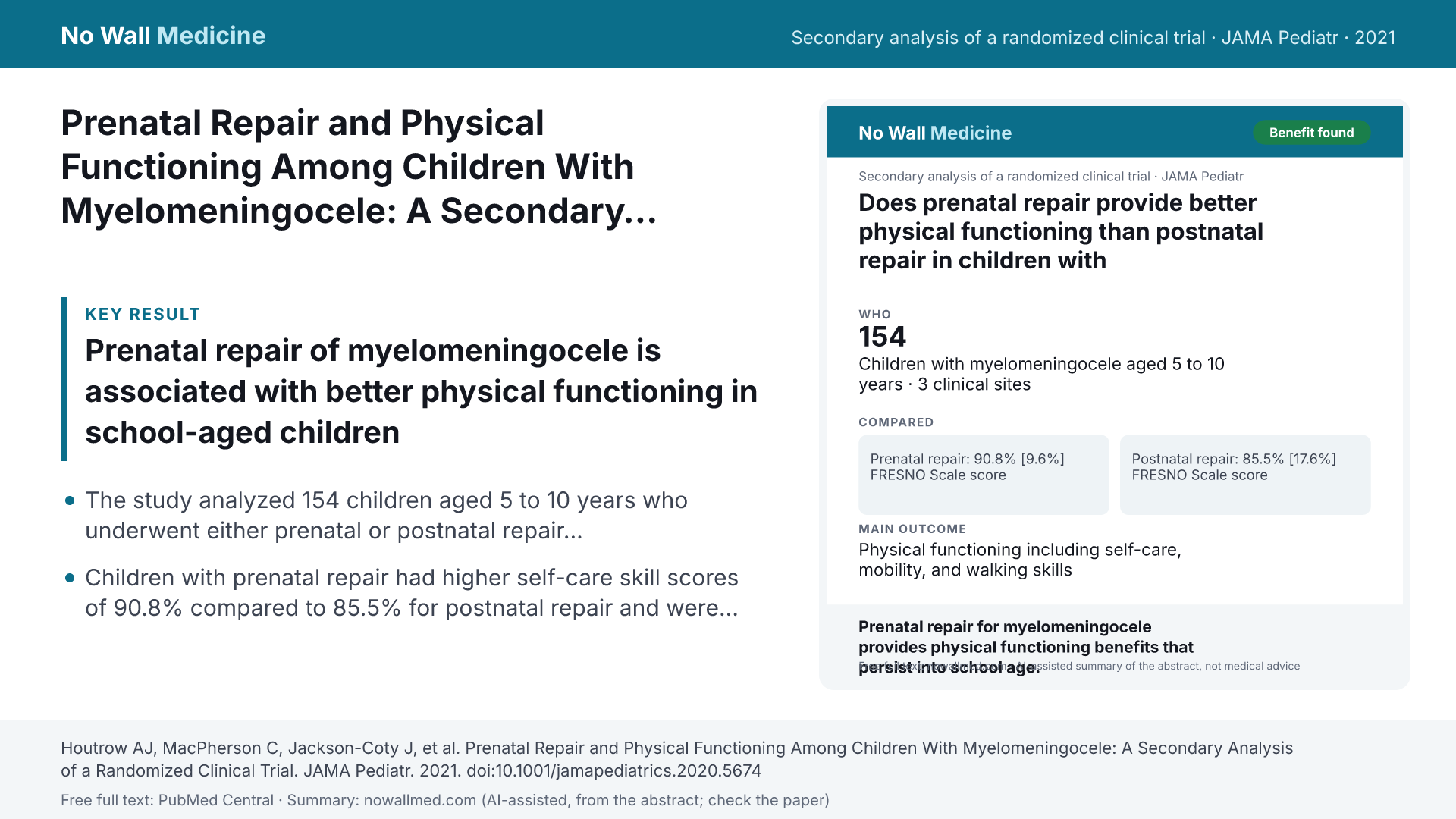
Prenatal repair of myelomeningocele is associated with better physical functioning in school-aged children
Prenatal Repair and Physical Functioning Among Children With Myelomeningocele: A Secondary Analysis of a Randomized Clinical Trial
Secondary analysis of a randomized clinical trialBenefit found
Does prenatal repair provide better physical functioning than postnatal repair in children with myelomeningocele?
Who
154
Children with myelomeningocele aged 5 to 10 years · 3 clinical sites
Compared
Prenatal repair: 90.8% [9.6%] FRESNO Scale score
Postnatal repair: 85.5% [17.6%] FRESNO Scale score
Main outcome
Physical functioning including self-care, mobility, and walking skills
Result: adjusted relative risk 1.70 (95% CI, 1.23-2.34) for community ambulation
Bottom line: Prenatal repair for myelomeningocele provides physical functioning benefits that persist into school age.
JAMA Pediatr · 2021-04-05Download image
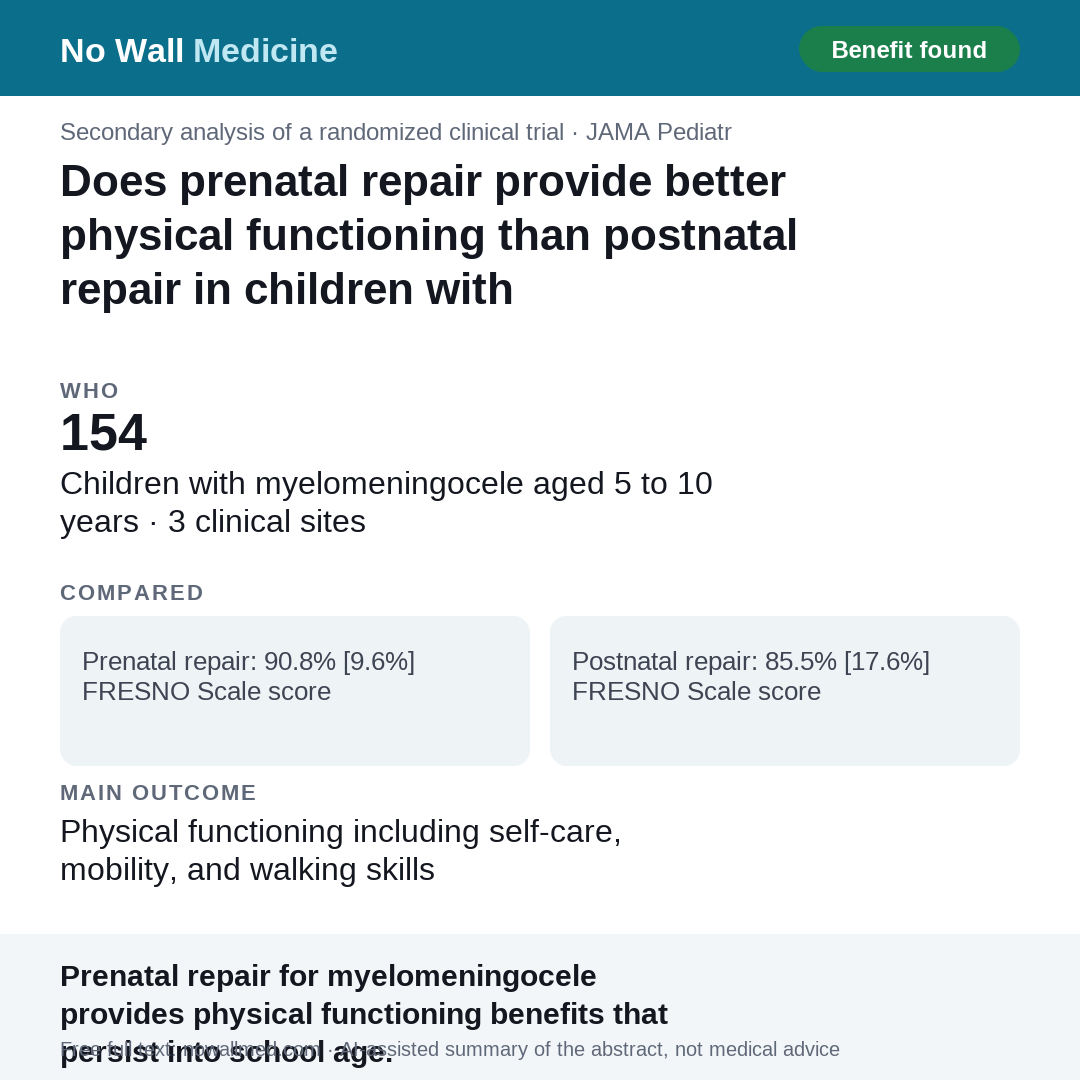
Clinical question: Does prenatal repair provide better physical functioning than postnatal repair in children with myelomeningocele?
Why it matters: It was unknown if the physical functioning benefits of prenatal repair for myelomeningocele observed at 30 months of age would persist into school age.
Key points
- The study analyzed 154 children aged 5 to 10 years who underwent either prenatal or postnatal repair for myelomeningocele, a type of spinal cord defect.
- Children with prenatal repair had higher self-care skill scores of 90.8% compared to 85.5% for postnatal repair and were more likely to be community ambulators (51.3% vs 23.1%).
- Prenatal repair was associated with walking 1 second faster in a 10-meter test and better gait quality and higher-level mobility skills.
Headline and key points written with AI from the paper’s abstract, with every number checked against it. Read the paper before relying on them.
Was this summary helpful?
Subject terms
Cite this article
Houtrow AJ, MacPherson C, Jackson-Coty J, et al. Prenatal Repair and Physical Functioning Among Children With Myelomeningocele: A Secondary Analysis of a Randomized Clinical Trial. JAMA Pediatr. 2021. doi:10.1001/jamapediatrics.2020.5674
Spotted a mistake? Suggest a correction