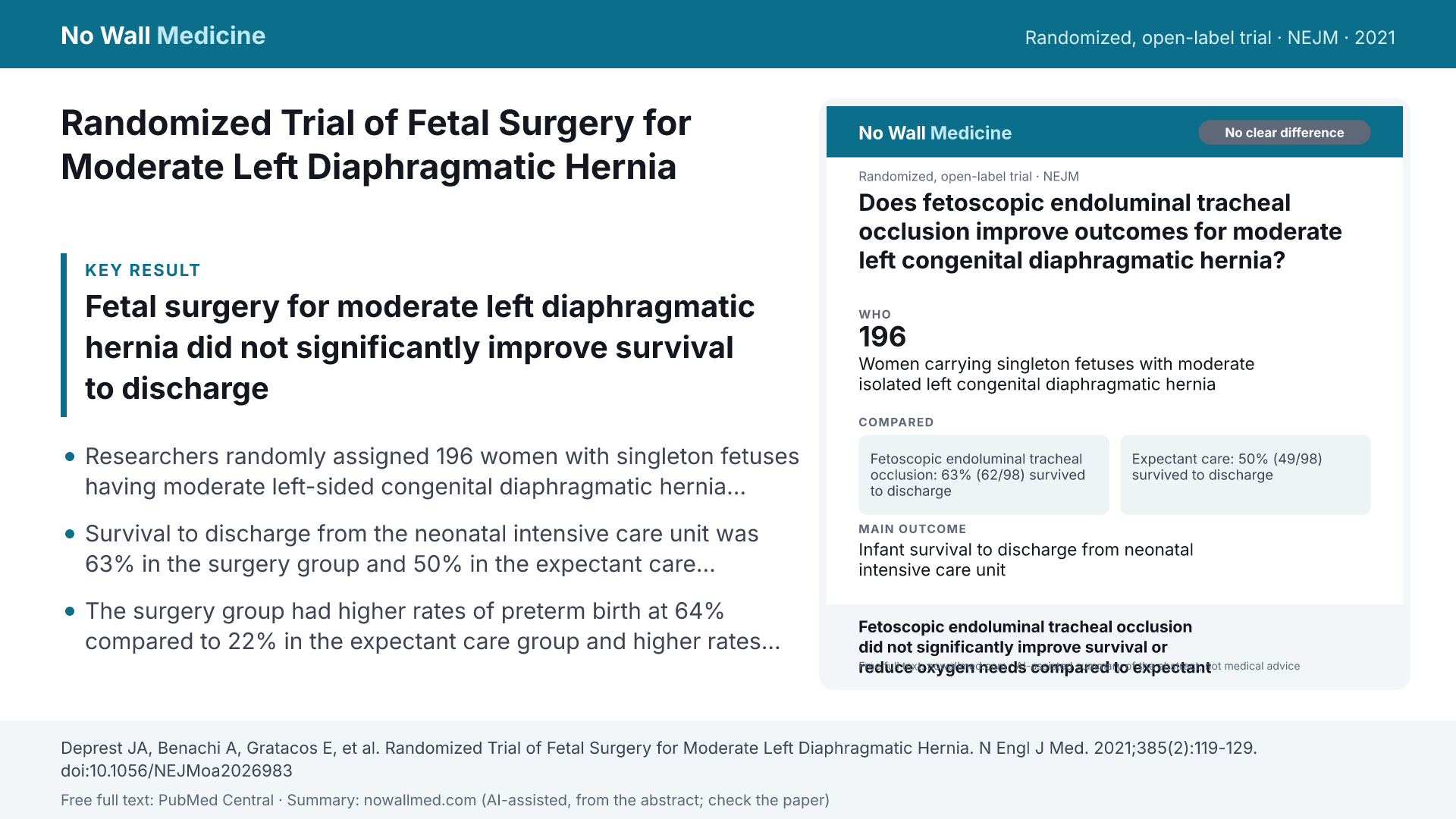
Fetal surgery for moderate left diaphragmatic hernia did not significantly improve survival to discharge
Randomized Trial of Fetal Surgery for Moderate Left Diaphragmatic Hernia
Randomized, open-label trialNo clear difference
Does fetoscopic endoluminal tracheal occlusion improve outcomes for moderate left congenital diaphragmatic hernia?
Who
196
Women carrying singleton fetuses with moderate isolated left congenital diaphragmatic hernia · Many centers with experience in prenatal surgery
Compared
Fetoscopic endoluminal tracheal occlusion: 63% (62/98) survived to discharge
Expectant care: 50% (49/98) survived to discharge
Main outcome
Infant survival to discharge from neonatal intensive care unit
Result: relative risk 1.27 (95% CI 0.99 to 1.63)
Bottom line: Fetoscopic endoluminal tracheal occlusion did not significantly improve survival or reduce oxygen needs compared to expectant care.
Funded by: European Commission and others
NEJM · 2021-06-08Download image
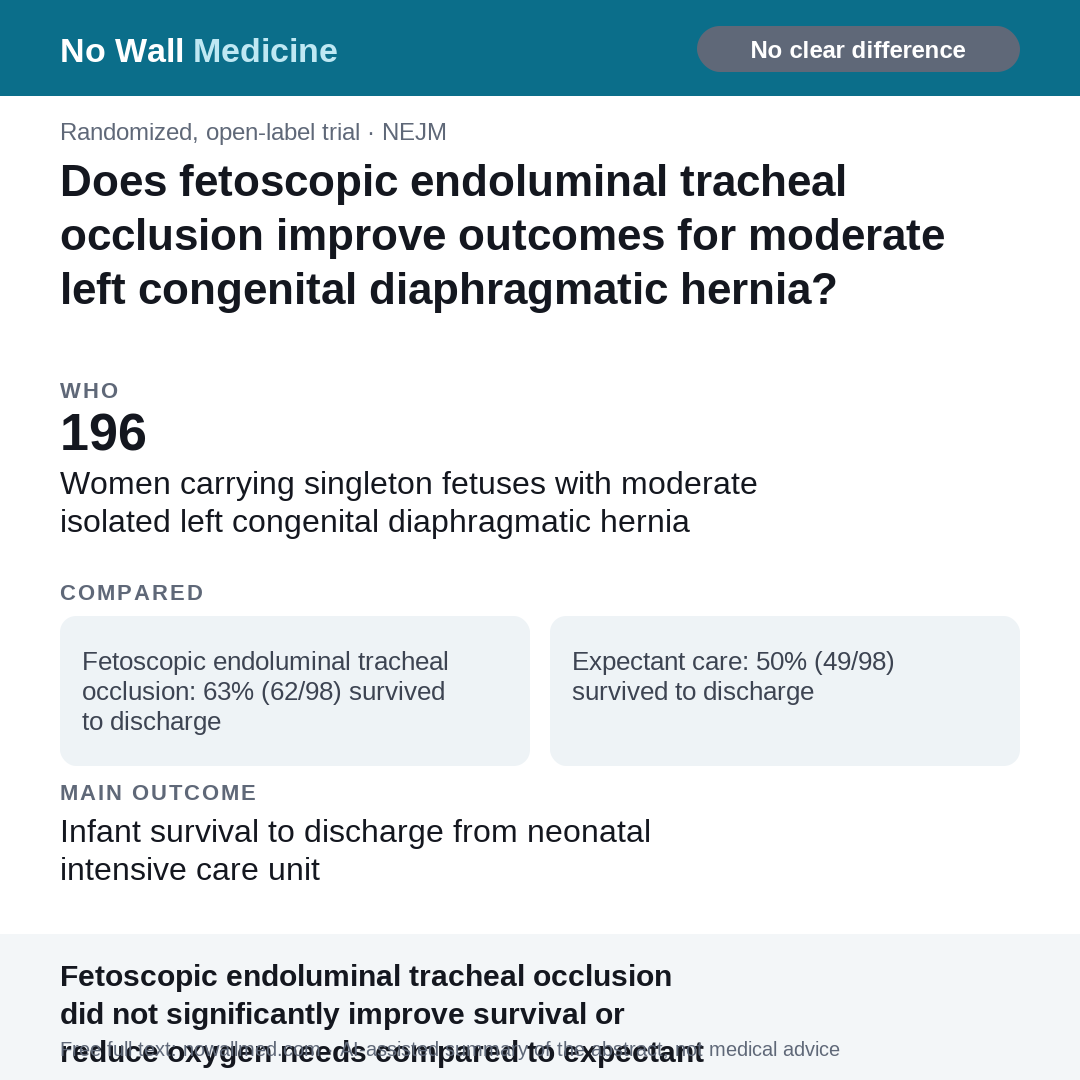
Clinical question: Does fetoscopic endoluminal tracheal occlusion improve outcomes for moderate left congenital diaphragmatic hernia?
Why it matters: It is unknown if fetoscopic endoluminal tracheal occlusion improves survival for infants with moderate, rather than severe, congenital diaphragmatic hernia.
Key points
- Researchers randomly assigned 196 women with singleton fetuses having moderate left-sided congenital diaphragmatic hernia to either fetoscopic endoluminal tracheal occlusion (a procedure to block the fetal airway) or expectant care.
- Survival to discharge from the neonatal intensive care unit was 63% in the surgery group and 50% in the expectant care group, which was not a statistically significant difference.
- The surgery group had higher rates of preterm birth at 64% compared to 22% in the expectant care group and higher rates of preterm, prelabor rupture of membranes at 44% versus 12%.
Headline and key points written with AI from the paper’s abstract, with every number checked against it. Read the paper before relying on them.
Was this summary helpful?
Subject terms
Cite this article
Deprest JA, Benachi A, Gratacos E, Nicolaides KH, Berg C, Persico N. Randomized Trial of Fetal Surgery for Moderate Left Diaphragmatic Hernia. NEJM. 2021. doi:10.1056/NEJMoa2026983
Spotted a mistake? Suggest a correction