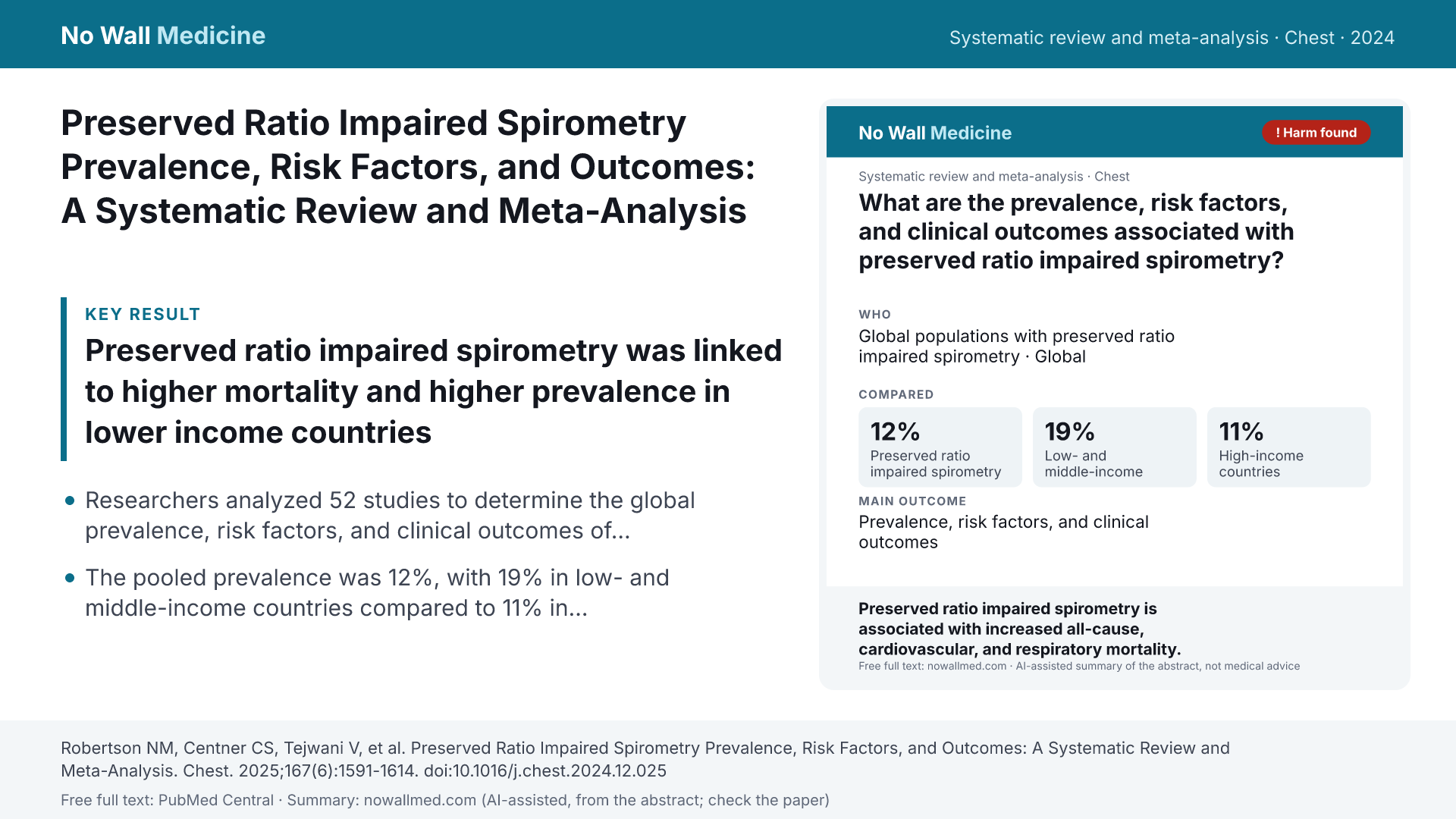
Preserved ratio impaired spirometry was linked to higher mortality and higher prevalence in lower income countries
Preserved Ratio Impaired Spirometry Prevalence, Risk Factors, and Outcomes: A Systematic Review and Meta-Analysis
Systematic review and meta-analysisHarm found
What are the prevalence, risk factors, and clinical outcomes associated with preserved ratio impaired spirometry?
Who
Global populations with preserved ratio impaired spirometry · Global
Compared
12%Preserved ratio impaired spirometry (95% CI, 0.10-0.15)
19%Low- and middle-income countries
11%High-income countries
Main outcome
Prevalence, risk factors, and clinical outcomes
Result: all-cause mortality OR 1.41 (95% CI 1.08-1.83)
Bottom line: Preserved ratio impaired spirometry is associated with increased all-cause, cardiovascular, and respiratory mortality.
Chest · 2024-12-30Download image
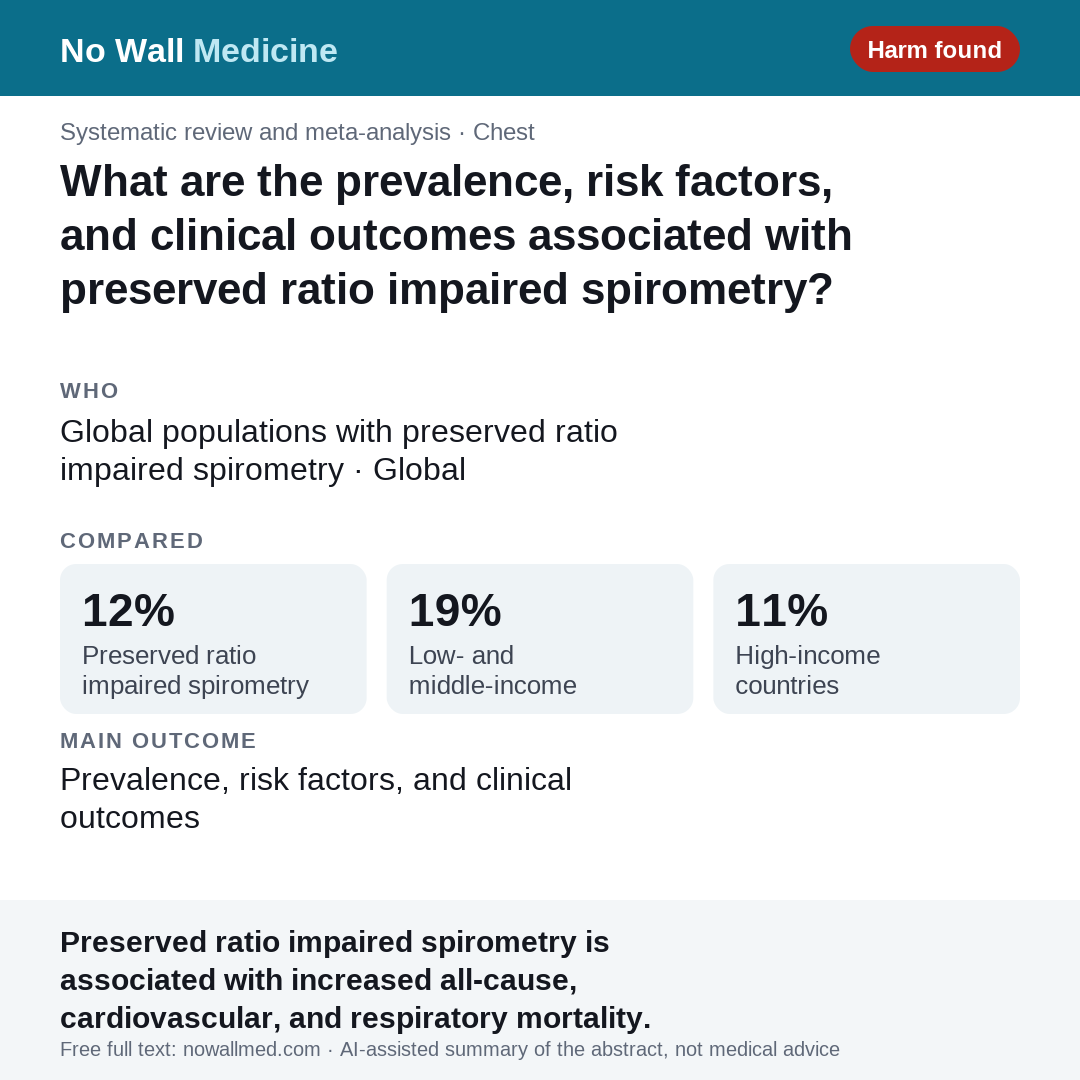
Clinical question: What are the prevalence, risk factors, and clinical outcomes associated with preserved ratio impaired spirometry?
Why it matters: The global prevalence, risk factors, and clinical outcomes associated with preserved ratio impaired spirometry remain poorly characterized.
Key points
- Researchers analyzed 52 studies to determine the global prevalence, risk factors, and clinical outcomes of preserved ratio impaired spirometry, a condition where lung function tests show impairment without airway obstruction.
- The pooled prevalence was 12%, with 19% in low- and middle-income countries compared to 11% in high-income countries.
- Preserved ratio impaired spirometry was associated with increased all-cause mortality (OR, 1.41), cardiovascular mortality (OR, 1.84), and respiratory mortality (OR, 1.82).
Headline and key points written with AI from the paper’s abstract, with every number checked against it. Read the paper before relying on them.
Was this summary helpful?
Subject terms
Cite this article
Robertson NM, Centner CS, Tejwani V, Hossen S, Karmali D, Liu S. Preserved Ratio Impaired Spirometry Prevalence, Risk Factors, and Outcomes: A Systematic Review and Meta-Analysis. Chest. 2024. doi:10.1016/j.chest.2024.12.025
Spotted a mistake? Suggest a correction
Top studies every Monday
The week’s key trials and guidelines in your specialties, plus any topics you follow. By email, free.
Get the weekly digest