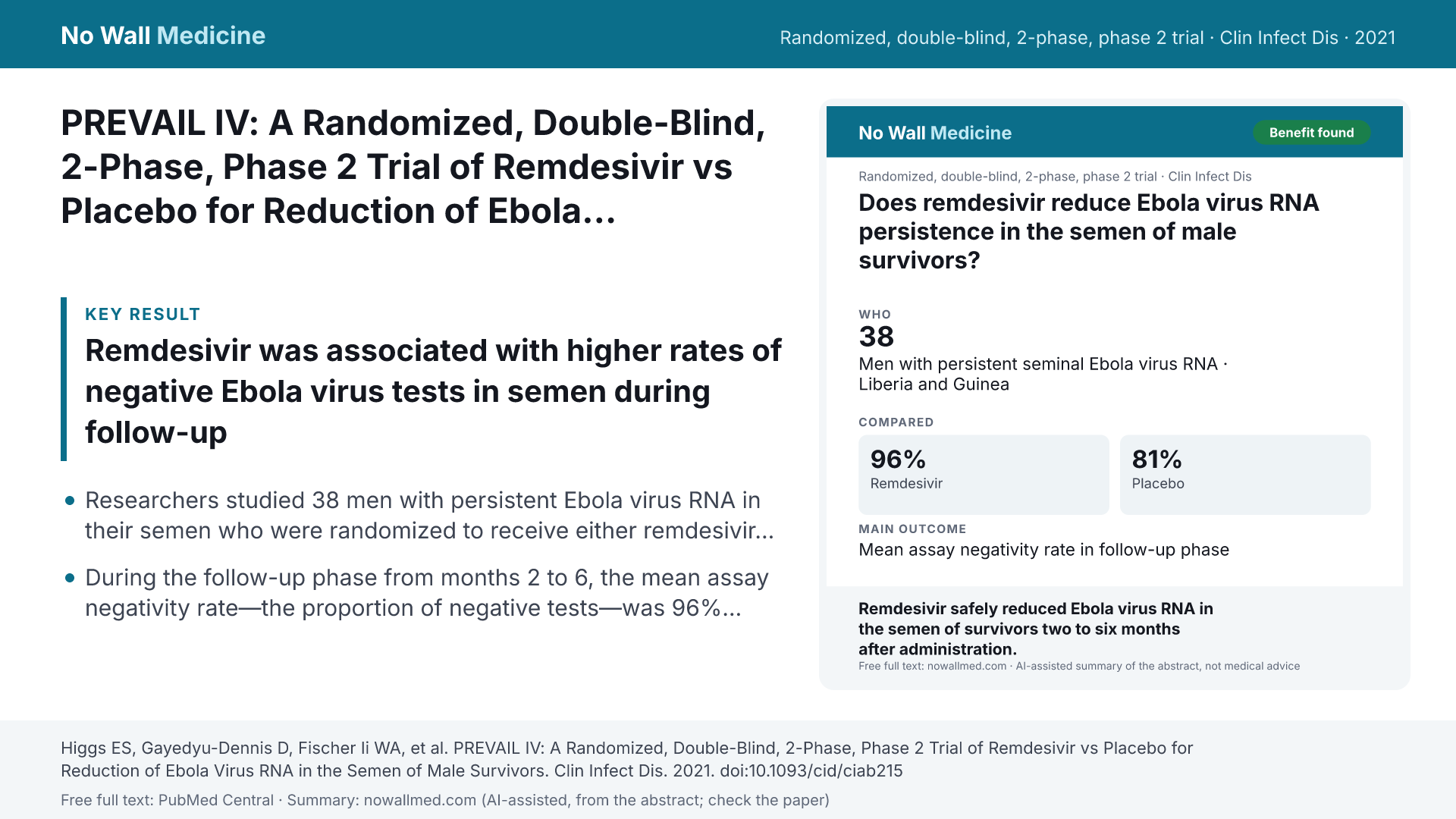
Remdesivir was associated with higher rates of negative Ebola virus tests in semen during follow-up
PREVAIL IV: A Randomized, Double-Blind, 2-Phase, Phase 2 Trial of Remdesivir vs Placebo for Reduction of Ebola Virus RNA in the Semen of Male Survivors
Randomized, double-blind, 2-phase, phase 2 trialBenefit found
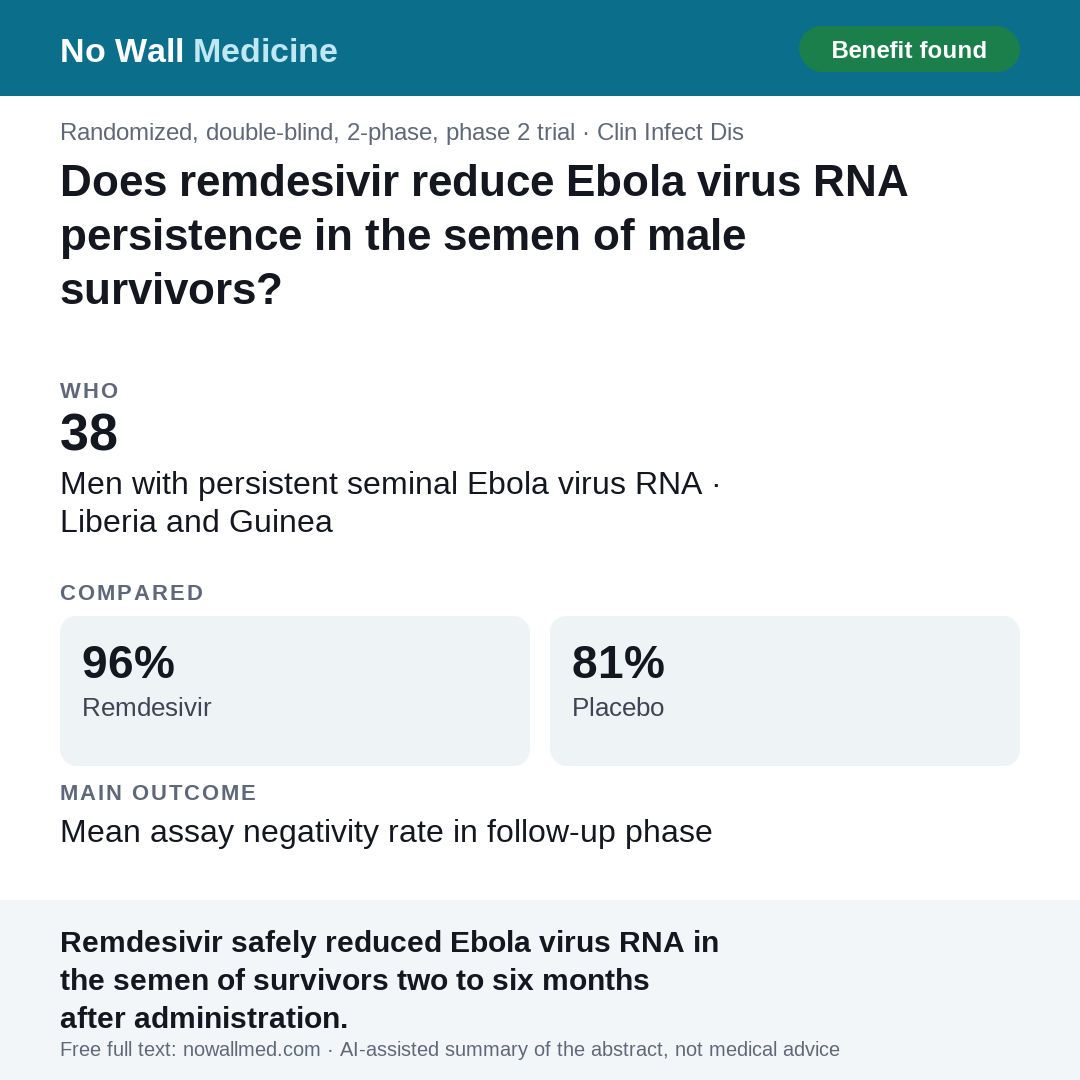
Does remdesivir reduce Ebola virus RNA persistence in the semen of male survivors?
Who
38
Men with persistent seminal Ebola virus RNA · Liberia and Guinea
Compared
96%Remdesivir (SD = 10%)
81%Placebo (SD = 29%)
Main outcome
Mean assay negativity rate in follow-up phase
Bottom line: Remdesivir safely reduced Ebola virus RNA in the semen of survivors two to six months after administration.
Clin Infect Dis · 2021-03-13Download image
Clinical question: Does remdesivir reduce Ebola virus RNA persistence in the semen of male survivors?
Why it matters: It is unknown if remdesivir can safely reduce the persistence of Ebola virus RNA in the semen of male survivors to prevent sexual transmission.
Key points
- Researchers studied 38 men with persistent Ebola virus RNA in their semen who were randomized to receive either remdesivir or a placebo for 5 days.
- During the follow-up phase from months 2 to 6, the mean assay negativity rate—the proportion of negative tests—was 96% for remdesivir and 81% for placebo.
- In the initial 28-day treatment phase, the mean assay negativity rate was 85% for remdesivir and 76% for placebo, which was not a statistically significant difference.
Limitation the authors note: The authors state that a larger follow-up study is necessary to confirm these results.
Headline and key points written with AI from the paper’s abstract, with every number checked against it. Read the paper before relying on them.
Was this summary helpful?
Subject terms
Cite this article
Higgs ES, Gayedyu-Dennis D, Fischer Ii WA, Nason M, Reilly C, Beavogui AH. PREVAIL IV: A Randomized, Double-Blind, 2-Phase, Phase 2 Trial of Remdesivir vs Placebo for Reduction of Ebola Virus RNA in the Semen of Male Survivors. Clin Infect Dis. 2021. doi:10.1093/cid/ciab215
Spotted a mistake? Suggest a correction