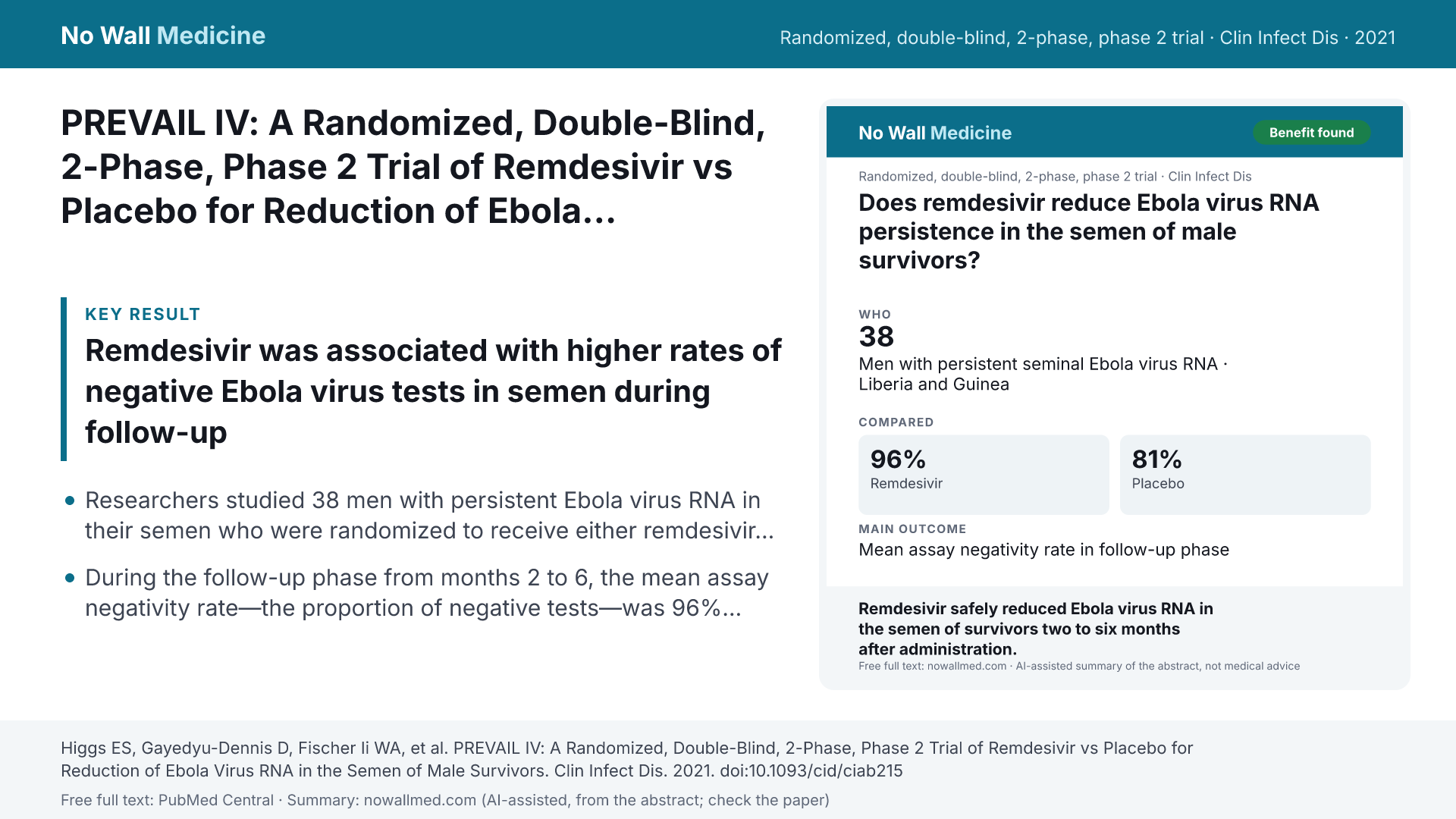
PREVAIL IV: A Randomized, Double-Blind, 2-Phase, Phase 2 Trial of Remdesivir vs Placebo for Reduction of Ebola Virus RNA in the Semen of Male Survivors
Key result: Remdesivir was associated with higher rates of negative Ebola virus tests in semen during follow-up
Key points
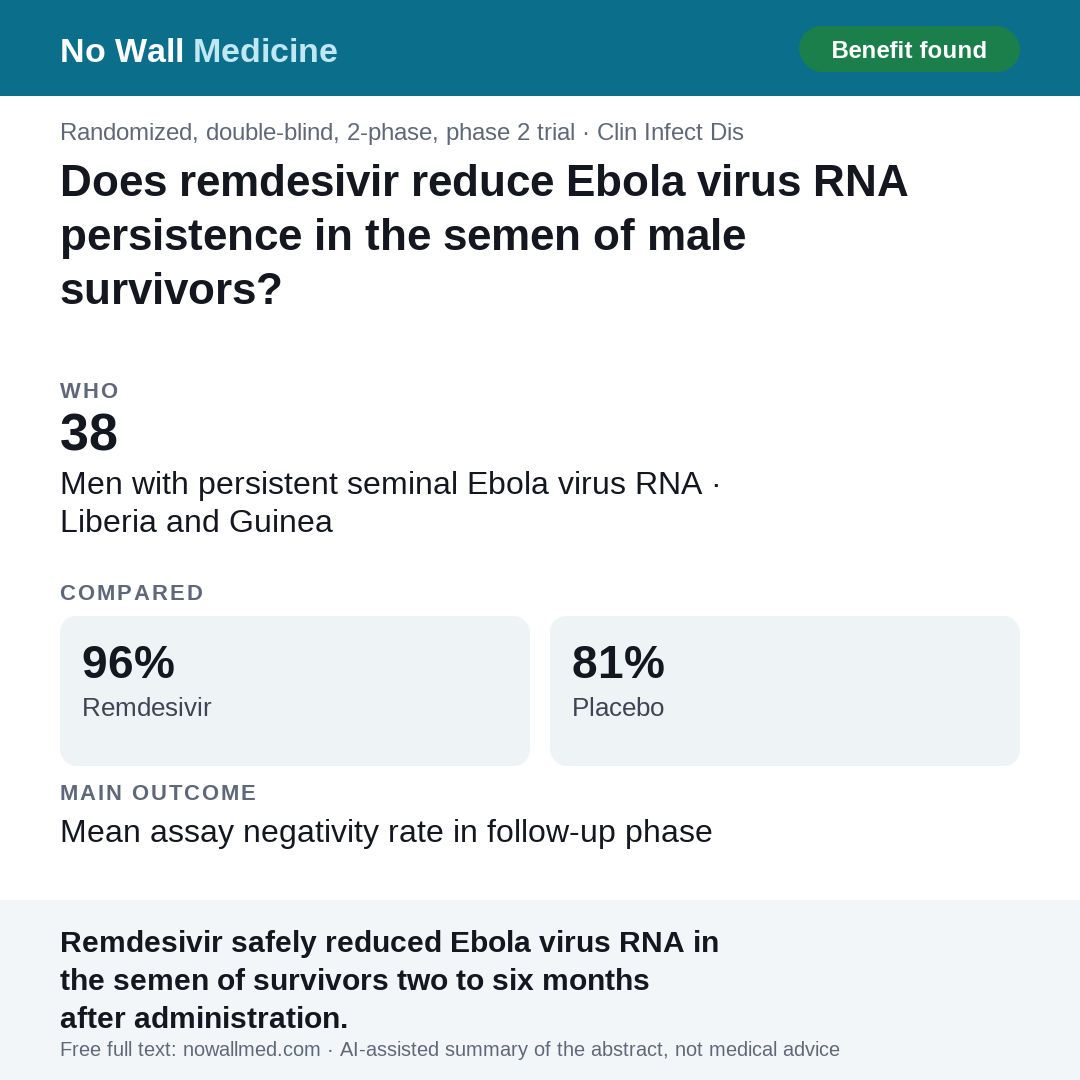
- Researchers studied 38 men with persistent Ebola virus RNA in their semen who were randomized to receive either remdesivir or a placebo for 5 days.
- During the follow-up phase from months 2 to 6, the mean assay negativity rate—the proportion of negative tests—was 96% for remdesivir and 81% for placebo.
- In the initial 28-day treatment phase, the mean assay negativity rate was 85% for remdesivir and 76% for placebo, which was not a statistically significant difference.
Why it matters: It is unknown if remdesivir can safely reduce the persistence of Ebola virus RNA in the semen of male survivors to prevent sexual transmission.
Limitation the authors note: The authors state that a larger follow-up study is necessary to confirm these results.
Discussion prompts
- Would these patients look like yours? Who was left out?
- Is the main outcome one that matters to patients?
- Is the difference large enough to change what you do?
Cite: Higgs ES, Gayedyu-Dennis D, Fischer Ii WA, Nason M, Reilly C, Beavogui AH. PREVAIL IV: A Randomized, Double-Blind, 2-Phase, Phase 2 Trial of Remdesivir vs Placebo for Reduction of Ebola Virus RNA in the Semen of Male Survivors. Clin Infect Dis. 2021. doi:10.1093/cid/ciab215
Free full text: PubMed Central · Summary and visual abstract: nowallmed.com/a/prevail-iv-a-randomized-double-blind-2-phase-phase-2-trial-of-1md66ja/ (AI-assisted from the abstract; check the paper before relying on it).