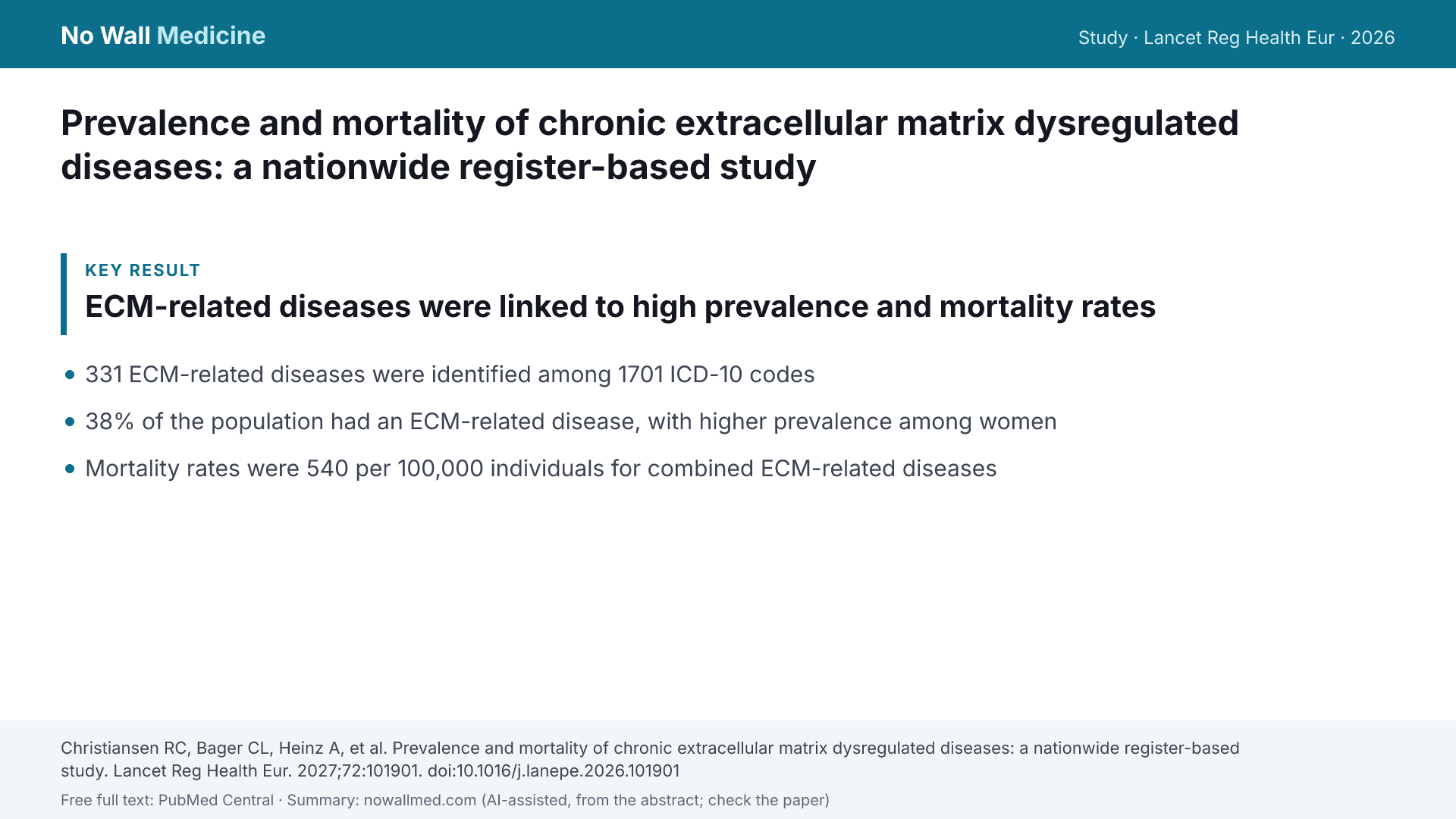
ECM-related diseases were linked to high prevalence and mortality rates
Prevalence and mortality of chronic extracellular matrix dysregulated diseases: a nationwide register-based study
Why it matters: The burden of ECM-related diseases remains poorly defined
Key points
- 331 ECM-related diseases were identified among 1701 ICD-10 codes.
- 38% of the population had an ECM-related disease, with higher prevalence among women.
- Mortality rates were 540 per 100,000 individuals for combined ECM-related diseases.
Study type: Observational study: it can show a link, but not prove that one thing causes another.
Headline and key points written with AI from the paper’s abstract, with every number checked against it. Read the paper before relying on them.
Was this summary helpful?
Abstract
Background
Extracellular matrix (ECM) dysregulation, manifesting as fibrosis or tissue destruction, is a hallmark of many chronic diseases, leading to organ dysfunction and mortality. However, ECM-related diseases are rarely considered as a unified group, and their burden remains poorly defined. We aimed to quantify the burden of ECM-related diseases by estimating prevalence and mortality. Methods
We conducted a register-based study using Danish health registers. Chronic diseases were classified as ECM-related, either fibrotic or tissue destruction diseases, based on ICD-10 codes by field experts. Prevalence was estimated using the Danish National Patient Register, and mortality using the Danish Register of Causes of Death. Analyses were stratified by sex, and key analyses were replicated using the UK Biobank cohort (Application ID 31823). Findings
Among 1701 ICD-10 level-two disease codes, we identified 194 fibrotic diseases and 137 tissue destruction diseases, totalling 331 ECM-related diseases. 19% (1120068/5945094) of the population had a fibrotic disease, 30% (1772148/5945094) a tissue destruction disease, and 38% (2250048/5945094) an ECM-related disease, with higher prevalence among women. Mortality rates recorded as underlying causes were 381, 159 and 540 per 100,000 individuals for fibrotic, tissue destruction, and combined ECM-related diseases, accounting for 40% (22715/56795), 17% (9513/56795) and 57% (32228/56795) of deaths. Mortality was higher when ECM-related diseases were recorded as contributing causes of death. Mortality was higher among men. Interpretation
ECM-related diseases impose a substantial burden through high prevalence and mortality. Recognition of ECM dysregulation as a disease mechanism may inform therapeutic strategies and public health planning. Funding
Innovation Fund Denmark.
Abstract reproduced under the article’s CC BY-NC licence.
Headline, design, result, key points, caveat and citation as plain text.
Cite this article
Christiansen RC, Bager CL, Heinz A, et al. Prevalence and mortality of chronic extracellular matrix dysregulated diseases: a nationwide register-based study. Lancet Reg Health Eur. 2027;72:101901. doi:10.1016/j.lanepe.2026.101901
Spotted a mistake? Suggest a correction