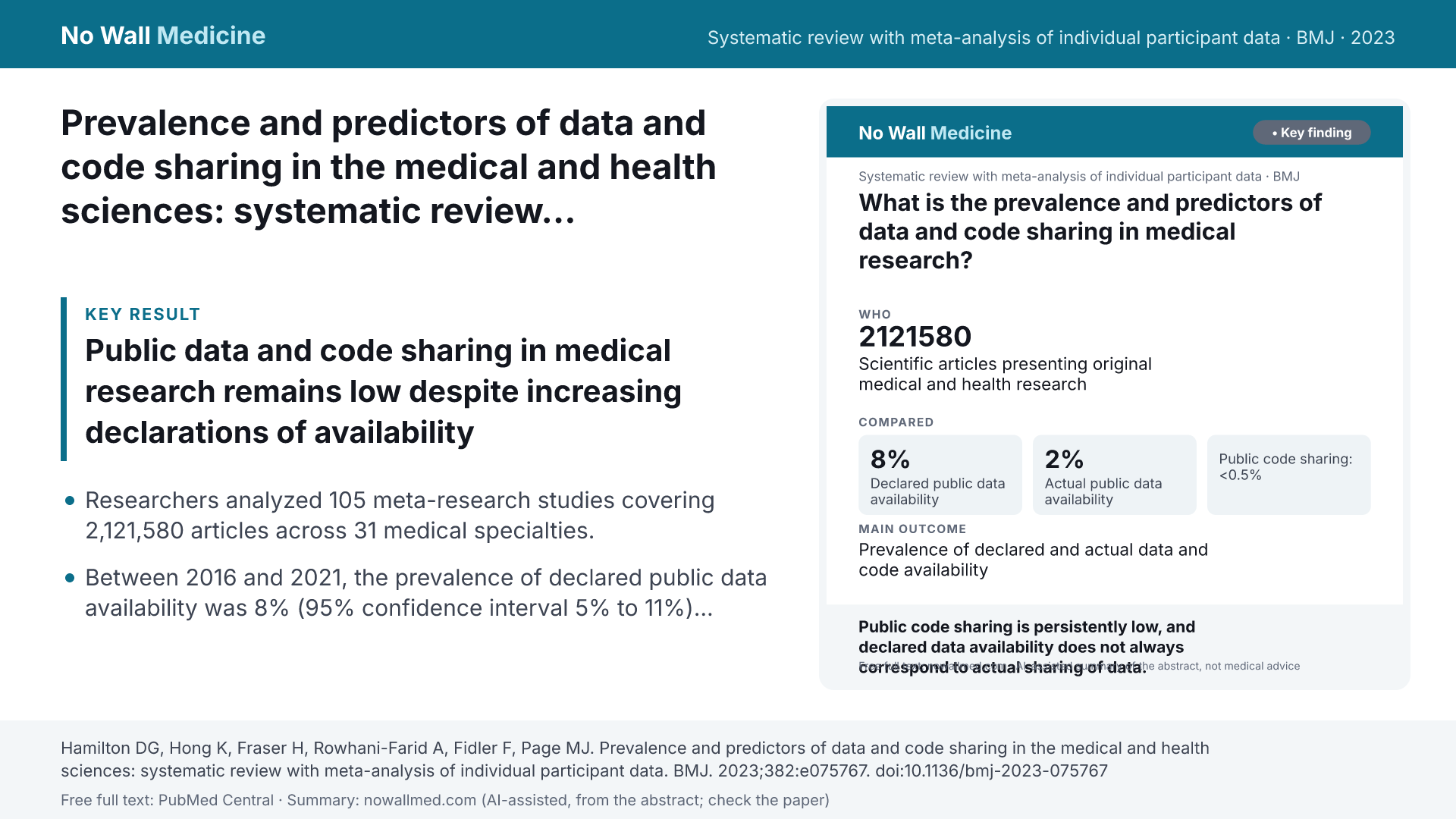
Public data and code sharing in medical research remains low despite increasing declarations of availability
Prevalence and predictors of data and code sharing in the medical and health sciences: systematic review with meta-analysis of individual participant data
Systematic review with meta-analysis of individual participant dataHarm found
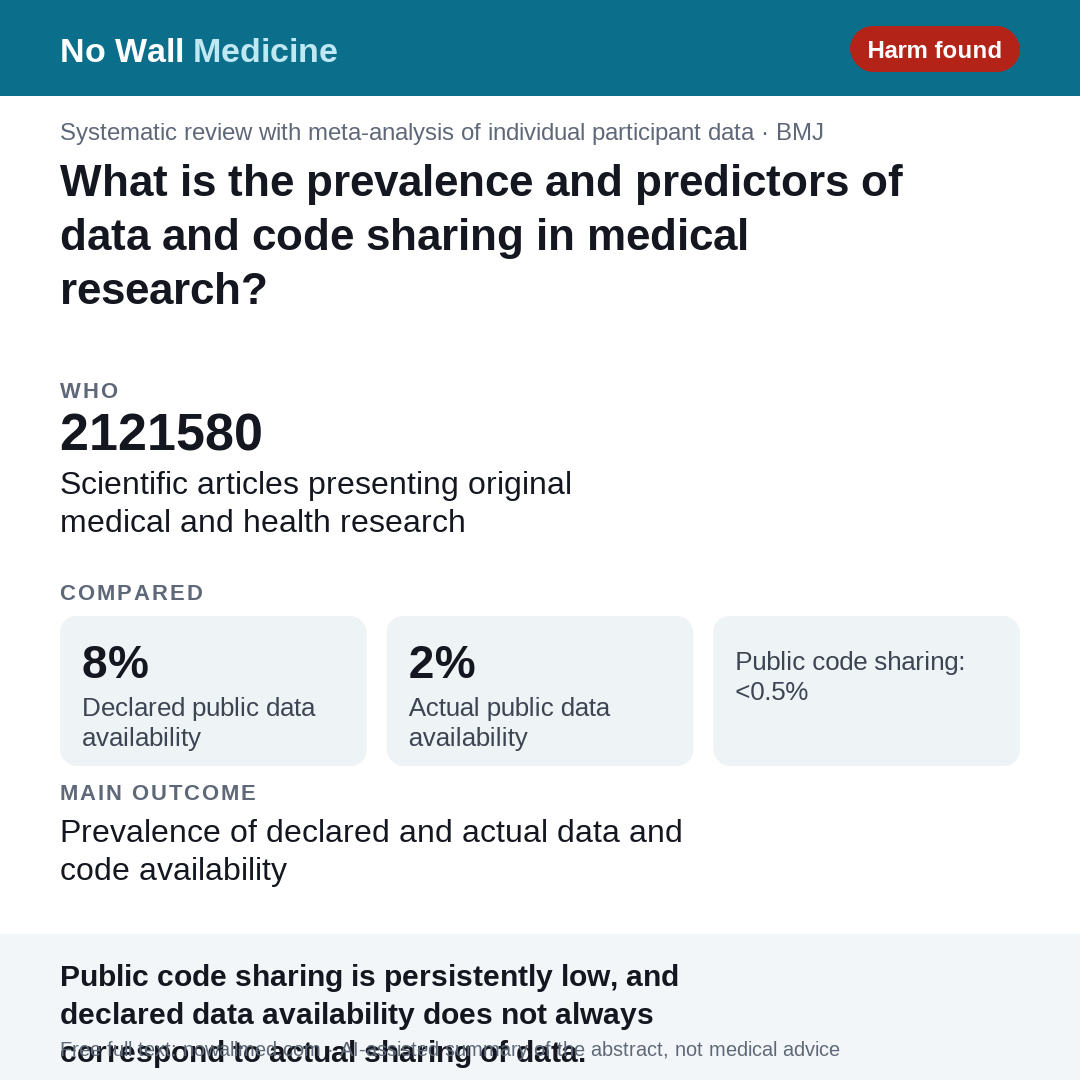
What is the prevalence and predictors of data and code sharing in medical research?
Who
2121580
Scientific articles presenting original medical and health research
Compared
8%Declared public data availability (95% confidence interval 5% to 11%)
2%Actual public data availability (1% to 3%)
Public code sharing: <0.5%
Main outcome
Prevalence of declared and actual data and code availability
Bottom line: Public code sharing is persistently low, and declared data availability does not always correspond to actual sharing of data.
Limitation: Only eight studies (8%) were classified as having a low risk of bias.
BMJ · 2023-07-11Download image
Clinical question: What is the prevalence and predictors of data and code sharing in medical research?
Why it matters: It is unclear how often medical research data and code are actually available to the public versus how often authors simply declare that they are available.
Key points
- Researchers analyzed 105 meta-research studies covering 2,121,580 articles across 31 medical specialties.
- Between 2016 and 2021, the prevalence of declared public data availability was 8% (95% confidence interval 5% to 11%) and actual availability was 2% (1% to 3%).
- Public code sharing was estimated to be <0.5% for both declared and actual availability since 2016.
Limitation the authors note: Only eight studies (8%) were classified as having a low risk of bias.
Headline and key points written with AI from the paper’s abstract, with every number checked against it. Read the paper before relying on them.
Was this summary helpful?
Abstract
Objectives
To synthesise research investigating data and code sharing in medicine and health to establish an accurate representation of the prevalence of sharing, how this frequency has changed over time, and what factors influence availability. Design
Systematic review with meta-analysis of individual participant data. Data sources
Ovid Medline, Ovid Embase, and the preprint servers medRxiv, bioRxiv, and MetaArXiv were searched from inception to 1 July 2021. Forward citation searches were also performed on 30 August 2022. Review methods
Meta-research studies that investigated data or code sharing across a sample of scientific articles presenting original medical and health research were identified. Two authors screened records, assessed the risk of bias, and extracted summary data from study reports when individual participant data could not be retrieved. Key outcomes of interest were the prevalence of statements that declared that data or code were publicly or privately available (declared availability) and the success rates of retrieving these products (actual availability). The associations between data and code availability and several factors (eg, journal policy, type of data, trial design, and human participants) were also examined. A two stage approach to meta-analysis of individual participant data was performed, with proportions and risk ratios pooled with the Hartung-Knapp-Sidik-Jonkman method for random effects meta-analysis. Results
The review included 105 meta-research studies examining 2 121 580 articles across 31 specialties. Eligible studies examined a median of 195 primary articles (interquartile range 113-475), with a median publication year of 2015 (interquartile range 2012-2018). Only eight studies (8%) were classified as having a low risk of bias. Meta-analyses showed a prevalence of declared and actual public data availability of 8% (95% confidence interval 5% to 11%) and 2% (1% to 3%), respectively, between 2016 and 2021. For public code sharing, both the prevalence of declared and actual availability were estimated to be <0.5% since 2016. Meta-regressions indicated that only declared public data sharing prevalence estimates have increased over time. Compliance with mandatory data sharing policies ranged from 0% to 100% across journals and varied by type of data. In contrast, success in privately obtaining data and code from authors historically ranged between 0% and 37% and 0% and 23%, respectively. Conclusions
The review found that public code sharing was persistently low across medical research. Declarations of data sharing were also low, increasing over time, but did not always correspond to actual sharing of data. The effectiveness of mandatory data sharing policies varied substantially by journal and type of data, a finding that might be informative for policy makers when designing policies and allocating resources to audit compliance. Systematic review registration
Open Science Framework doi:10.17605/OSF.IO/7SX8U.
Abstract reproduced under the article’s CC BY NC licence.
Subject terms
Cite this article
Hamilton DG, Hong K, Fraser H, Rowhani-Farid A, Fidler F, Page MJ. Prevalence and predictors of data and code sharing in the medical and health sciences: systematic review with meta-analysis of individual participant data. BMJ. 2023. doi:10.1136/bmj-2023-075767
Spotted a mistake? Suggest a correction
Top studies every Monday
The week’s key trials and guidelines in your specialties, plus any topics you follow. By email, free.
Get the weekly digest