Prevalence and predictors of data and code sharing in the medical and health sciences: systematic review with meta-analysis of individual participant data
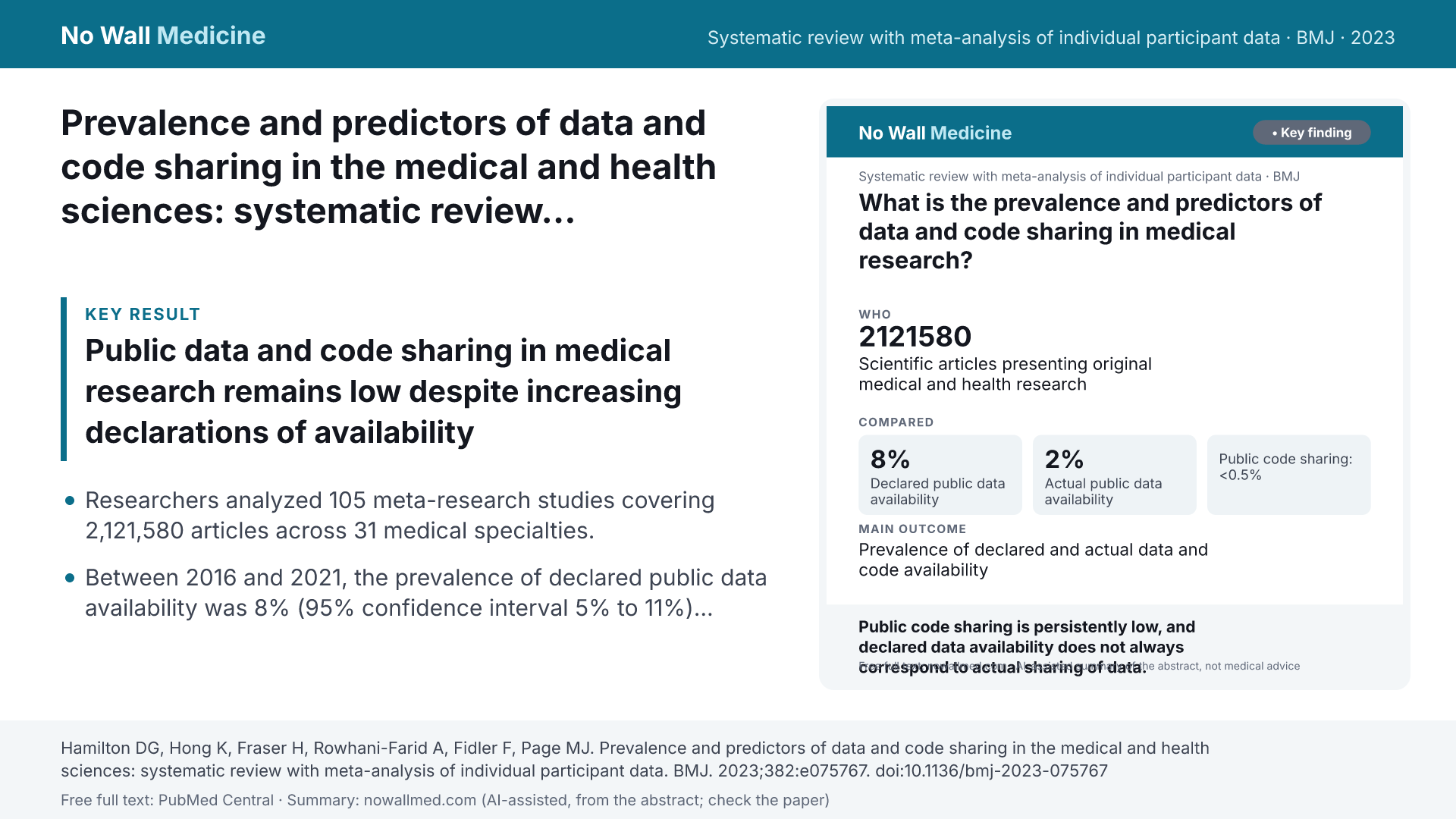
Key result: Public data and code sharing in medical research remains low despite increasing declarations of availability
Systematic review with meta-analysis of individual participant dataKey finding
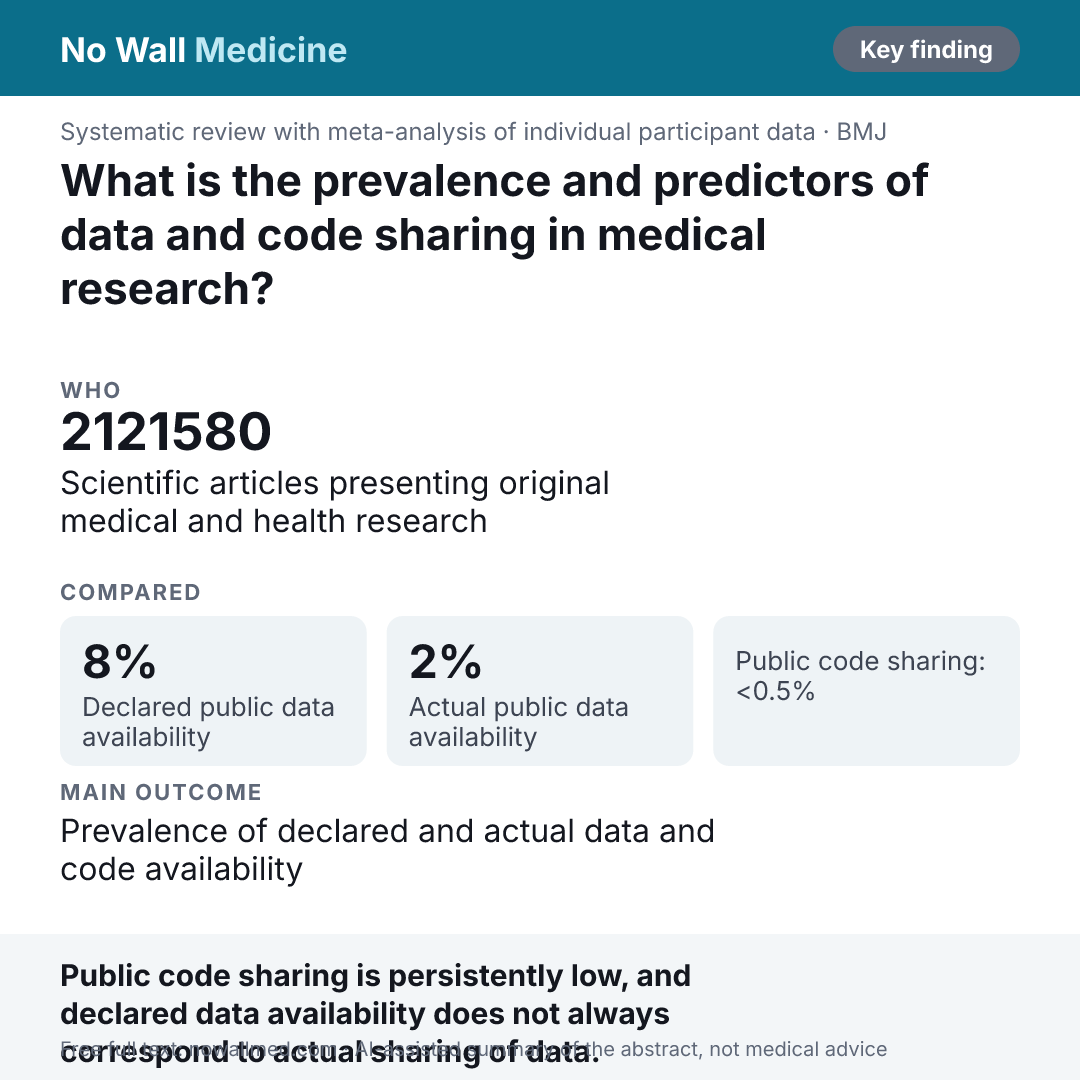
What is the prevalence and predictors of data and code sharing in medical research?
Who
2121580
Scientific articles presenting original medical and health research
Compared
8%Declared public data availability (95% confidence interval 5% to 11%)
2%Actual public data availability (1% to 3%)
Public code sharing: <0.5%
Main outcome
Prevalence of declared and actual data and code availability
Bottom line: Public code sharing is persistently low, and declared data availability does not always correspond to actual sharing of data.
Limitation: Only eight studies (8%) were classified as having a low risk of bias.
BMJ · 2023-07-11 · Save PNG
Key points
- Researchers analyzed 105 meta-research studies covering 2,121,580 articles across 31 medical specialties.
- Between 2016 and 2021, the prevalence of declared public data availability was 8% (95% confidence interval 5% to 11%) and actual availability was 2% (1% to 3%).
- Public code sharing was estimated to be <0.5% for both declared and actual availability since 2016.
Limitation the authors note: Only eight studies (8%) were classified as having a low risk of bias.
Discussion prompts
- Would these patients look like yours? Who was left out?
- Is the main outcome one that matters to patients?
- Is the difference large enough to change what you do?
Cite: Hamilton DG, Hong K, Fraser H, Rowhani-Farid A, Fidler F, Page MJ. Prevalence and predictors of data and code sharing in the medical and health sciences: systematic review with meta-analysis of individual participant data. BMJ. 2023;382:e075767. doi:10.1136/bmj-2023-075767
Free full text: PubMed Central · Summary and visual abstract: nowallmed.com/a/prevalence-and-predictors-of-data-and-code-sharing-in-the-medical-and-5an7dg/ (AI-assisted from the abstract; check the paper before relying on it).