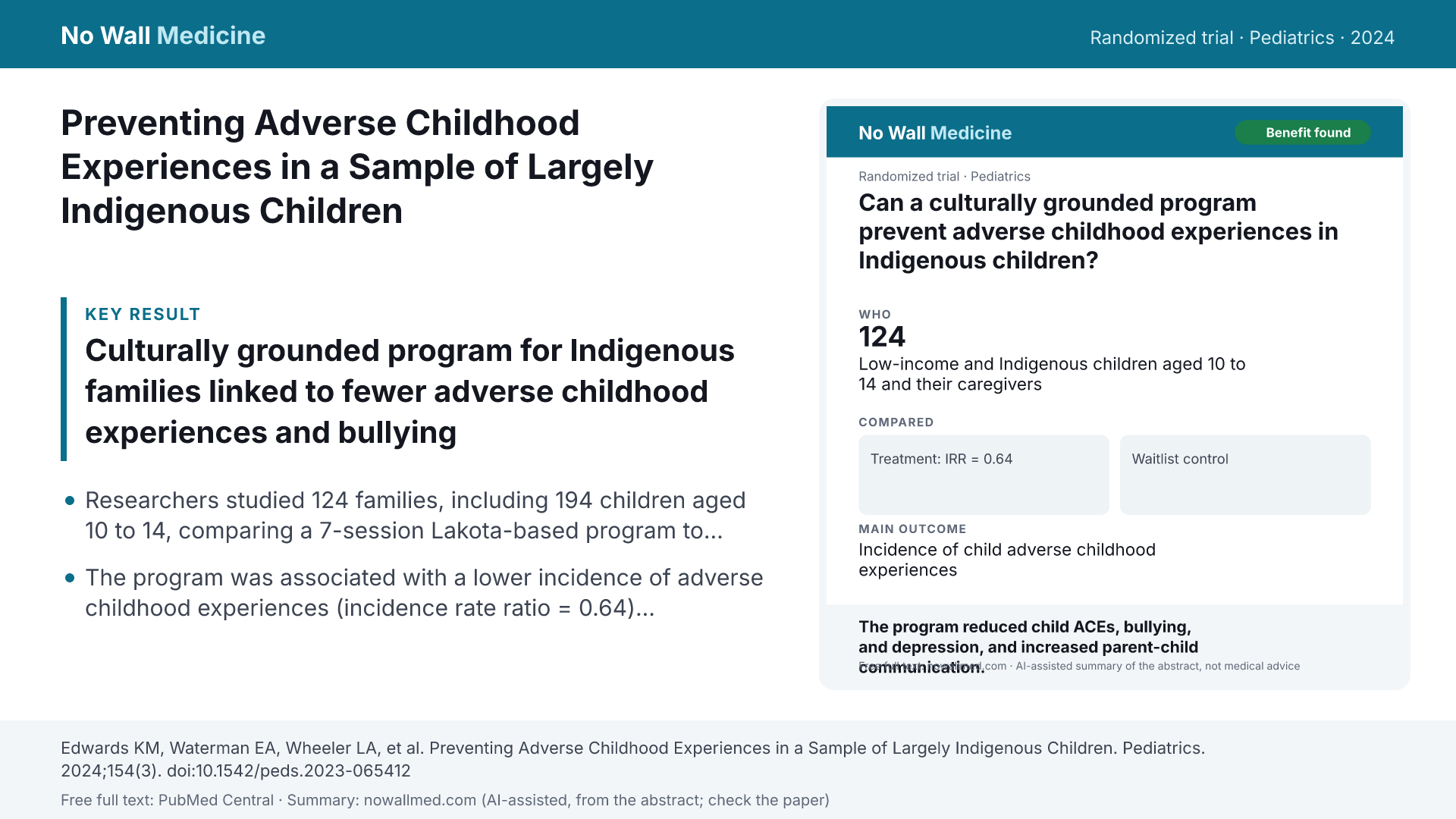
Culturally grounded program for Indigenous families linked to fewer adverse childhood experiences and bullying
Preventing Adverse Childhood Experiences in a Sample of Largely Indigenous Children
Randomized trialBenefit found
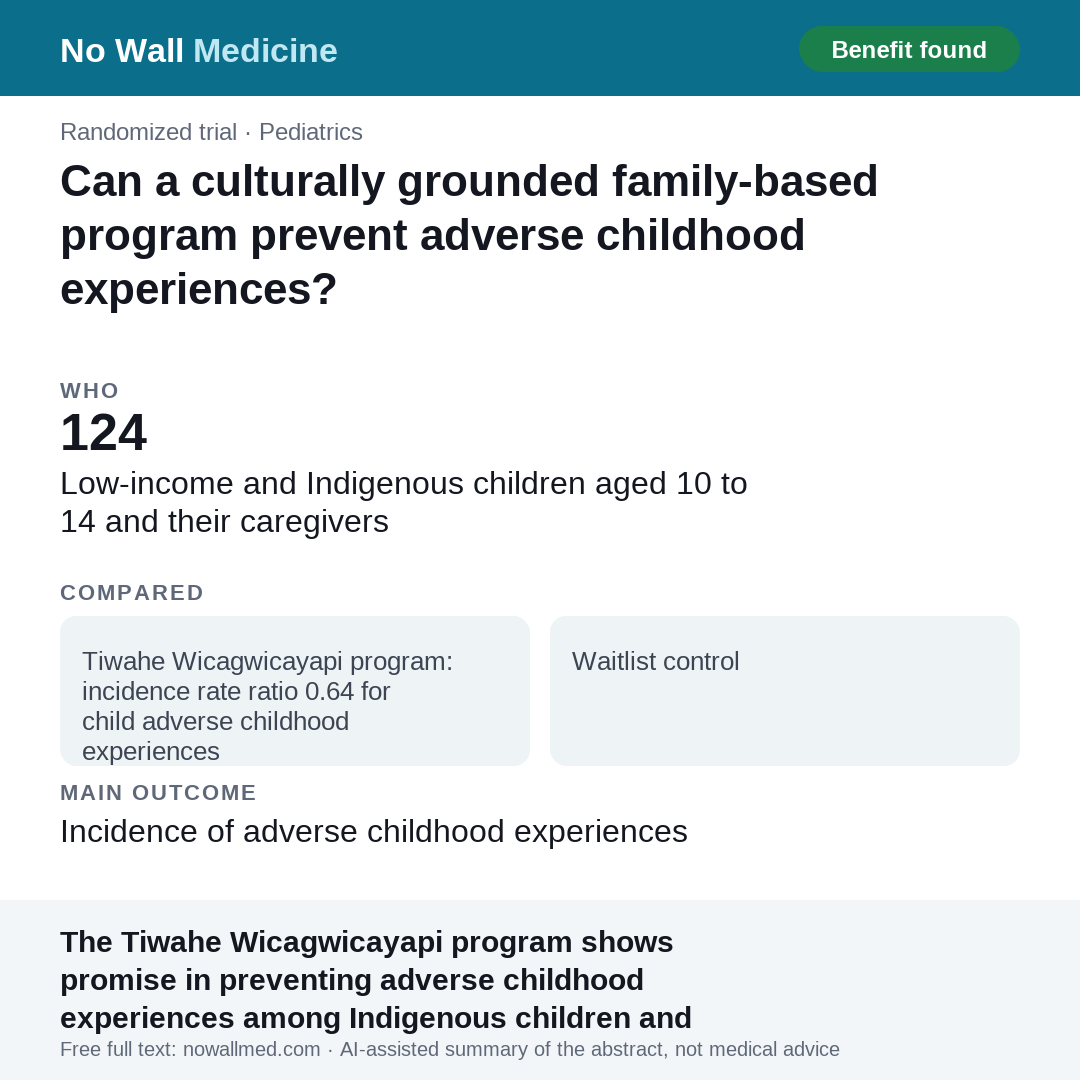
Can a culturally grounded family-based program prevent adverse childhood experiences?
Who
124
Low-income and Indigenous children aged 10 to 14 and their caregivers
Compared
Tiwahe Wicagwicayapi program: incidence rate ratio 0.64 for child adverse childhood experiences
Waitlist control
Main outcome
Incidence of adverse childhood experiences
Result: incidence rate ratio 0.64
Bottom line: The Tiwahe Wicagwicayapi program shows promise in preventing adverse childhood experiences among Indigenous children and families.
Pediatrics · 2024-08-13Download image
Clinical question: Can a culturally grounded family-based program prevent adverse childhood experiences?
Why it matters: It was unknown if a culturally grounded, family-based program could prevent adverse childhood experiences among low-income and Indigenous children.
Key points
- Researchers studied 124 families, including 194 children aged 10 to 14, comparing a 7-session Lakota-based program to a waitlist control group.
- The program was associated with a lower incidence of adverse childhood experiences (incidence rate ratio = 0.64) and bullying victimization (odds ratio = 0.53).
- Caregivers in the program were associated with lower rates of intimate partner violence victimization (incidence rate ratio = 0.36) and harsh parenting (g = -0.35).
Headline and key points written with AI from the paper’s abstract, with every number checked against it. Read the paper before relying on them.
Was this summary helpful?
Subject terms
Cite this article
Edwards KM, Waterman EA, Wheeler LA, Herrington R, Mullet N, Xu W. Preventing Adverse Childhood Experiences in a Sample of Largely Indigenous Children. Pediatrics. 2024. doi:10.1542/peds.2023-065412
Spotted a mistake? Suggest a correction