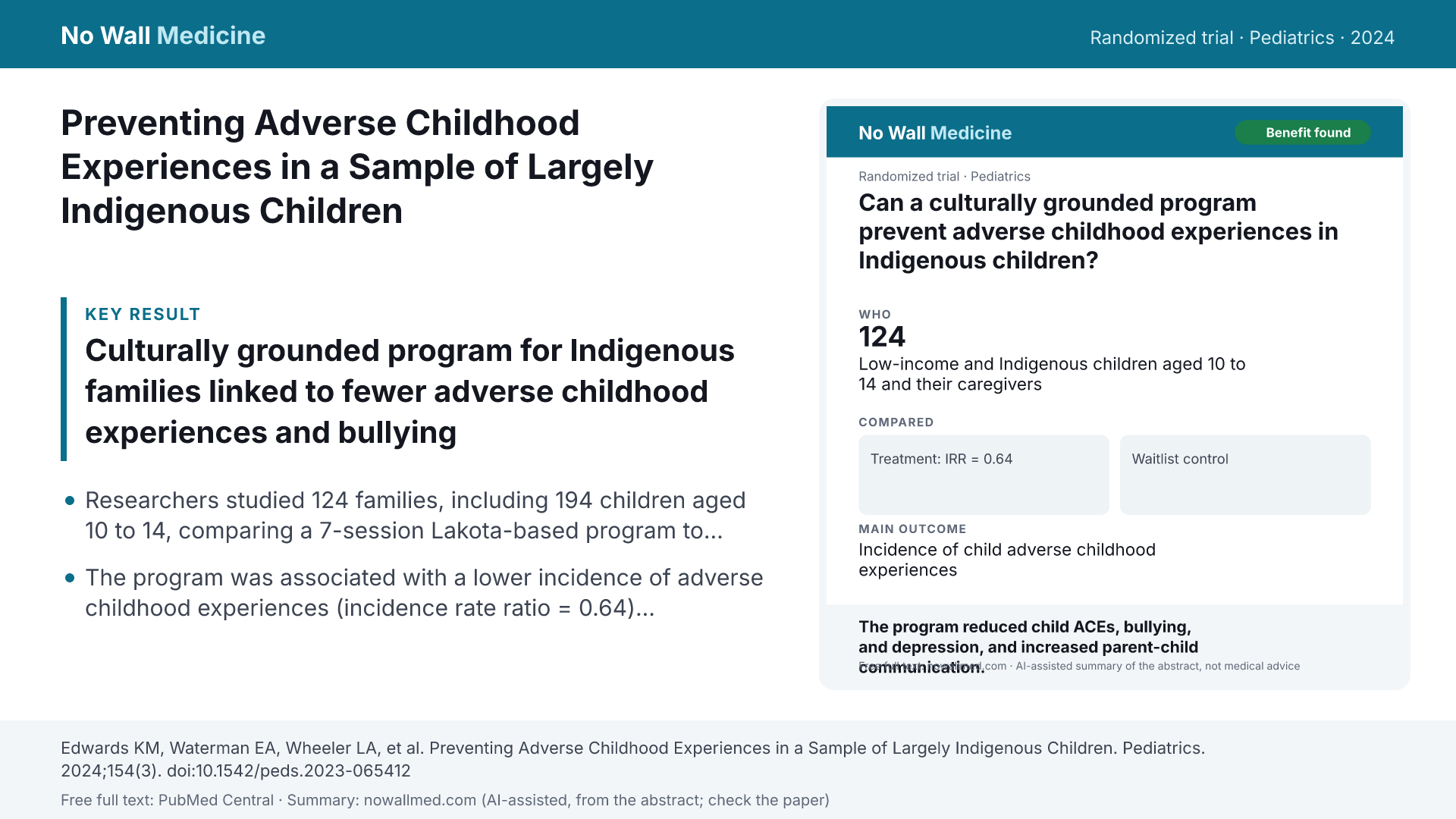
Preventing Adverse Childhood Experiences in a Sample of Largely Indigenous Children
Key result: Culturally grounded program for Indigenous families linked to fewer adverse childhood experiences and bullying
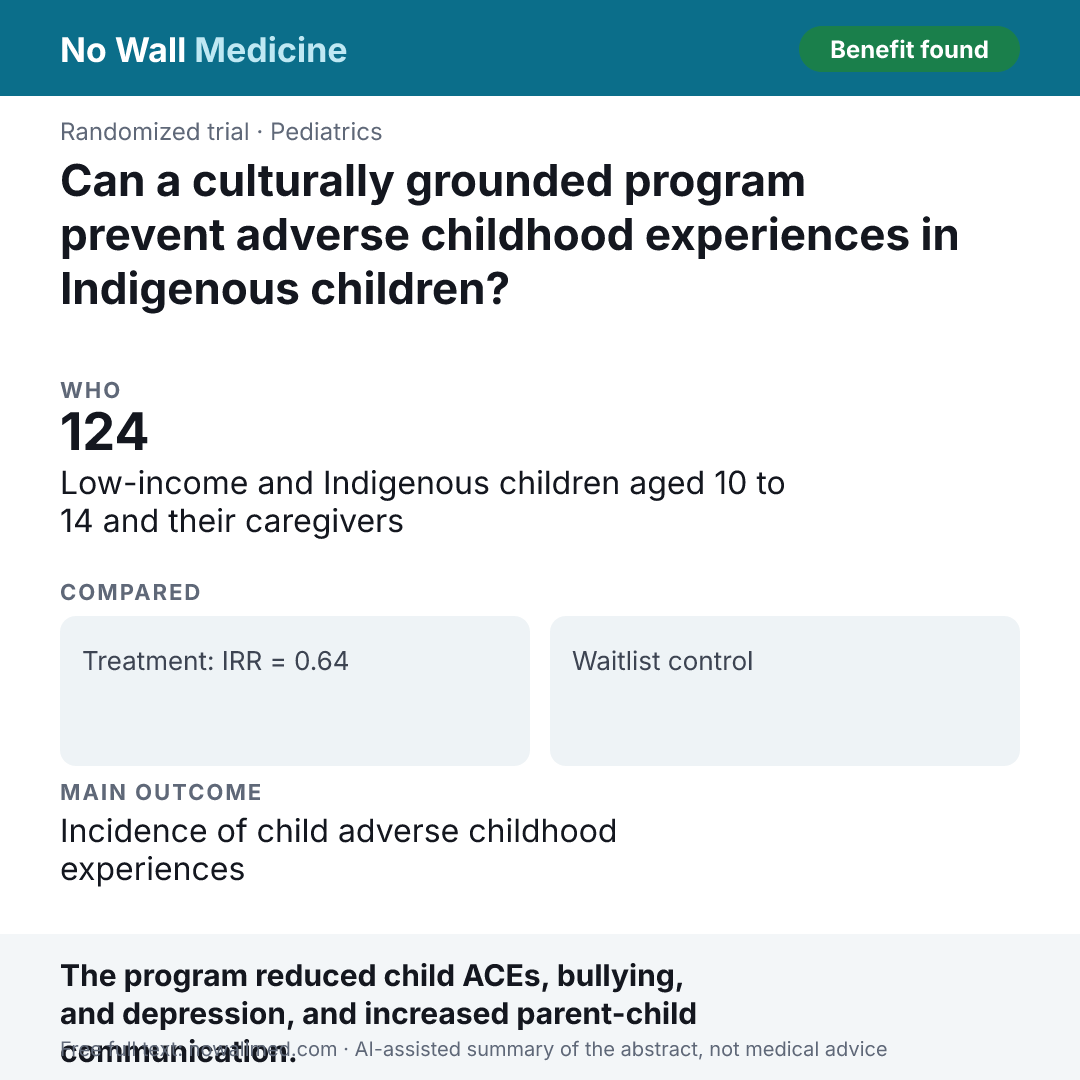
Randomized trialBenefit found
Can a culturally grounded program prevent adverse childhood experiences in Indigenous children?
Who
124
Low-income and Indigenous children aged 10 to 14 and their caregivers
Compared
Treatment: IRR = 0.64
Waitlist control
Main outcome
Incidence of child adverse childhood experiences
Result: incidence rate ratio [IRR] = 0.64
Bottom line: The program reduced child ACEs, bullying, and depression, and increased parent-child communication.
Pediatrics · 2024-08-13 · Save PNG
Key points
- Researchers studied 124 families, including 194 children aged 10 to 14, comparing a 7-session Lakota-based program to a waitlist control group.
- The program was associated with a lower incidence of adverse childhood experiences (incidence rate ratio = 0.64) and bullying victimization (odds ratio = 0.53).
- Caregivers in the program were associated with lower rates of intimate partner violence victimization (incidence rate ratio = 0.36) and harsh parenting (g = -0.35).
Discussion prompts
- Would these patients look like yours? Who was left out?
- Is the main outcome one that matters to patients?
- Is the difference large enough to change what you do?
Cite: Edwards KM, Waterman EA, Wheeler LA, et al. Preventing Adverse Childhood Experiences in a Sample of Largely Indigenous Children. Pediatrics. 2024;154(3). doi:10.1542/peds.2023-065412
Free full text: PubMed Central · Summary and visual abstract: nowallmed.com/a/preventing-adverse-childhood-experiences-in-a-sample-of-largely-doh3mr/ (AI-assisted from the abstract; check the paper before relying on it).