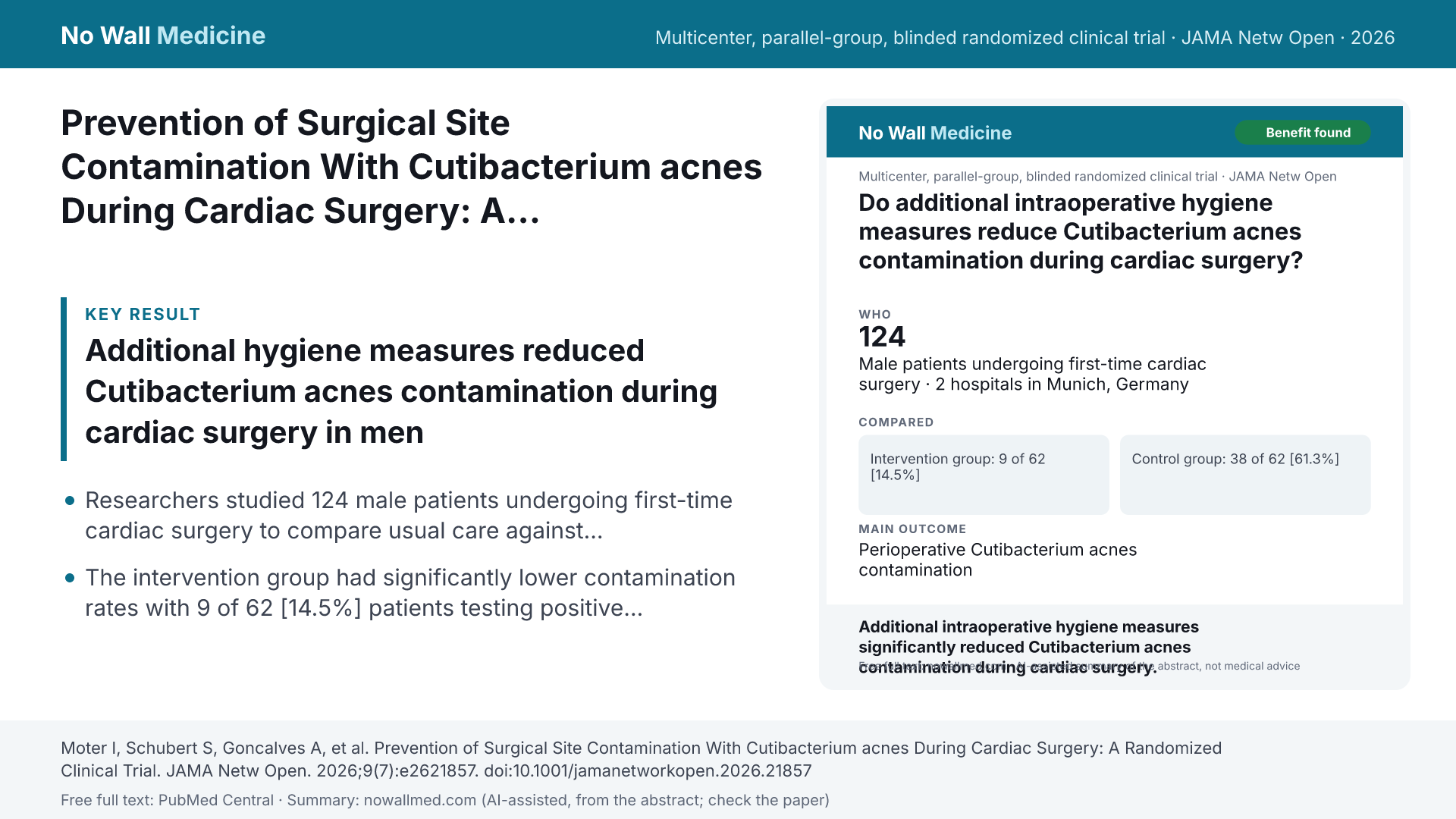
Additional hygiene measures reduced Cutibacterium acnes contamination during cardiac surgery in men
Prevention of Surgical Site Contamination With Cutibacterium acnes During Cardiac Surgery: A Randomized Clinical Trial
Multicenter, parallel-group, blinded randomized clinical trialBenefit found
Do additional intraoperative hygiene measures reduce Cutibacterium acnes contamination during cardiac surgery?
Who
124
Male patients undergoing first-time cardiac surgery · 2 hospitals in Munich, Germany
Compared
Intervention group: 9 of 62 [14.5%]
Control group: 38 of 62 [61.3%]
Main outcome
Perioperative Cutibacterium acnes contamination
Result: risk ratio 0.24 (95% CI, 0.13-0.45)
Bottom line: Additional intraoperative hygiene measures significantly reduced Cutibacterium acnes contamination during cardiac surgery.
JAMA Netw Open · 2026-07-01 · Save PNG
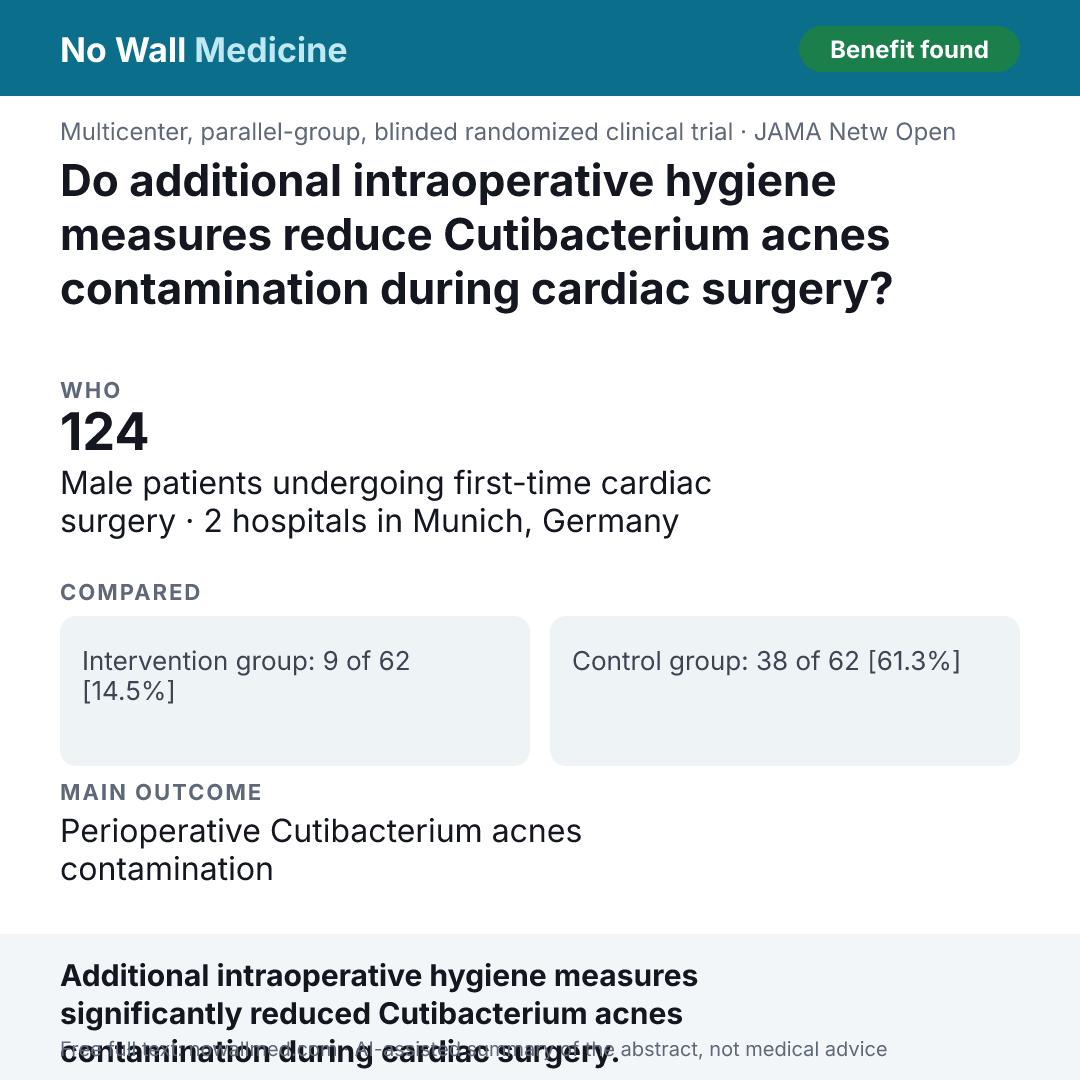
Clinical question: Do additional intraoperative hygiene measures reduce Cutibacterium acnes contamination during cardiac surgery?
Why it matters: Cutibacterium acnes is increasingly recognized as a pathogen in prosthetic valve endocarditis, and it is hypothesized that bacteria transfer from hair follicles during surgery.
Key points
- Researchers studied 124 male patients undergoing first-time cardiac surgery to compare usual care against additional hygiene measures like disinfecting wound margins.
- The intervention group had significantly lower contamination rates with 9 of 62 [14.5%] patients testing positive compared to 38 of 62 [61.3%] in the control group.
- Overall bacterial contamination was also reduced in the intervention group with 10 of 62 [16.1%] versus 44 of 62 [71.0%] in the control group.
Headline and key points written with AI from the paper’s abstract, with every number checked against it. Read the paper before relying on them.
Was this summary helpful?
Subject terms
Headline, design, result, key points, caveat and citation as plain text.
Cite this article
Moter I, Schubert S, Goncalves A, et al. Prevention of Surgical Site Contamination With Cutibacterium acnes During Cardiac Surgery: A Randomized Clinical Trial. JAMA Netw Open. 2026;9(7):e2621857. doi:10.1001/jamanetworkopen.2026.21857
Spotted a mistake? Suggest a correction