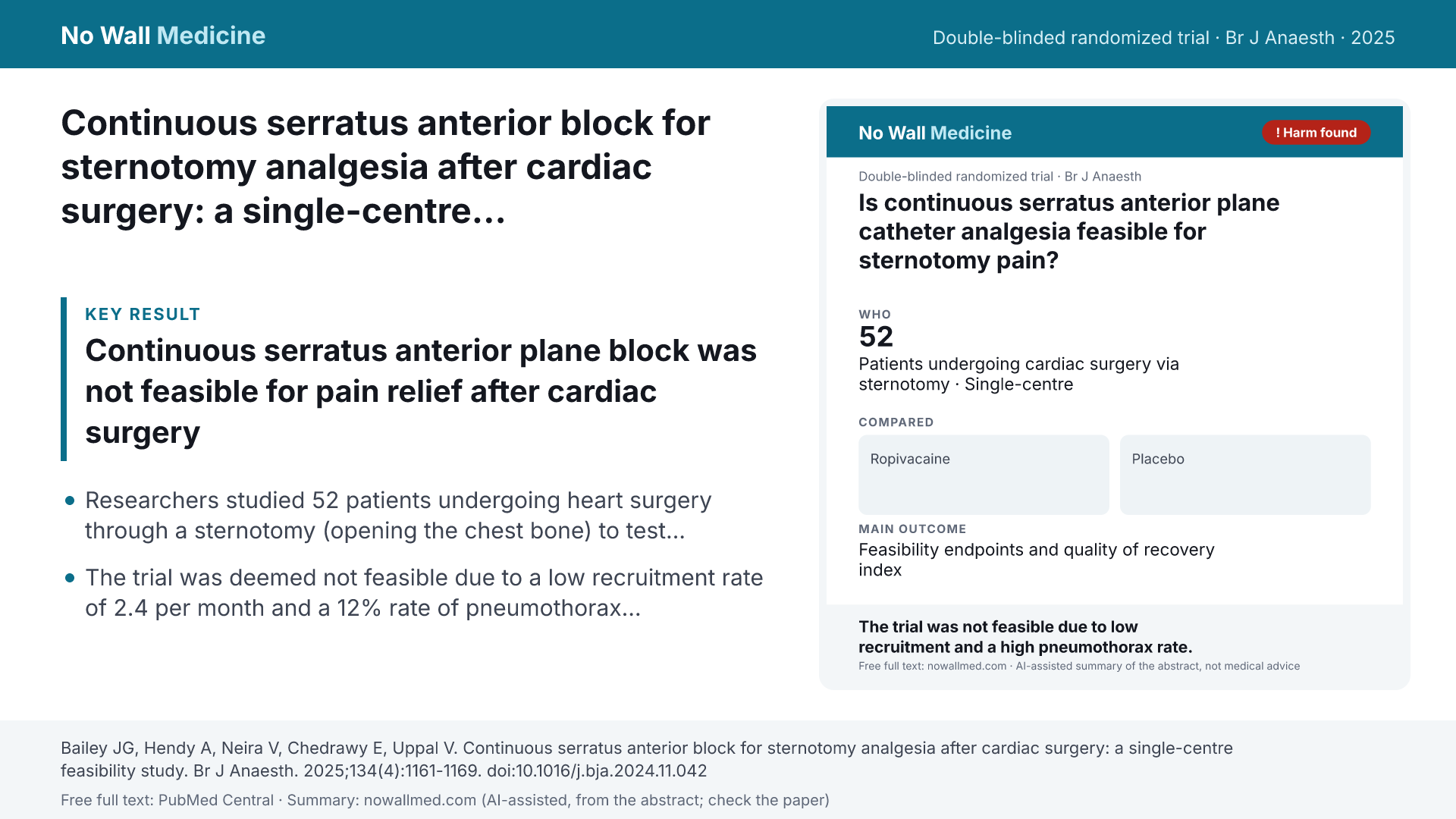
Continuous serratus anterior plane block was not feasible for pain relief after cardiac surgery
Continuous serratus anterior block for sternotomy analgesia after cardiac surgery: a single-centre feasibility study
Double-blinded randomized trialHarm found
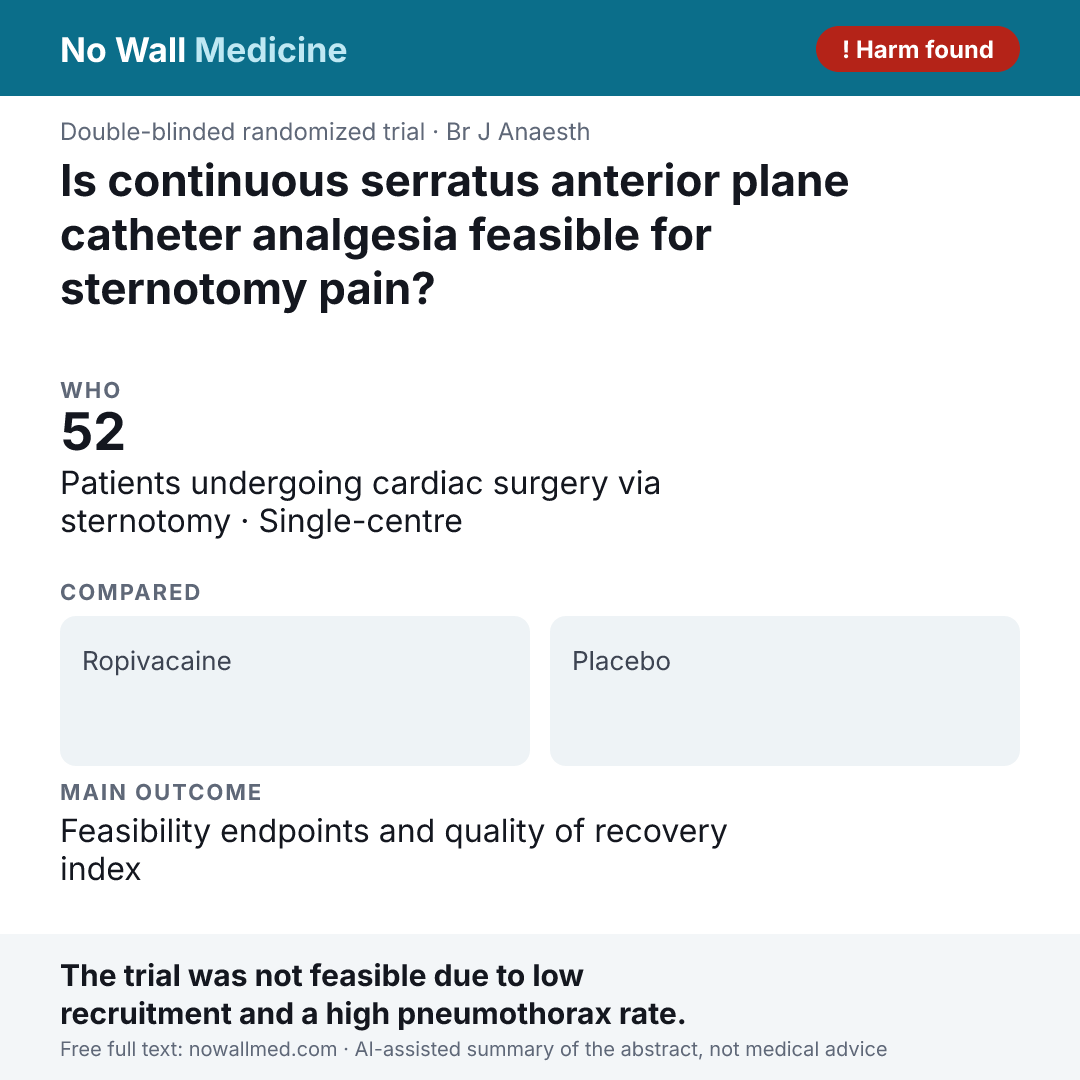
Is continuous serratus anterior plane catheter analgesia feasible for sternotomy pain?
Who
52
Patients undergoing cardiac surgery via sternotomy · Single-centre
Compared
Ropivacaine
Placebo
Main outcome
Feasibility endpoints and quality of recovery index
Bottom line: The trial was not feasible due to low recruitment and a high pneumothorax rate.
Limitation: Single-centre study with limited data
Br J Anaesth · 2025-01-24 · Save PNG
Clinical question: Is continuous serratus anterior plane catheter analgesia feasible for sternotomy pain?
Why it matters: The optimal location for placing continuous catheters to manage pain after sternotomy has not been established.
Key points
- Researchers studied 52 patients undergoing heart surgery through a sternotomy (opening the chest bone) to test the feasibility of using nerve blocks with ropivacaine or a placebo.
- The trial was deemed not feasible due to a low recruitment rate of 2.4 per month and a 12% rate of pneumothorax (collapsed lung).
- There were no differences between the ropivacaine and placebo groups regarding pain, opioid use, complications, or quality of recovery.
Limitation the authors note: The study was a single-centre feasibility study with limited data.
Headline and key points written with AI from the paper’s abstract, with every number checked against it. Read the paper before relying on them.
Was this summary helpful?
Subject terms
Headline, design, result, key points, caveat and citation as plain text.
Cite this article
Bailey JG, Hendy A, Neira V, Chedrawy E, Uppal V. Continuous serratus anterior block for sternotomy analgesia after cardiac surgery: a single-centre feasibility study. Br J Anaesth. 2025;134(4):1161-1169. doi:10.1016/j.bja.2024.11.042
Spotted a mistake? Suggest a correction