Rectus sheath block used less morphine than local anesthetic infiltration in pediatric hernia repair
Rectus sheath block versus local anesthetic infiltration in pediatric laparoscopic inguinal hernia repair: a randomized controlled trial
Randomized controlled trialBenefit found
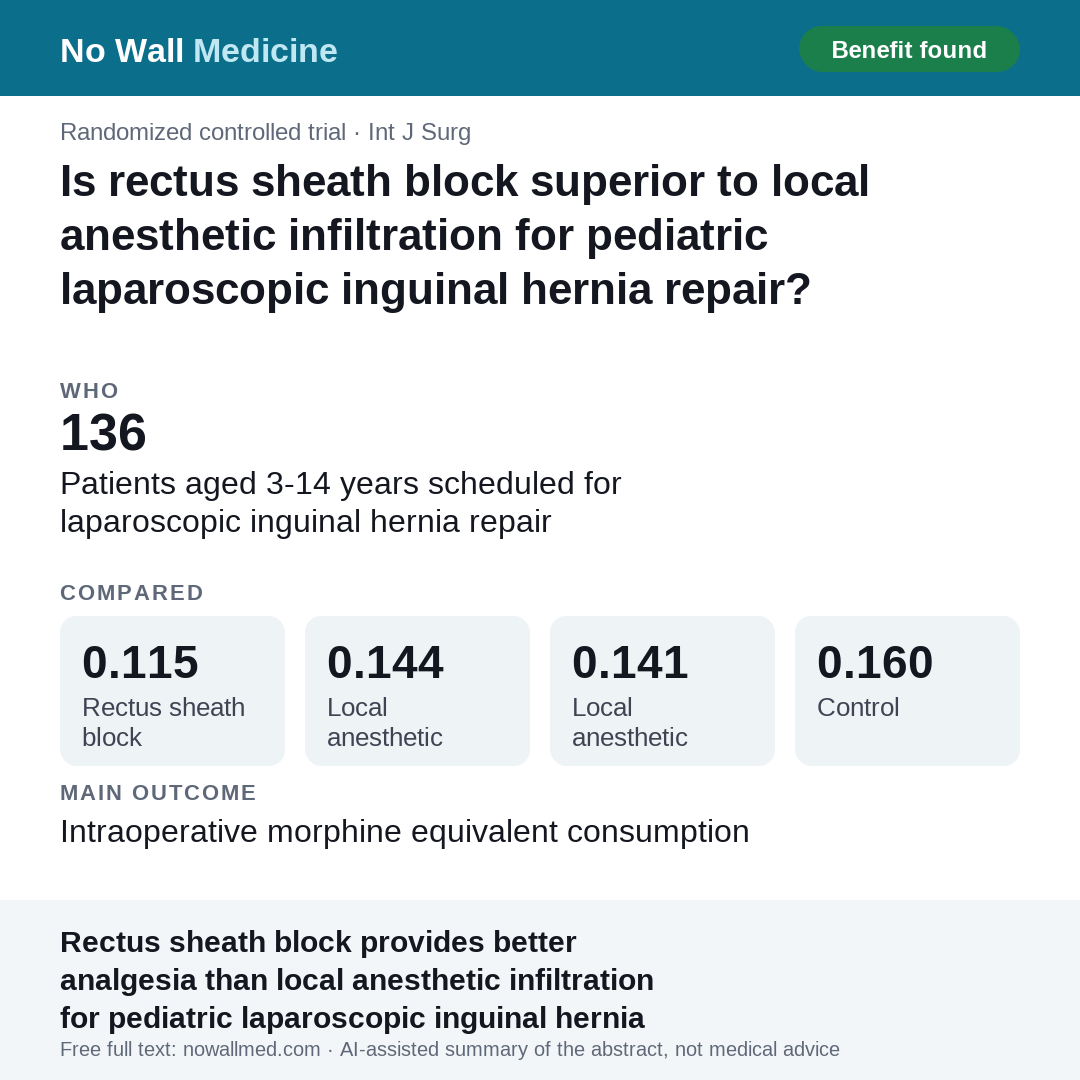
Is rectus sheath block superior to local anesthetic infiltration for pediatric laparoscopic inguinal hernia repair?
Who
136
Patients aged 3-14 years scheduled for laparoscopic inguinal hernia repair
Compared
0.115Rectus sheath block (0.107-0.123)
0.144Local anesthetic infiltration high concentration (0.137-0.151)
0.141Local anesthetic infiltration low concentration (0.134-0.149)
0.160Control (0.151-0.170)
Main outcome
Intraoperative morphine equivalent consumption
Bottom line: Rectus sheath block provides better analgesia than local anesthetic infiltration for pediatric laparoscopic inguinal hernia repair.
Int J Surg · 2023-04-01Download image
Clinical question: Is rectus sheath block superior to local anesthetic infiltration for pediatric laparoscopic inguinal hernia repair?
Why it matters: It is unclear whether a rectus sheath block provides better pain relief than local anesthetic infiltration for children undergoing laparoscopic inguinal hernia repair.
Key points
- Researchers studied 136 children aged 3-14 years undergoing laparoscopic inguinal hernia repair, comparing a rectus sheath block to two types of local anesthetic infiltration and a control group.
- Intraoperative morphine consumption was 0.115 (0.107-0.123) in the rectus sheath block group compared to 0.144 (0.137-0.151) for high concentration infiltration and 0.141 (0.134-0.149) for low concentration infiltration.
- In the post-anesthesia care unit, morphine consumption was 0.018 (0.010-0.027) for the rectus sheath block group, 0.038 (0.028-0.049) for high concentration infiltration, and 0.056 (0.044-0.067) for low concentration infiltration.
Headline and key points written with AI from the paper’s abstract, with every number checked against it. Read the paper before relying on them.
Was this summary helpful?
Subject terms
Cite this article
Chen L, Liu S, Cao Y, Yan L, Shen Y. Rectus sheath block versus local anesthetic infiltration in pediatric laparoscopic inguinal hernia repair: a randomized controlled trial. Int J Surg. 2023. doi:10.1097/JS9.0000000000000265
Spotted a mistake? Suggest a correction
Top studies every Monday
The week’s key trials and guidelines in your specialties, plus any topics you follow. By email, free.
Get the weekly digest