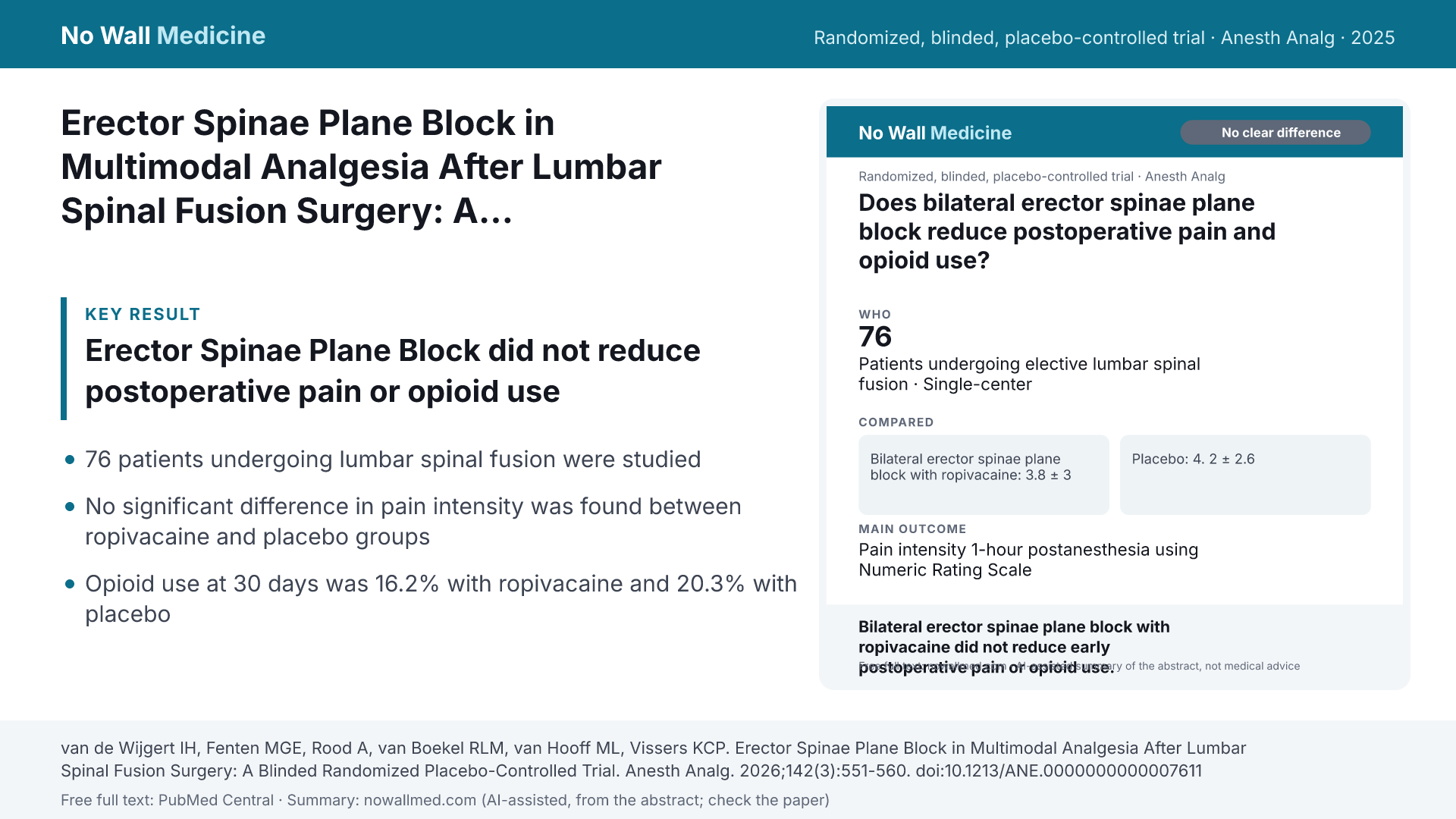
Erector Spinae Plane Block did not reduce postoperative pain or opioid use
Erector Spinae Plane Block in Multimodal Analgesia After Lumbar Spinal Fusion Surgery: A Blinded Randomized Placebo-Controlled Trial
Randomized, blinded, placebo-controlled trialNo clear difference
Does bilateral erector spinae plane block reduce postoperative pain and opioid use?
Who
76
Patients undergoing elective lumbar spinal fusion · Single-center
Compared
Bilateral erector spinae plane block with ropivacaine: 3.8 ± 3
Placebo: 4. 2 ± 2.6
Main outcome
Pain intensity 1-hour postanesthesia using Numeric Rating Scale
Bottom line: Bilateral erector spinae plane block with ropivacaine did not reduce early postoperative pain or opioid use.
Anesth Analg · 2025-07-02 · Save PNG
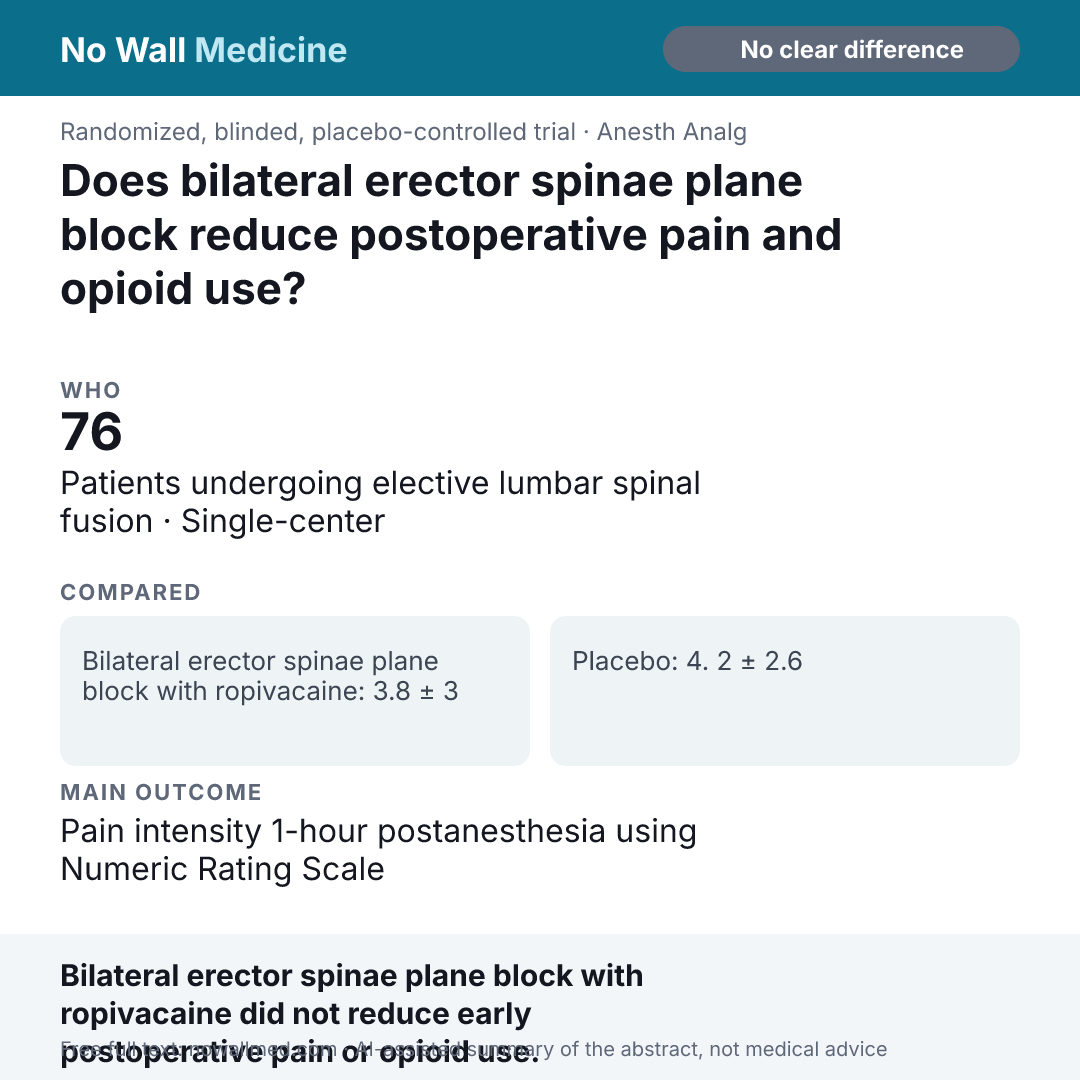
Clinical question: Does bilateral erector spinae plane block reduce postoperative pain and opioid use?
Key points
- 76 patients undergoing lumbar spinal fusion were studied.
- No significant difference in pain intensity was found between ropivacaine and placebo groups.
- Opioid use at 30 days was 16.2% with ropivacaine and 20.3% with placebo.
Limitation the authors note: This was a single-center trial
Headline and key points written with AI from the paper’s abstract, with every number checked against it. Read the paper before relying on them.
Was this summary helpful?
Subject terms
Headline, design, result, key points, caveat and citation as plain text.
Cite this article
van de Wijgert IH, Fenten MGE, Rood A, van Boekel RLM, van Hooff ML, Vissers KCP. Erector Spinae Plane Block in Multimodal Analgesia After Lumbar Spinal Fusion Surgery: A Blinded Randomized Placebo-Controlled Trial. Anesth Analg. 2026;142(3):551-560. doi:10.1213/ANE.0000000000007611
Spotted a mistake? Suggest a correction