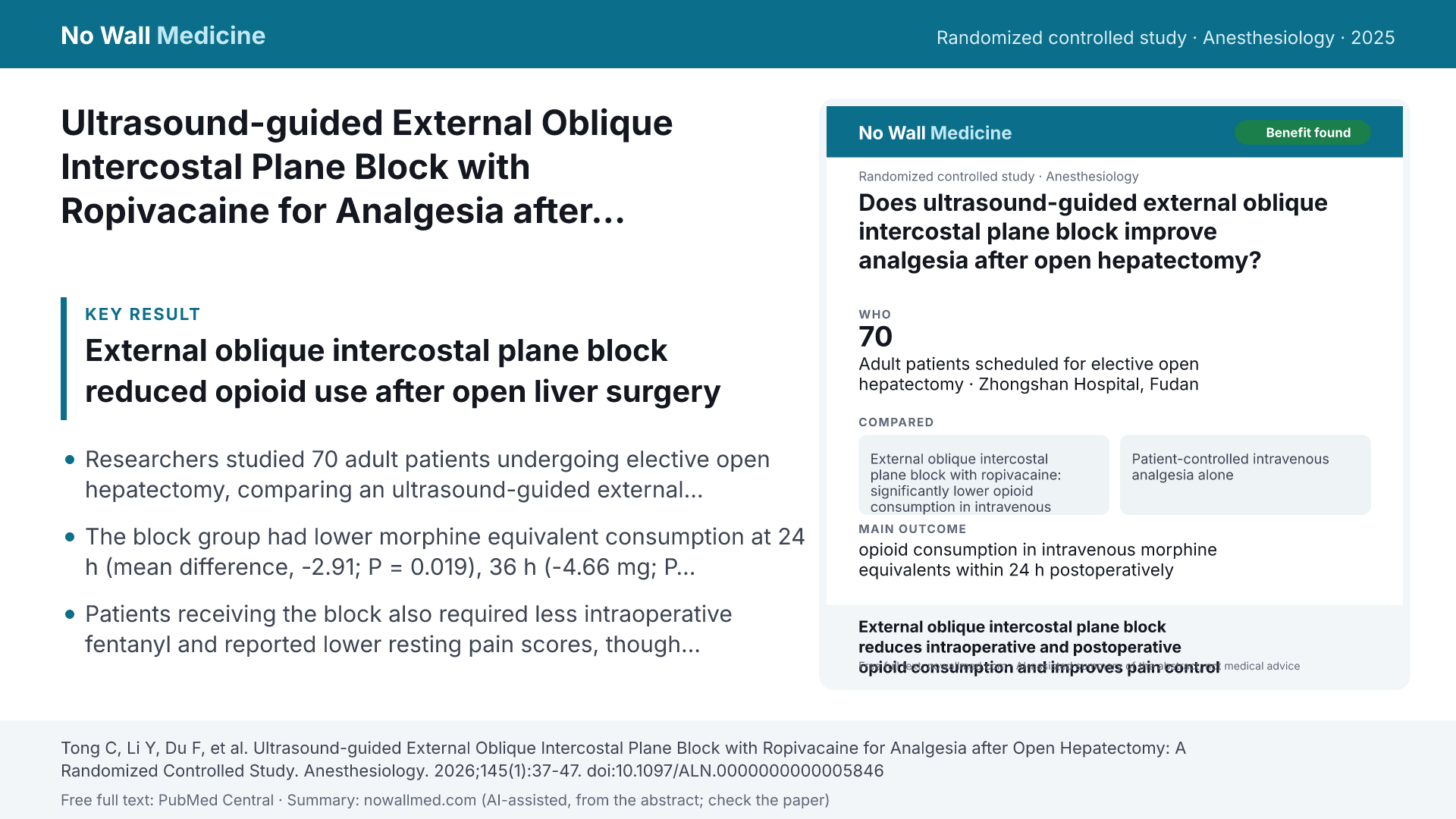
External oblique intercostal plane block reduced opioid use after open liver surgery
Ultrasound-guided External Oblique Intercostal Plane Block with Ropivacaine for Analgesia after Open Hepatectomy: A Randomized Controlled Study
Randomized controlled studyBenefit found
Does ultrasound-guided external oblique intercostal plane block improve analgesia after open hepatectomy?
Who
70
Adult patients scheduled for elective open hepatectomy · Zhongshan Hospital, Fudan University, Shanghai, China
Compared
External oblique intercostal plane block with ropivacaine: significantly lower opioid consumption in intravenous morphine equivalents at 24 h postoperatively
Patient-controlled intravenous analgesia alone
Main outcome
opioid consumption in intravenous morphine equivalents within 24 h postoperatively
Result: mean difference, -2.91; P = 0.019
Bottom line: External oblique intercostal plane block reduces intraoperative and postoperative opioid consumption and improves pain control after open hepatectomy.
Anesthesiology · 2025-11-11Download image
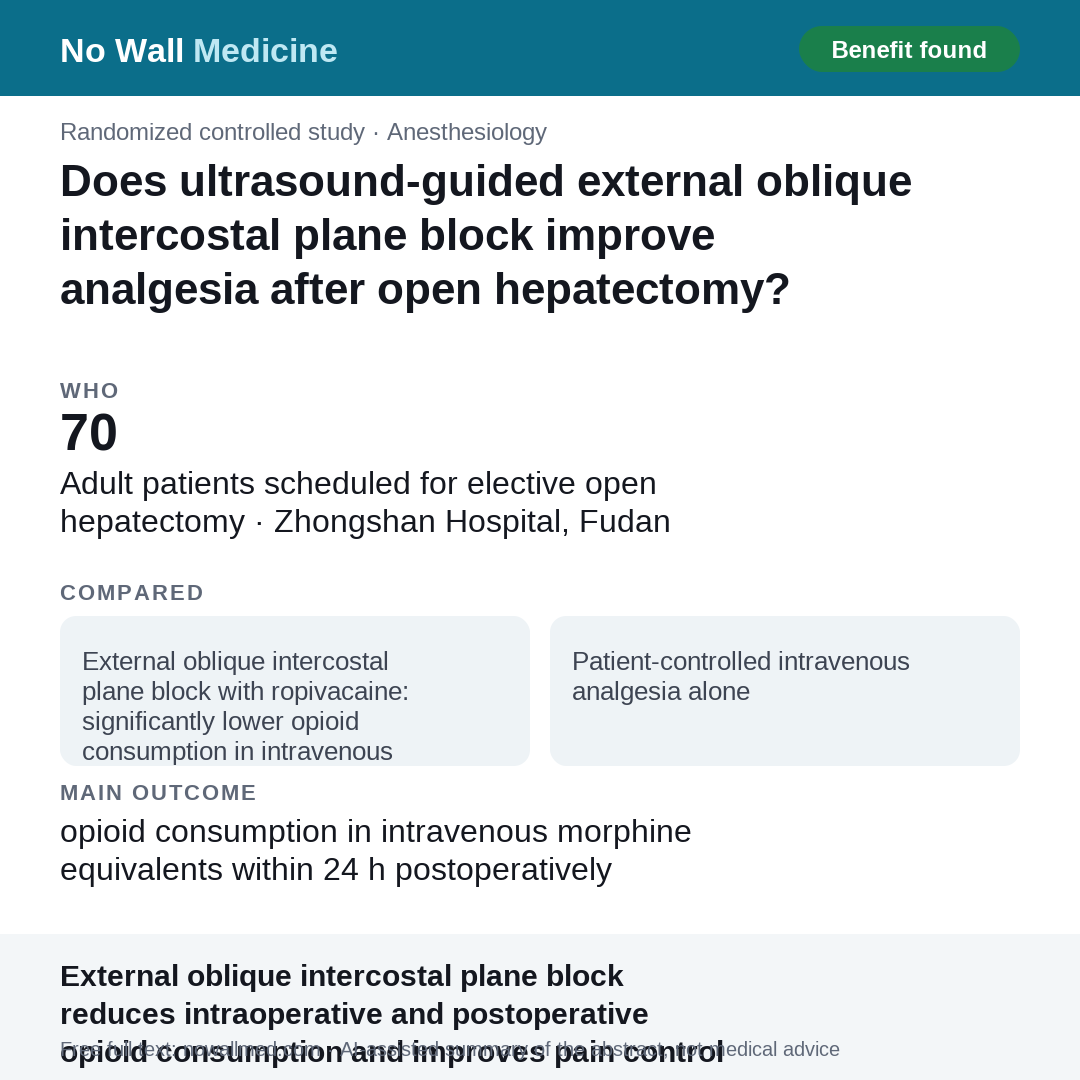
Clinical question: Does ultrasound-guided external oblique intercostal plane block improve analgesia after open hepatectomy?
Why it matters: It is unclear if the external oblique intercostal plane block provides better pain relief than intravenous morphine alone for patients undergoing open hepatectomy.
Key points
- Researchers studied 70 adult patients undergoing elective open hepatectomy, comparing an ultrasound-guided external oblique intercostal plane block with ropivacaine to patient-controlled intravenous analgesia alone.
- The block group had lower morphine equivalent consumption at 24 h (mean difference, -2.91; P = 0.019), 36 h (-4.66 mg; P < 0.001), and 48 h (-6.06 mg; P < 0.001).
- Patients receiving the block also required less intraoperative fentanyl and reported lower resting pain scores, though no significant differences were found in coughing pain or hospital stay.
Headline and key points written with AI from the paper’s abstract, with every number checked against it. Read the paper before relying on them.
Was this summary helpful?
Subject terms
Cite this article
Tong C, Li Y, Du F, et al. Ultrasound-guided External Oblique Intercostal Plane Block with Ropivacaine for Analgesia after Open Hepatectomy: A Randomized Controlled Study. Anesthesiology. 2025. doi:10.1097/ALN.0000000000005846
Spotted a mistake? Suggest a correction