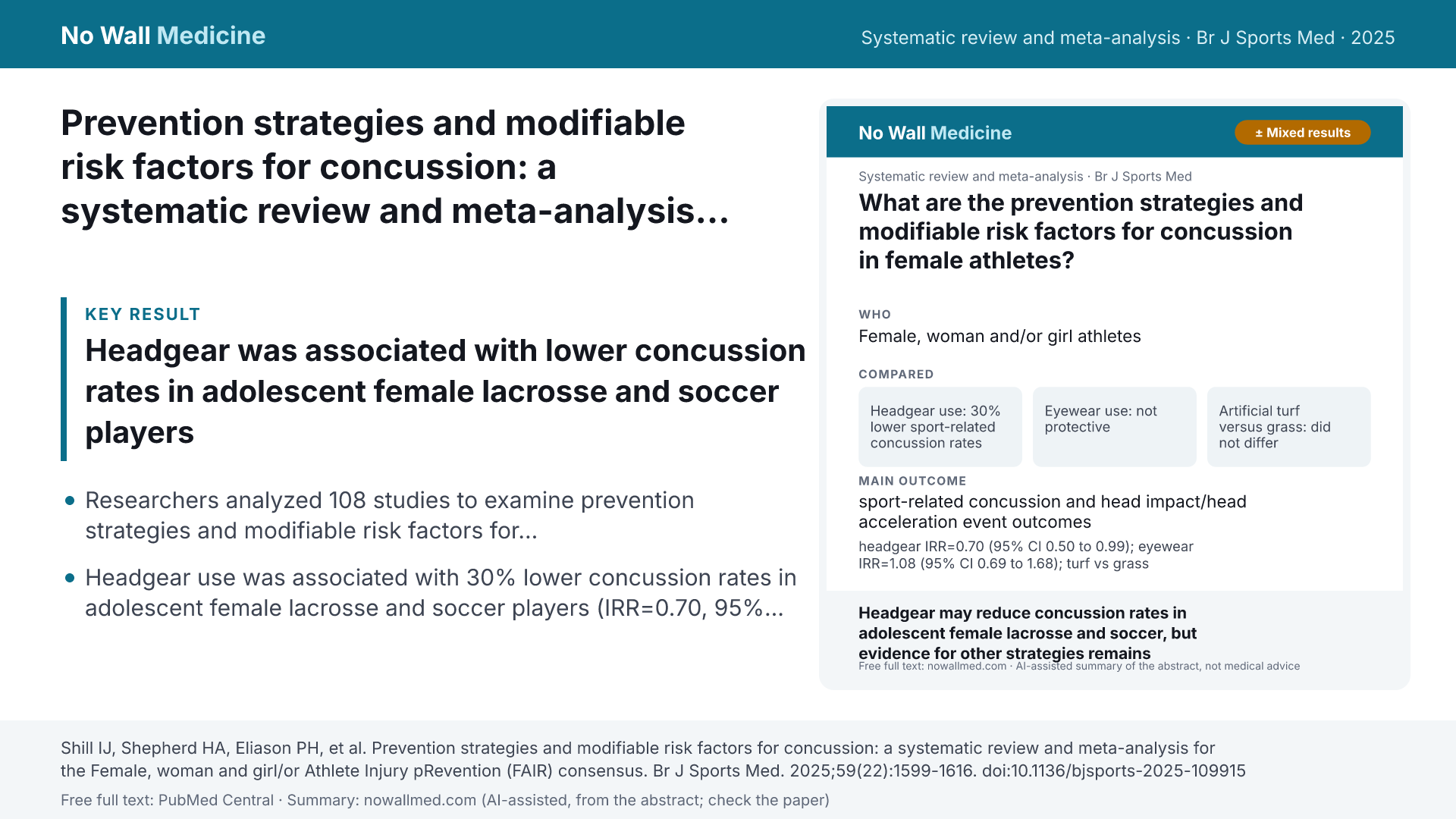
Headgear was associated with lower concussion rates in adolescent female lacrosse and soccer players
Prevention strategies and modifiable risk factors for concussion: a systematic review and meta-analysis for the Female, woman and girl/or Athlete Injury pRevention (FAIR) consensus
Systematic review and meta-analysisMixed results
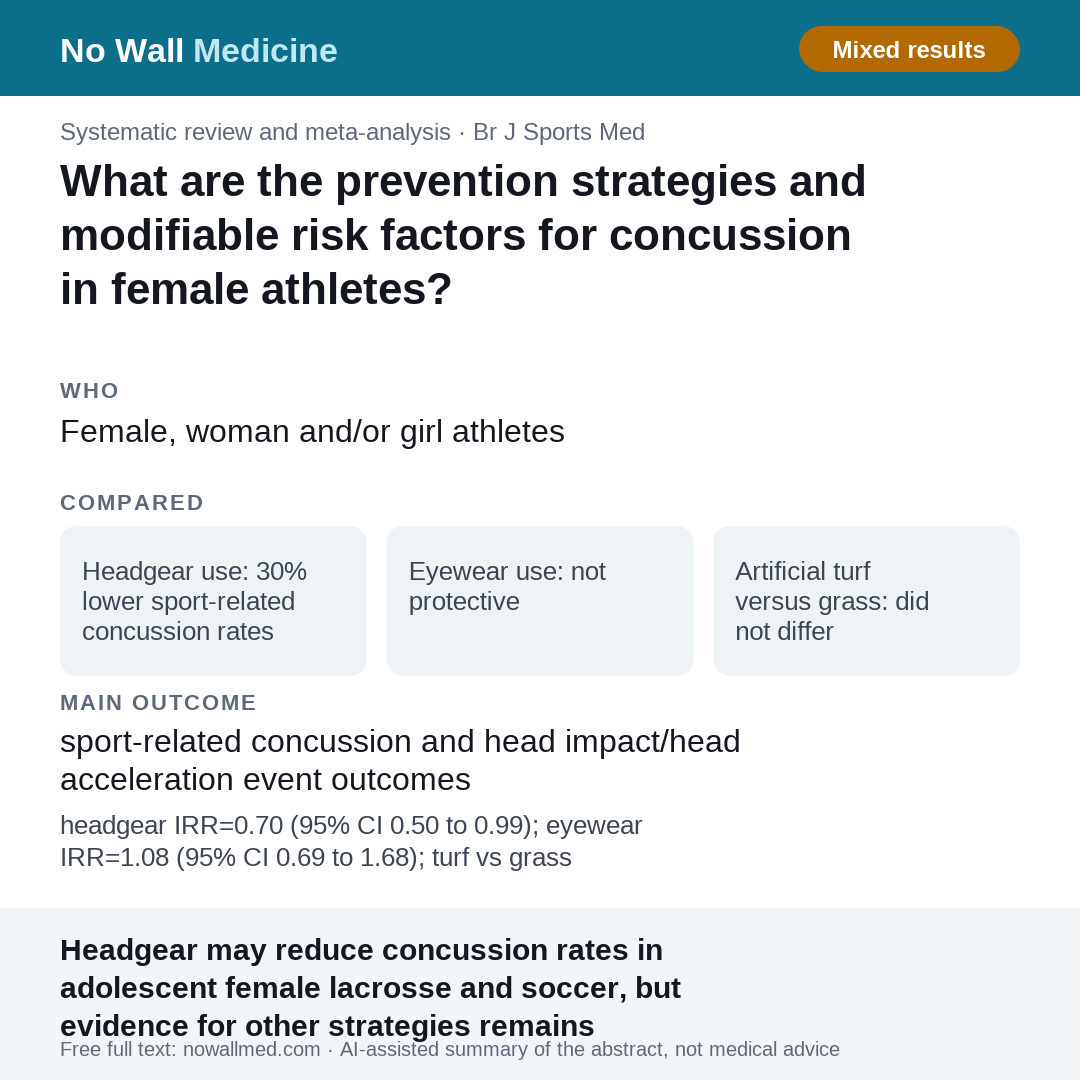
What are the prevention strategies and modifiable risk factors for concussion in female athletes?
Who
Female, woman and/or girl athletes
Compared
Headgear use: 30% lower sport-related concussion rates
Eyewear use: not protective
Artificial turf versus grass: did not differ
Main outcome
sport-related concussion and head impact/head acceleration event outcomes
Result: headgear IRR=0.70 (95% CI 0.50 to 0.99); eyewear IRR=1.08 (95% CI 0.69 to 1.68); turf vs grass IRR=0.95 (95% CI 0.62 to 1.45)
Bottom line: Headgear may reduce concussion rates in adolescent female lacrosse and soccer, but evidence for other strategies remains limited.
Limitation: very-low certainty evidence
Br J Sports Med · 2025-12-03Download image
Clinical question: What are the prevention strategies and modifiable risk factors for concussion in female athletes?
Why it matters: There is limited evidence regarding specific prevention strategies and modifiable risk factors for sport-related concussions in female, woman, and girl athletes.
Key points
- Researchers analyzed 108 studies to examine prevention strategies and modifiable risk factors for sport-related concussion in female athletes.
- Headgear use was associated with 30% lower concussion rates in adolescent female lacrosse and soccer players (IRR=0.70, 95% CI 0.50 to 0.99).
- Eyewear use was not protective for concussion and concussion rates did not differ between artificial turf and grass surfaces.
Limitation the authors note: The evidence for the findings was rated as very-low certainty.
Headline and key points written with AI from the paper’s abstract, with every number checked against it. Read the paper before relying on them.
Was this summary helpful?
Abstract
Objective
To examine prevention strategies and potential modifiable risk factors (MRFs) for sport-related concussion (SRC) and head impact/head acceleration event (HAE) outcomes in female, woman and/or girl athletes. Design
Systematic review with meta-analyses and Grading of Recommendations, Assessment, Development and Evaluation. Data sources
Medline, CINAHL, PsycINfo, SportDiscus, ERIC, CENTRAL and CDSR. Eligibility
Primary data studies with comparison group(s) assessing the association of prevention interventions and/or MRFs for SRC or HAE with ≥1 female/woman/girl in each study group. Results
Of the 108 included studies, 67 evaluated a SRC prevention strategy (equipment n=25, policy/rule n=21, training n=10, management n=11) and 41 evaluated potential MRFs (34 distinct MRFs across nine categories). In total, 40/108 (37%) studies (prevention 19/67; MRF 21/41) included female/woman/girl-specific estimates. Three meta-analyses were conducted: two SRC prevention strategies (headgear, eyewear) and one MRF (artificial turf vs grass) based on availability of female/woman/girl-only estimates and similar outcomes and exposure. Headgear was associated with 30% lower SRC rates in adolescent female/girl lacrosse and soccer (IRR=0.70, 95% CI 0.50 to 0.99; very-low certainty). Eyewear use was not protective for SRC (IRR=1.08, 95% CI 0.69 to 1.68; very-low certainty). SRC rates did not differ by artificial turf versus grass (IRR=0.95, 95% CI 0.62 to 1.45; very-low certainty). Conclusion
We found limited evidence for prevention strategies and MRFs in female/woman/girl athletes except for very-low certainty evidence supporting headgear use in adolescent lacrosse and soccer. Future studies should consider the design, implementation and evaluation of SRC prevention strategies that target MRFs to guide safe practice recommendations specifically for female/woman/girl athletes.
Abstract reproduced under the article’s CC BY NC licence.
Subject terms
Cite this article
Shill IJ, Shepherd HA, Eliason PH, Kolstad AT, Heyward O, Martens G. Prevention strategies and modifiable risk factors for concussion: a systematic review and meta-analysis for the Female, woman and girl/or Athlete Injury pRevention (FAIR) consensus. Br J Sports Med. 2025. doi:10.1136/bjsports-2025-109915
Spotted a mistake? Suggest a correction
Top studies every Monday
The week’s key trials and guidelines in your specialties, plus any topics you follow. By email, free.
Get the weekly digest