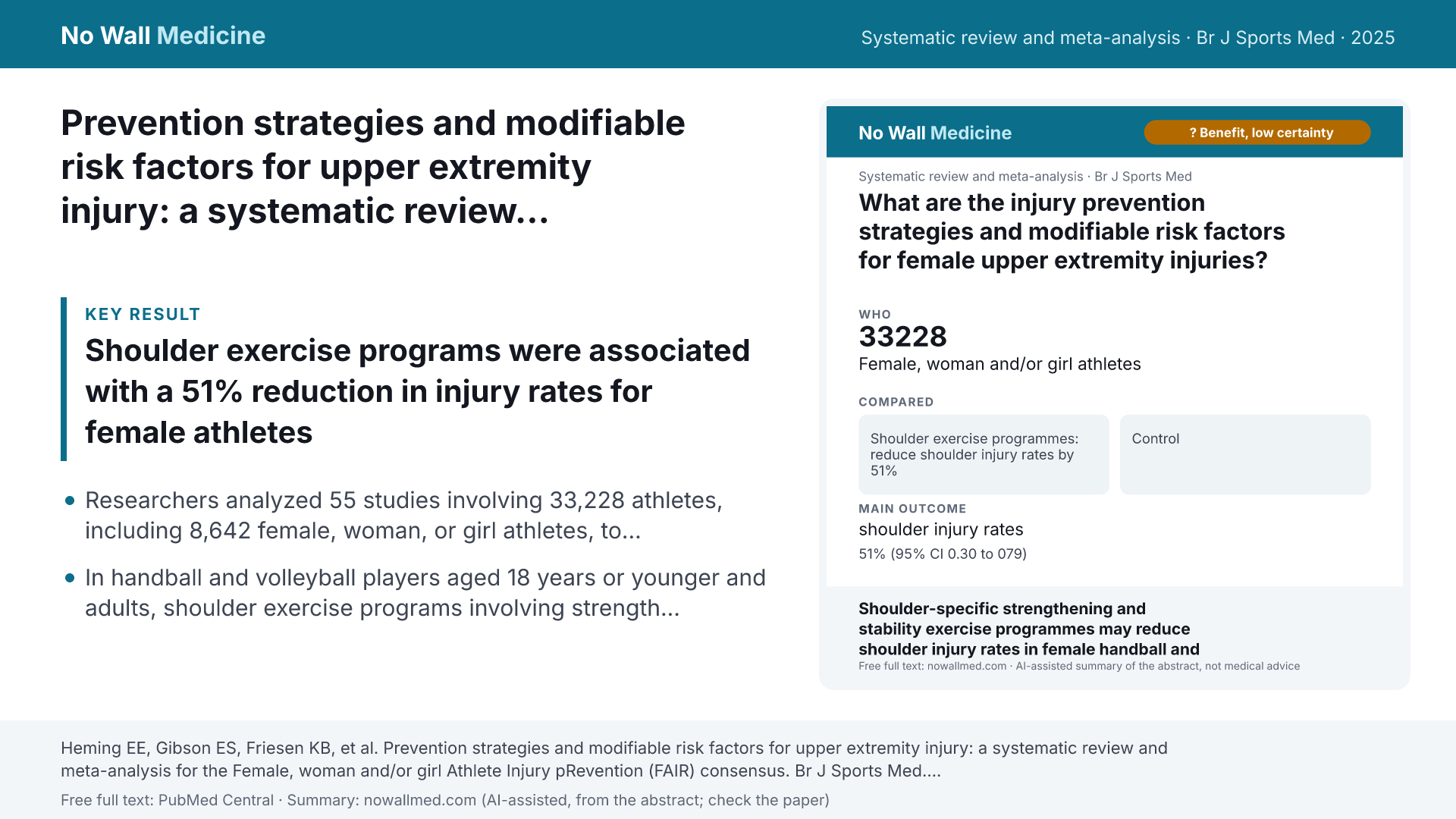
Shoulder exercise programs were associated with a 51% reduction in injury rates for female athletes
Prevention strategies and modifiable risk factors for upper extremity injury: a systematic review and meta-analysis for the Female, woman and/or girl Athlete Injury pRevention (FAIR) consensus
Orthopedics & Sports MedicineAdult and pediatric
Systematic review and meta-analysisBenefit found
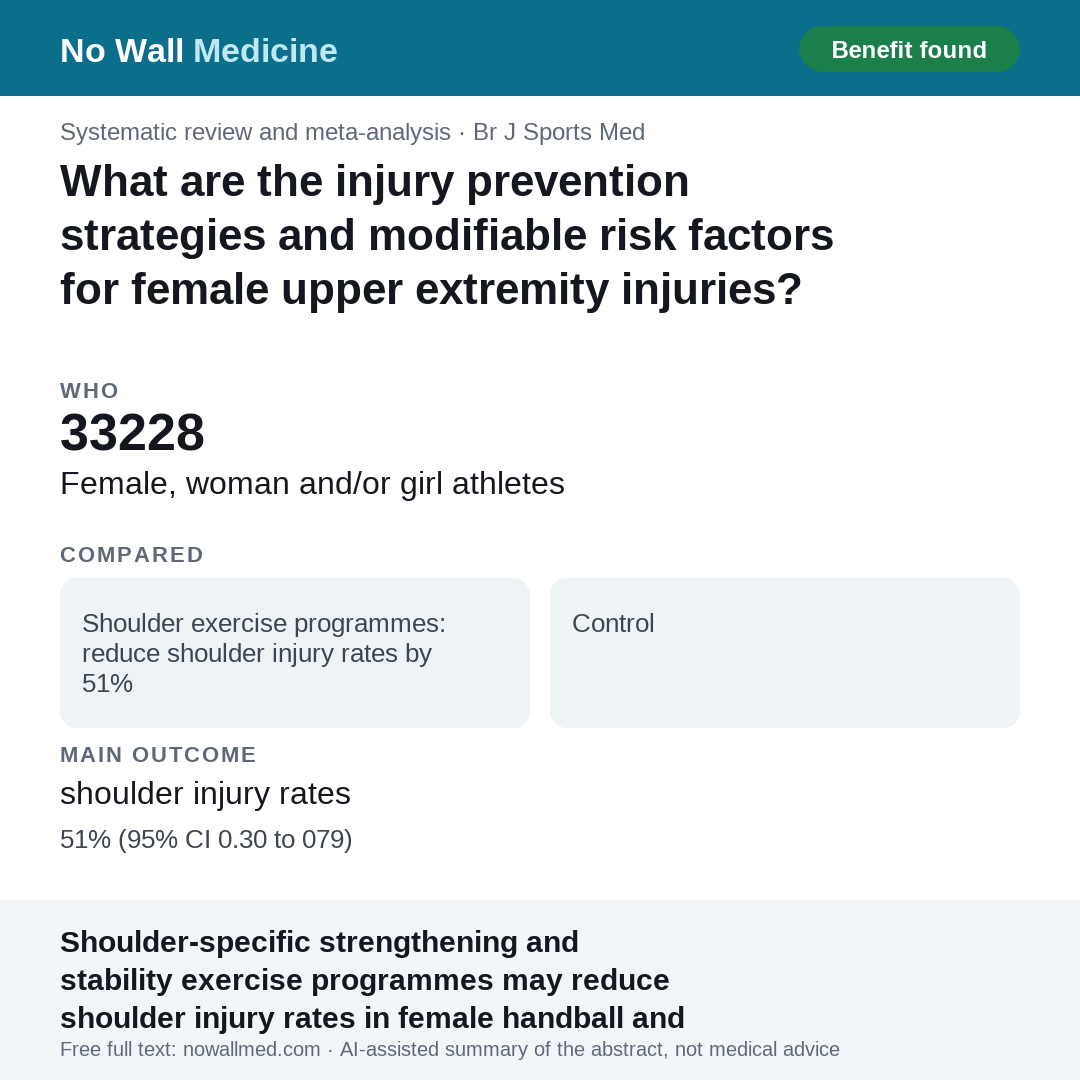
What are the injury prevention strategies and modifiable risk factors for female upper extremity injuries?
Who
33228
Female, woman and/or girl athletes
Compared
Shoulder exercise programmes: reduce shoulder injury rates by 51%
Control
Main outcome
shoulder injury rates
Result: 51% (95% CI 0.30 to 079)
Bottom line: Shoulder-specific strengthening and stability exercise programmes may reduce shoulder injury rates in female handball and volleyball players.
Limitation: Heterogeneity across injury outcomes, interventions, modifiable risk factors and limited female-specific data.
Br J Sports Med · 2025-12-03Download image
Clinical question: What are the injury prevention strategies and modifiable risk factors for female upper extremity injuries?
Why it matters: There is limited data regarding specific injury prevention strategies and modifiable risk factors for upper extremity injuries in female, woman, and girl athletes.
Key points
- Researchers analyzed 55 studies involving 33,228 athletes, including 8,642 female, woman, or girl athletes, to identify injury risk factors and prevention methods.
- In handball and volleyball players aged 18 years or younger and adults, shoulder exercise programs involving strength and stability were associated with a 51% reduction in shoulder injury rates.
- Identified risk factors included less range of motion, less shoulder muscle strength, high training load, scapular dyskinesis, high sport specialization, equipment differences, and less sport-specific conditioning.
Limitation the authors note: The understanding of injury prevention is limited by heterogeneity across injury outcomes, interventions, risk factors, and a lack of female-specific data.
Headline and key points written with AI from the paper’s abstract, with every number checked against it. Read the paper before relying on them.
Was this summary helpful?
Abstract
Objectives
To examine injury prevention strategies and potentially modifiable risk factors (MRFs) for upper extremity (UE) injuries in female, woman and/or girl athletes (female/woman/girl). Design
Systematic review with meta-analysis, semiquantitative analyses and Grading of Recommendations Assessment, Development and Evaluation in accordance with the Preferred Reporting Items for Systematic Reviews and Meta-Analyses. Data sources
MEDLINE (Medical Literature Analysis and Retrieval System Online), CINAHL (Cumulative Index to Nursing and Allied Health Literature), APA PsycINFO (American Psychological Association Psychological Information Database), SPORTDiscus (Sports Discus Database), EMBASE (Excerpta Medica Database), and ERIC (Education Resources Information Center) (30 October 2023) and Cochrane Systematic Review Database and the Cochrane Central Register of Controlled Trials (CENTRAL) (25 November 2023). Eligibility
Primary data studies with comparison group(s) assessing the association of prevention strategies and/or MRFs for sport-related UE injury, with ≥1 female/woman/girl in each study group. Results
55 studies (n=20 intervention, n=35 MRF) were included with 33 228 athletes (8642 female/woman/girl; 26%). Of these, 17 (31%) reported female/woman/girl-specific estimates and included five injury locations (n=3 general UE, n=12 shoulder, n=3 elbow, n=3 wrist/hand). One prevention strategy (n=5 shoulder-specific exercise programmes) and seven MRFs were identified, including less range of motion (n=6), less shoulder muscle strength (n=8), high training load (n=1), presence of scapular dyskinesis (n=3), high sport specialisation (n=2), equipment differences (n=1) and less sport-specific conditioning (n=1). Pooled data from three studies suggest that shoulder exercise programmes consisting of strength, stability/control and sport-specific exercises reduce shoulder injury rates by 51% (95% CI 0.30 to 079; I2 0.0%; very-low certainty evidence) across paediatric (≤18 years) and adult handball and volleyball players. Conclusions
Our understanding of female/woman/girl UE injury prevention is limited by heterogeneity across injury outcomes, interventions, MRFs and limited female/woman/girl athlete-specific data. Shoulder-specific strengthening and stability exercise programmes may be beneficial to reduce shoulder injury rates in female/woman/girl handball and volleyball players. Future research should prioritise female/woman/girl athletes to reduce the burden of UE injuries. Prospero registration number
PROSPERO CRD42024494967.
Abstract reproduced under the article’s CC BY NC licence.
Subject terms
Cite this article
Heming EE, Gibson ES, Friesen KB, Martin CL, Martin M, Asker M. Prevention strategies and modifiable risk factors for upper extremity injury: a systematic review and meta-analysis for the Female, woman and/or girl Athlete Injury pRevention (FAIR) consensus. Br J Sports Med. 2025. doi:10.1136/bjsports-2025-109907
Spotted a mistake? Suggest a correction
Top studies every Monday
The week’s key trials and guidelines in your specialties, plus any topics you follow. By email, free.
Get the weekly digest