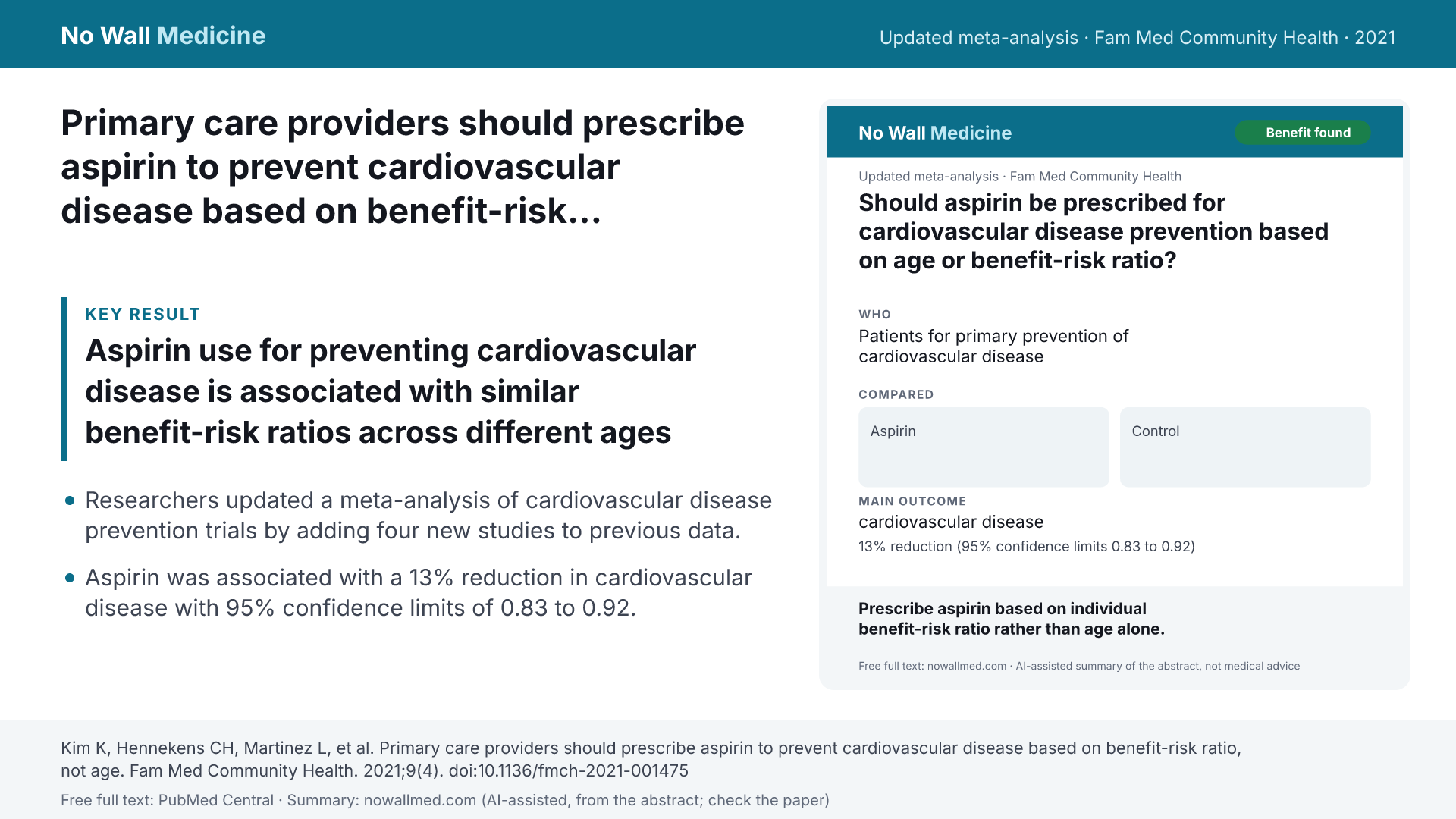
Primary care providers should prescribe aspirin to prevent cardiovascular disease based on benefit-risk ratio, not age
Key result: Aspirin use for preventing cardiovascular disease is associated with similar benefit-risk ratios across different ages
Updated meta-analysisBenefit found
Should aspirin be prescribed for cardiovascular disease prevention based on age or benefit-risk ratio?
Who
Patients for primary prevention of cardiovascular disease
Compared
Aspirin
Control
Main outcome
cardiovascular disease
Result: 13% reduction (95% confidence limits 0.83 to 0.92)
Bottom line: Prescribe aspirin based on individual benefit-risk ratio rather than age alone.
Fam Med Community Health · 2021-12-25
Key points
- Researchers updated a meta-analysis of cardiovascular disease prevention trials by adding four new studies to previous data.
- Aspirin was associated with a 13% reduction in cardiovascular disease with 95% confidence limits of 0.83 to 0.92.
- The benefits of aspirin were found to be similar at older ages in each of the trials studied.
Why it matters: Current guidelines restrict aspirin use for preventing cardiovascular disease to patients under 70 or 60 years old.
Discussion prompts
- Would these patients look like yours? Who was left out?
- Is the main outcome one that matters to patients?
- Is the difference large enough to change what you do?
Cite: Kim K, Hennekens CH, Martinez L, et al. Primary care providers should prescribe aspirin to prevent cardiovascular disease based on benefit-risk ratio, not age. Fam Med Community Health. 2021;9(4). doi:10.1136/fmch-2021-001475
Free full text: PubMed Central · Summary and visual abstract: nowallmed.com/a/primary-care-providers-should-prescribe-aspirin-to-prevent-79ba2y/ (AI-assisted from the abstract; check the paper before relying on it).