Nursing roles in primary healthcare models for refugees involve clinical, administrative, and coordinating tasks
Primary healthcare models for refugees involving nurses: a systematic review and narrative synthesis
Systematic review and narrative synthesisUnclear result
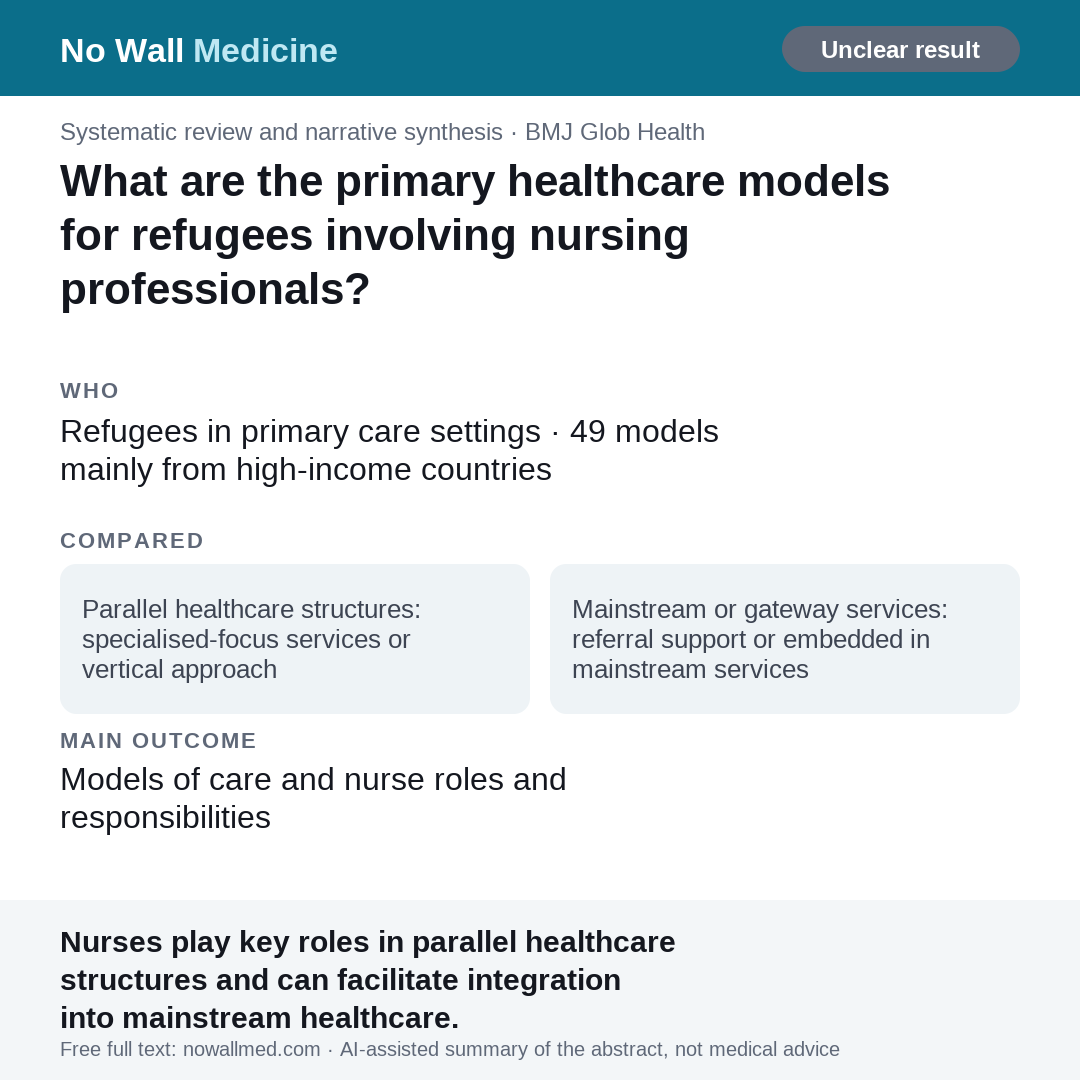
What are the primary healthcare models for refugees involving nursing professionals?
Who
Refugees in primary care settings · 49 models mainly from high-income countries
Compared
Parallel healthcare structures: specialised-focus services or vertical approach
Mainstream or gateway services: referral support or embedded in mainstream services
Main outcome
Models of care and nurse roles and responsibilities
Bottom line: Nurses play key roles in parallel healthcare structures and can facilitate integration into mainstream healthcare.
Limitation: Future research is needed into the long-term impact of existing models.
BMJ Glob Health · 2025-03-22Download image
Clinical question: What are the primary healthcare models for refugees involving nursing professionals?
Why it matters: The specific roles and responsibilities of nurses within primary healthcare models for refugees were previously not well known.
Key points
- Researchers reviewed 120 publications to identify models of care for refugees that involve nursing professionals in primary healthcare settings.
- Of the publications, 67 (56%) provided insights into 49 models of care, which were mainly located in high-income countries.
- Nurses in these models typically have a high degree of autonomy while performing clinical, administrative, educational, and coordinating responsibilities.
Headline and key points written with AI from the paper’s abstract, with every number checked against it. Read the paper before relying on them.
Abstract
Introduction
Primary healthcare (PHC) is key to addressing the health and social needs of refugees. Nurses are often part of multidisciplinary teams in PHC, but little is known about their roles and responsibilities in refugee healthcare. We aimed to synthesise the existing knowledge about models of care (MoC) for refugees in primary care settings which involve nursing professionals. Methods
Systematic review, searching PubMed, CINAHL and Web of Science for scientific literature, as well as Google Search and Scholar, Microsoft Bing and DuckDuckGo for grey literature. We included publications that reported MoC for refugees in primary care which involve nursing professionals. Following a relevancy rating, we extracted information about structural components (setting, target population, available services, funding and workforce composition), and inductively coded the roles and responsibilities of nurses within these models. Data were synthesised using qualitative and narrative synthesis. Results
We included 120 publications in the review. Of these, 67 (56%) provided in-depth insights into MoC and nurse involvement and were included for narrative synthesis, yielding 49 MoC mainly from high-income countries. Most MoCs identified to set up parallel healthcare structures (specialised-focus services) that refugees can access for a limited period of time or targeting specific conditions in a vertical approach. However, some of the MoCs we studied focus on referral support as gateway services or are embedded in mainstream services. Nurses in these models typically experience a high degree of autonomy within defined responsibilities, encompassing clinical, administrative, educational and coordinating tasks. Conclusions
Nurses take on key roles in parallel healthcare structures for refugees, and specially trained nurses are well positioned to facilitate the integration of refugees into mainstream healthcare. Future research into the long-term impact of existing models, identifying best practices and defining competency requirements for healthcare workers/nurses in refugee care may foster evidence-based policy and practice improvements. Prospero registration number
CRD42020221045.
Abstract reproduced under the article’s CC BY NC licence.
Topics
Cite this article
Gold AW, Perplies C, Biddle L, Bozorgmehr K. Primary healthcare models for refugees involving nurses: a systematic review and narrative synthesis. BMJ Glob Health. 2025. doi:10.1136/bmjgh-2024-018105
Spotted a mistake? Suggest a correction
Top studies every Monday
The week’s key trials and guidelines in your specialties, plus any topics you follow. By email, free.
Get the weekly digest