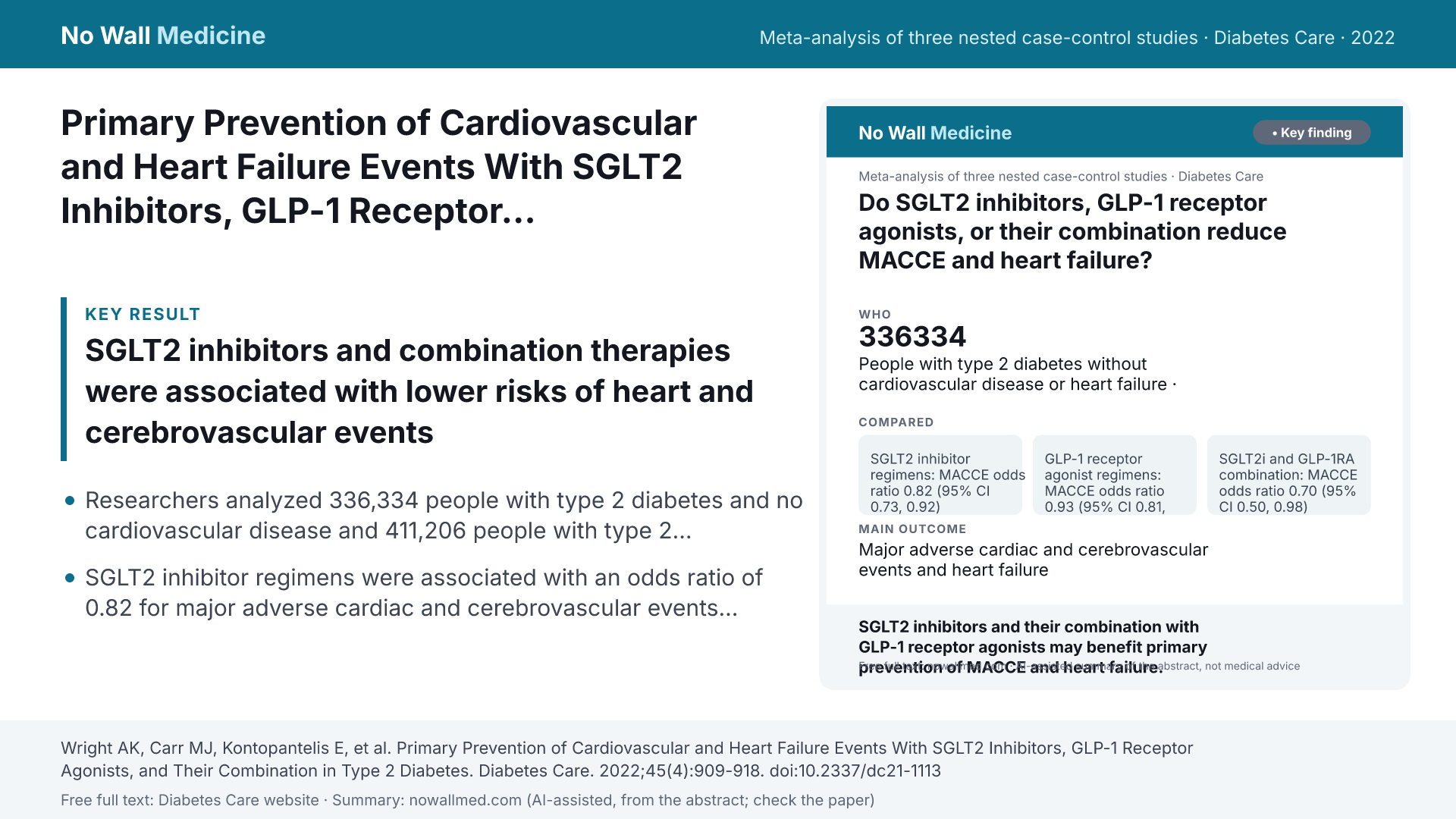
SGLT2 inhibitors and combination therapies were associated with lower risks of heart and cerebrovascular events
Primary Prevention of Cardiovascular and Heart Failure Events With SGLT2 Inhibitors, GLP-1 Receptor Agonists, and Their Combination in Type 2 Diabetes
Meta-analysis of three nested case-control studiesBenefit found
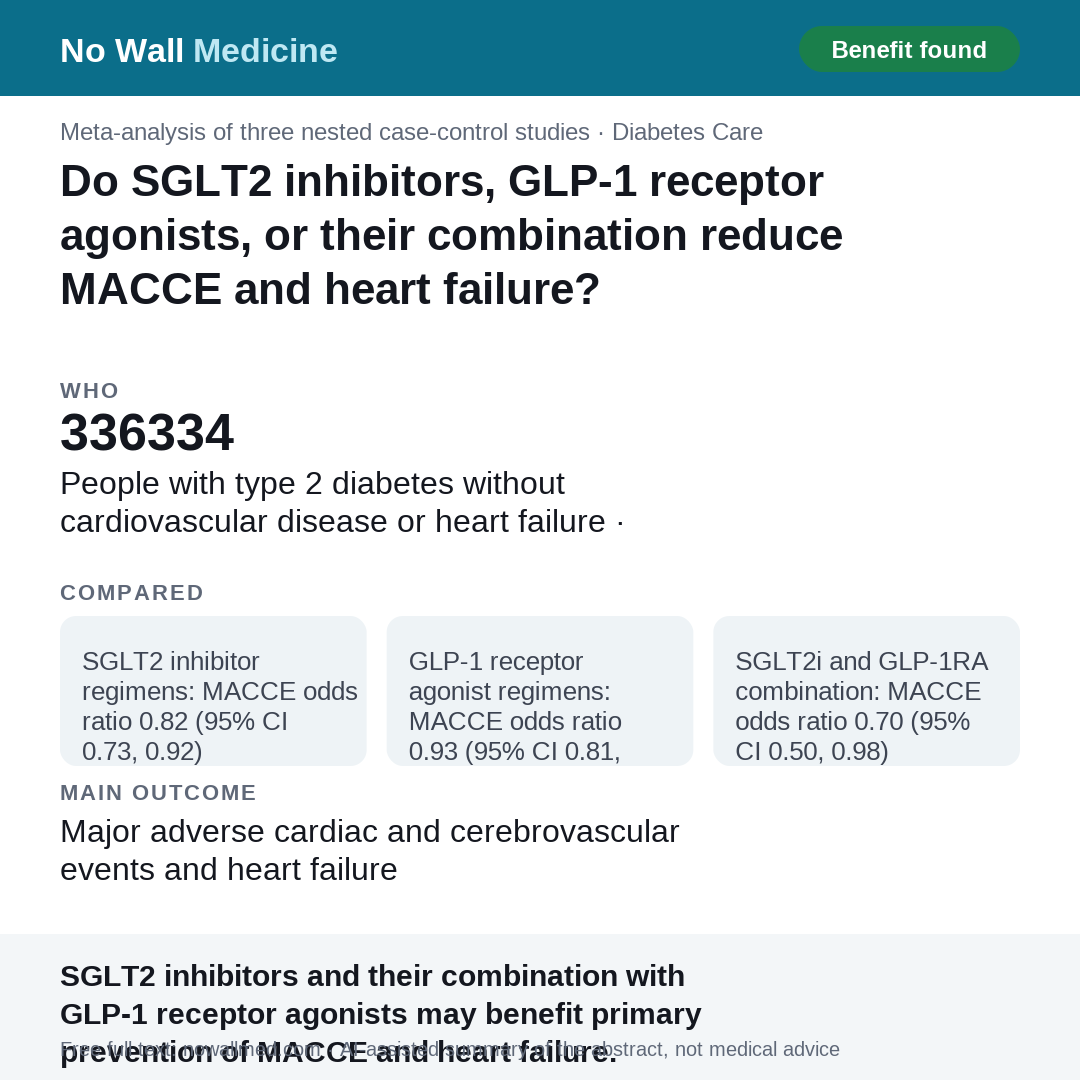
Do SGLT2 inhibitors, GLP-1 receptor agonists, or their combination reduce MACCE and heart failure?
Who
336334
People with type 2 diabetes without cardiovascular disease or heart failure · England and Wales
Compared
SGLT2 inhibitor regimens: MACCE odds ratio 0.82 (95% CI 0.73, 0.92)
GLP-1 receptor agonist regimens: MACCE odds ratio 0.93 (95% CI 0.81, 1.06)
SGLT2i and GLP-1RA combination: MACCE odds ratio 0.70 (95% CI 0.50, 0.98)
Main outcome
Major adverse cardiac and cerebrovascular events and heart failure
Result: MACCE SGLT2i 0.82 (95% CI 0.73, 0.92), GLP-1RA 0.93 (0.81, 1.06), combination 0.70 (0.50, 0.98)
Bottom line: SGLT2 inhibitors and their combination with GLP-1 receptor agonists may benefit primary prevention of MACCE and heart failure.
Diabetes Care · 2022-02-01Download image
Clinical question: Do SGLT2 inhibitors, GLP-1 receptor agonists, or their combination reduce MACCE and heart failure?
Why it matters: It was unknown if SGLT2 inhibitors, GLP-1 receptor agonists, or their combination could be used for the primary prevention of heart and cerebrovascular events in people with type 2 diabetes.
Key points
- Researchers analyzed 336,334 people with type 2 diabetes and no cardiovascular disease and 411,206 people with type 2 diabetes and no heart failure.
- SGLT2 inhibitor regimens were associated with an odds ratio of 0.82 for major adverse cardiac and cerebrovascular events and 0.49 for heart failure.
- The combination of SGLT2 inhibitors and GLP-1 receptor agonists was associated with an odds ratio of 0.70 for major adverse cardiac and cerebrovascular events and 0.43 for heart failure.
Headline and key points written with AI from the paper’s abstract, with every number checked against it. Read the paper before relying on them.
Was this summary helpful?
Subject terms
Cite this article
Wright AK, Carr MJ, Kontopantelis E, et al. Primary Prevention of Cardiovascular and Heart Failure Events With SGLT2 Inhibitors, GLP-1 Receptor Agonists, and Their Combination in Type 2 Diabetes. Diabetes Care. 2022. doi:10.2337/dc21-1113
Spotted a mistake? Suggest a correction