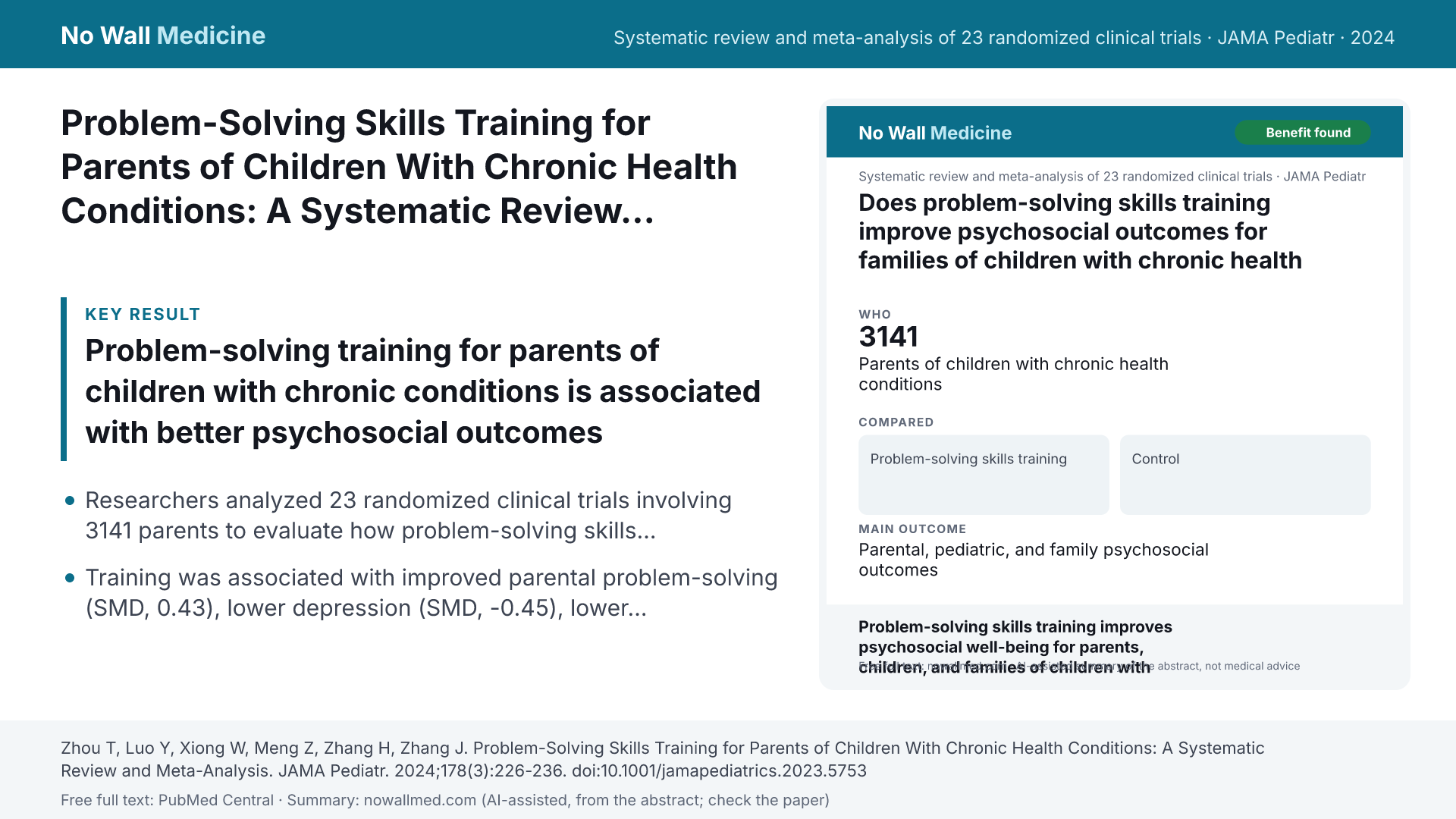
Problem-solving training for parents of children with chronic conditions is associated with better psychosocial outcomes
Problem-Solving Skills Training for Parents of Children With Chronic Health Conditions: A Systematic Review and Meta-Analysis
Systematic review and meta-analysis of 23 randomized clinical trialsBenefit found
Does problem-solving skills training improve psychosocial outcomes for families of children with chronic health conditions?
Who
3141
Parents of children with chronic health conditions
Compared
Problem-solving skills training
Control
Main outcome
Parental, pediatric, and family psychosocial outcomes
Result: not explicitly provided as a single pooled effect for all outcomes
Bottom line: Problem-solving skills training improves psychosocial well-being for parents, children, and families of children with chronic health conditions.
JAMA Pediatr · 2024-01-02Download image
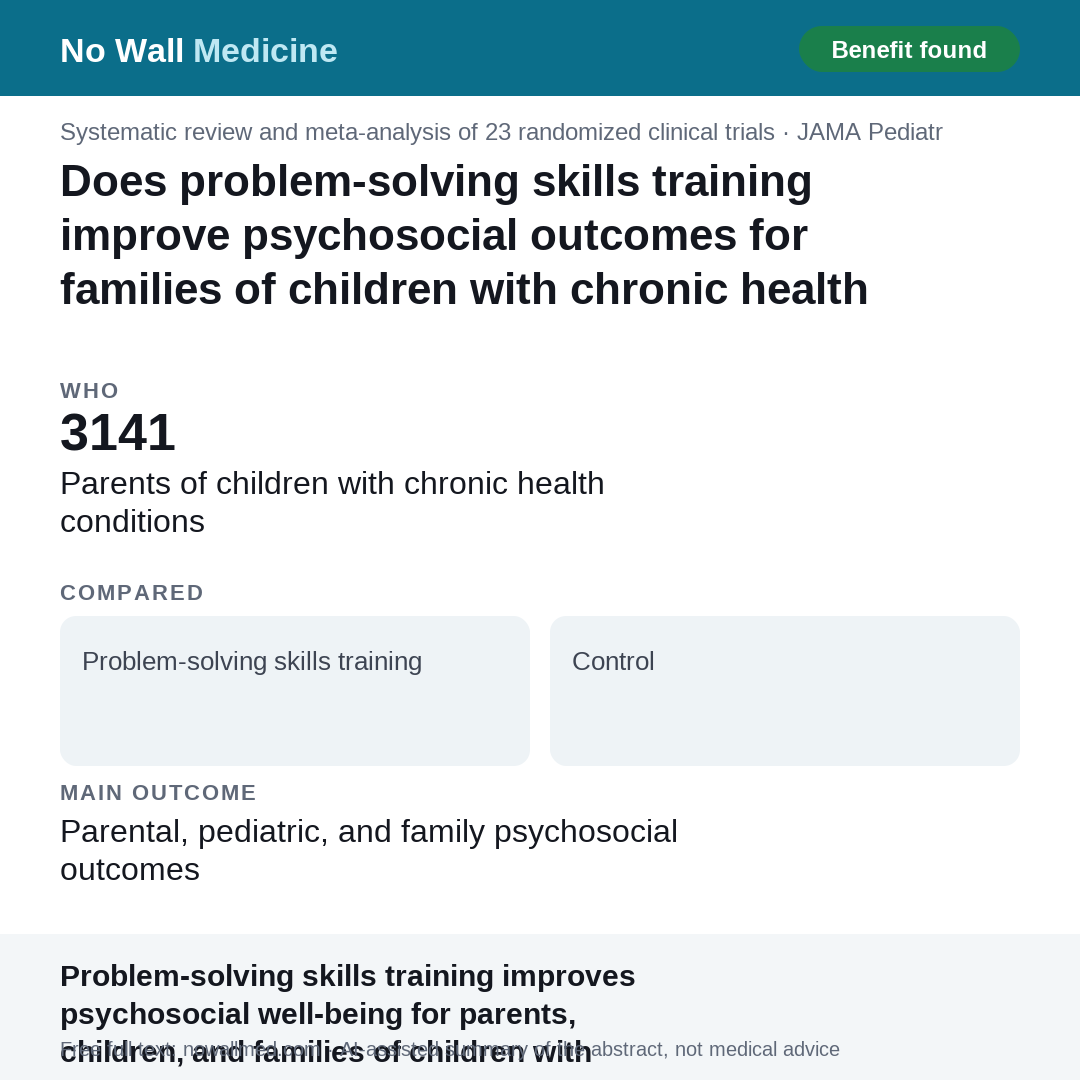
Clinical question: Does problem-solving skills training improve psychosocial outcomes for families of children with chronic health conditions?
Why it matters: The potential of problem-solving skills training to improve psychosocial well-being for parents of children with chronic health conditions had not been fully systematically synthesized.
Key points
- Researchers analyzed 23 randomized clinical trials involving 3141 parents to evaluate how problem-solving skills training affects parents, children, and families.
- Training was associated with improved parental problem-solving (SMD, 0.43), lower depression (SMD, -0.45), lower distress (SMD, -0.61), and higher quality of life (SMD, 0.45).
- For children, the training was associated with better quality of life (SMD, 0.76), fewer mental problems (SMD, -0.51), and less parent-child conflict (SMD, -0.38).
Headline and key points written with AI from the paper’s abstract, with every number checked against it. Read the paper before relying on them.
Was this summary helpful?
Subject terms
Cite this article
Zhou T, Luo Y, Xiong W, Meng Z, Zhang H, Zhang J. Problem-Solving Skills Training for Parents of Children With Chronic Health Conditions: A Systematic Review and Meta-Analysis. JAMA Pediatr. 2024. doi:10.1001/jamapediatrics.2023.5753
Spotted a mistake? Suggest a correction