Problem-solving therapy-induced amygdala engagement mediates lifestyle behavior change in obesity with comorbid depression: a randomized proof-of-mechanism trial
Key result: Problem-solving therapy for depression was linked to changes in brain activity and physical activity
Randomized proof-of-mechanism trialBenefit found
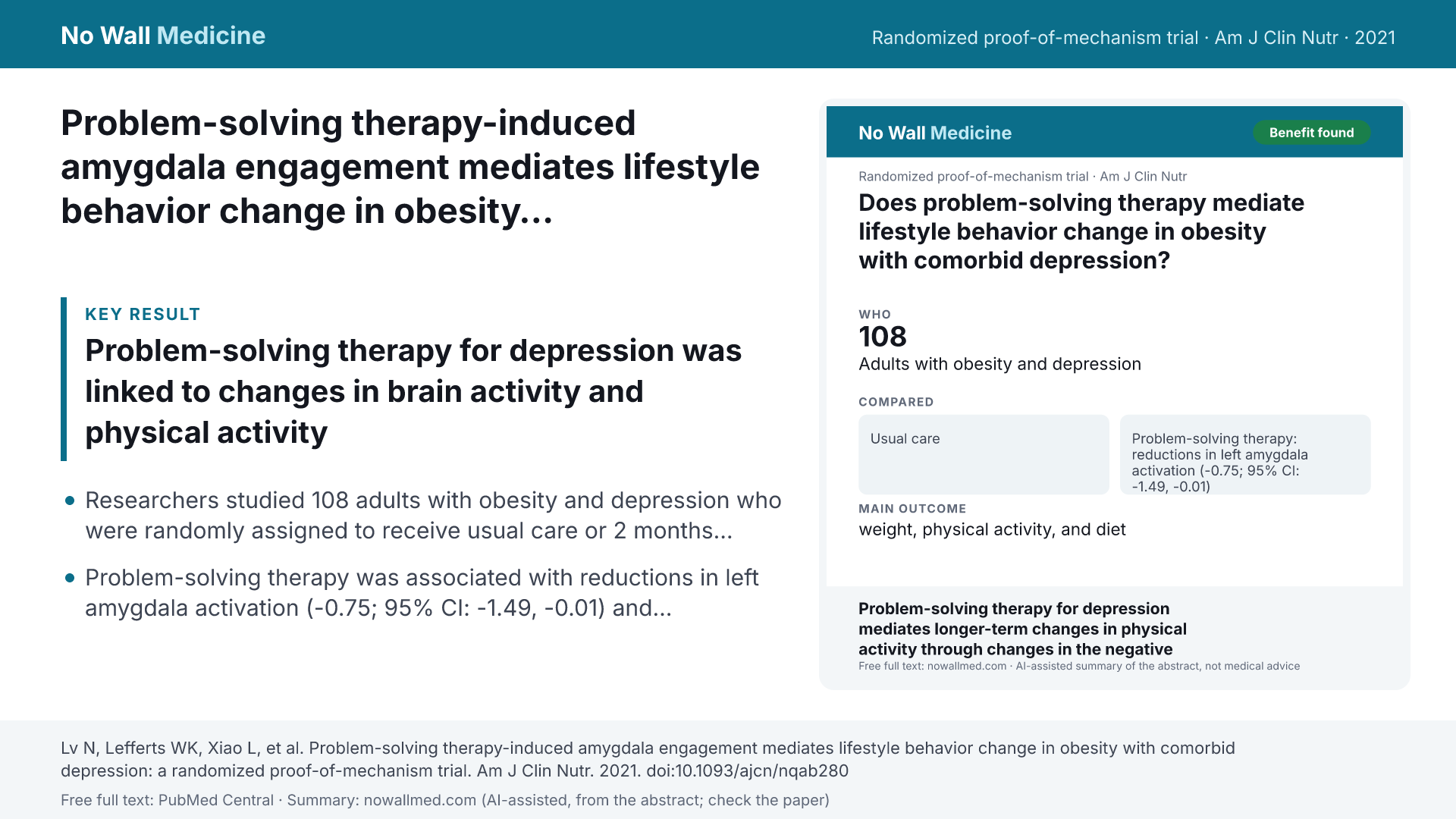
Does problem-solving therapy mediate lifestyle behavior change in obesity with comorbid depression?
Who
108
Adults with obesity and depression
Compared
Usual care
Problem-solving therapy: reductions in left amygdala activation (-0.75; 95% CI: -1.49, -0.01)
Main outcome
weight, physical activity, and diet
Bottom line: Problem-solving therapy for depression mediates longer-term changes in physical activity through changes in the negative affect circuit.
Am J Clin Nutr · 2021-09-04Download image

Key points
- Researchers studied 108 adults with obesity and depression who were randomly assigned to receive usual care or 2 months of problem-solving therapy.
- Problem-solving therapy was associated with reductions in left amygdala activation (-0.75; 95% CI: -1.49, -0.01) and global negative affect circuit scores (-0.43; -0.81, -0.06).
- Changes in these brain circuits were linked to changes in physical activity at 12 months, but results were null for body mass index and diet.
Discussion prompts
- Would these patients look like yours? Who was left out?
- Is the main outcome one that matters to patients?
- Is the difference large enough to change what you do?
Cite: Lv N, Lefferts WK, Xiao L, et al. Problem-solving therapy-induced amygdala engagement mediates lifestyle behavior change in obesity with comorbid depression: a randomized proof-of-mechanism trial. Am J Clin Nutr. 2021. doi:10.1093/ajcn/nqab280
Free full text: PubMed Central · Summary and visual abstract: nowallmed.com/a/problem-solving-therapy-induced-amygdala-engagement-mediates-13a4gx/ (AI-assisted from the abstract; check the paper before relying on it).