Problem-solving therapy for depression was linked to changes in brain activity and physical activity
Problem-solving therapy-induced amygdala engagement mediates lifestyle behavior change in obesity with comorbid depression: a randomized proof-of-mechanism trial
Randomized proof-of-mechanism trialBenefit found
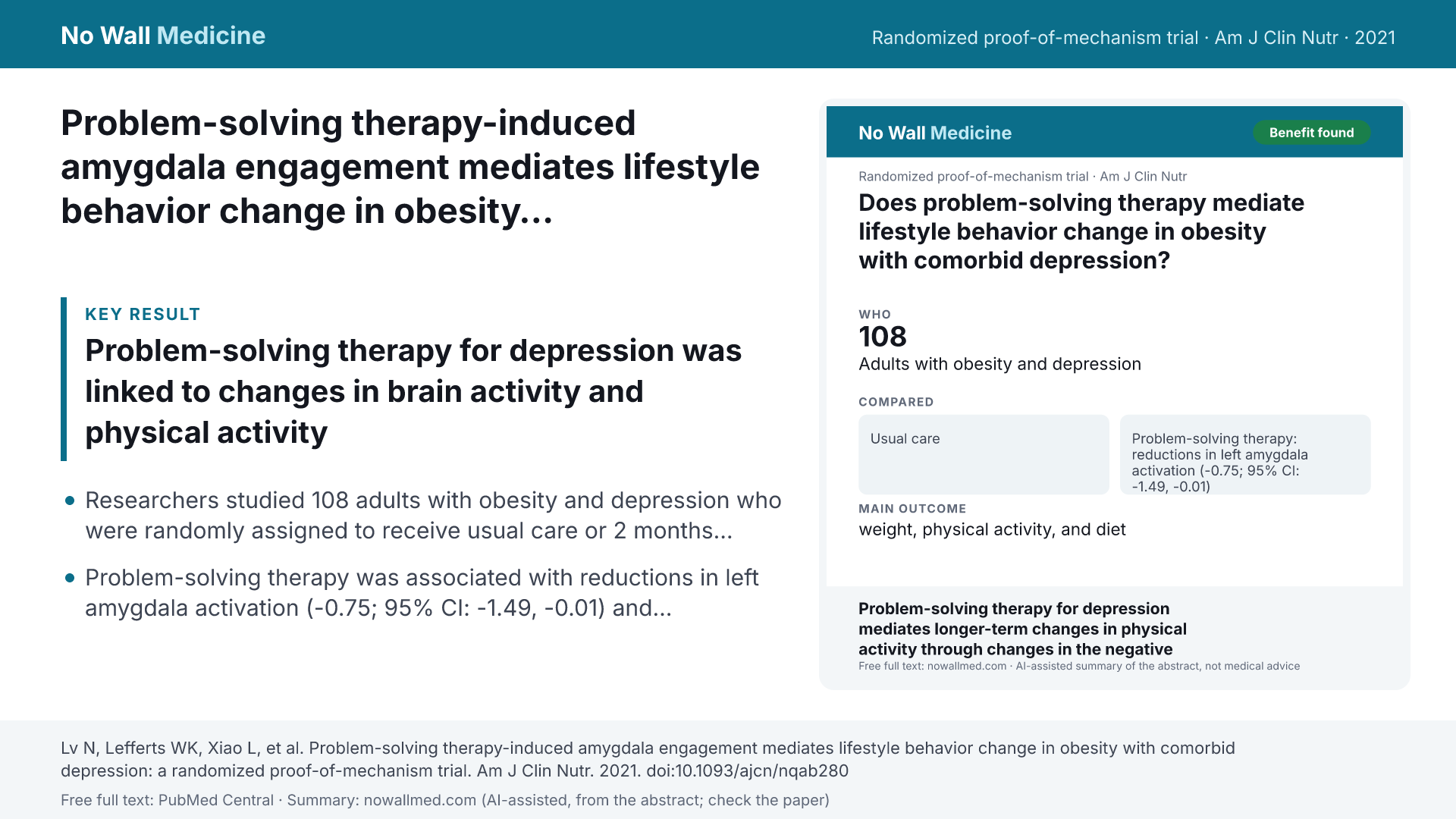
Does problem-solving therapy mediate lifestyle behavior change in obesity with comorbid depression?
Who
108
Adults with obesity and depression
Compared
Usual care
Problem-solving therapy: reductions in left amygdala activation (-0.75; 95% CI: -1.49, -0.01)
Main outcome
weight, physical activity, and diet
Bottom line: Problem-solving therapy for depression mediates longer-term changes in physical activity through changes in the negative affect circuit.
Am J Clin Nutr · 2021-09-04Download image

Clinical question: Does problem-solving therapy mediate lifestyle behavior change in obesity with comorbid depression?
Key points
- Researchers studied 108 adults with obesity and depression who were randomly assigned to receive usual care or 2 months of problem-solving therapy.
- Problem-solving therapy was associated with reductions in left amygdala activation (-0.75; 95% CI: -1.49, -0.01) and global negative affect circuit scores (-0.43; -0.81, -0.06).
- Changes in these brain circuits were linked to changes in physical activity at 12 months, but results were null for body mass index and diet.
Headline and key points written with AI from the paper’s abstract, with every number checked against it. Read the paper before relying on them.
Was this summary helpful?
Subject terms
Cite this article
Lv N, Lefferts WK, Xiao L, et al. Problem-solving therapy-induced amygdala engagement mediates lifestyle behavior change in obesity with comorbid depression: a randomized proof-of-mechanism trial. Am J Clin Nutr. 2021. doi:10.1093/ajcn/nqab280
Spotted a mistake? Suggest a correction