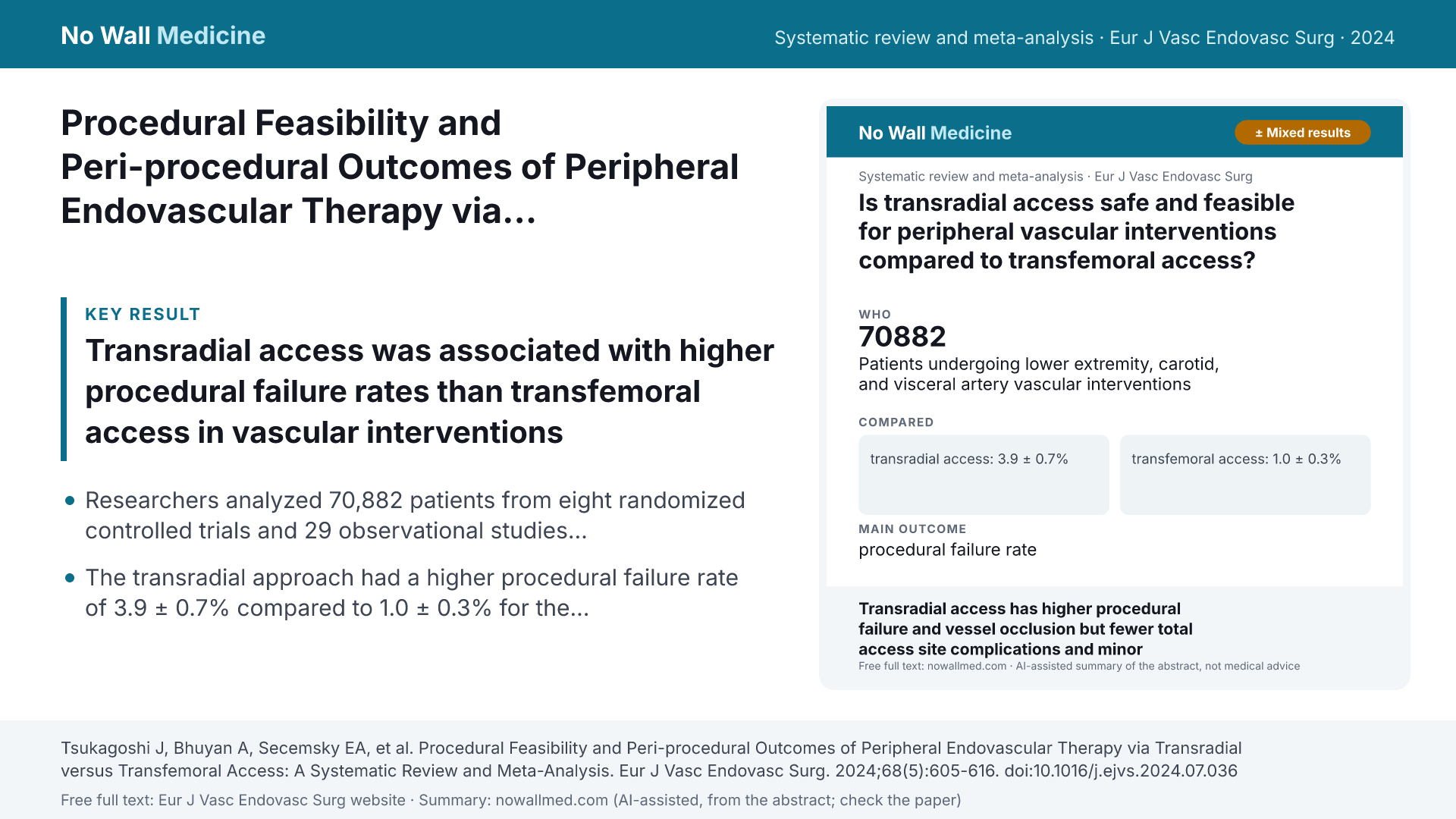
Procedural Feasibility and Peri-procedural Outcomes of Peripheral Endovascular Therapy via Transradial versus Transfemoral Access: A Systematic Review and Meta-Analysis
Key result: Transradial access was associated with higher procedural failure rates than transfemoral access in vascular interventions
Key points
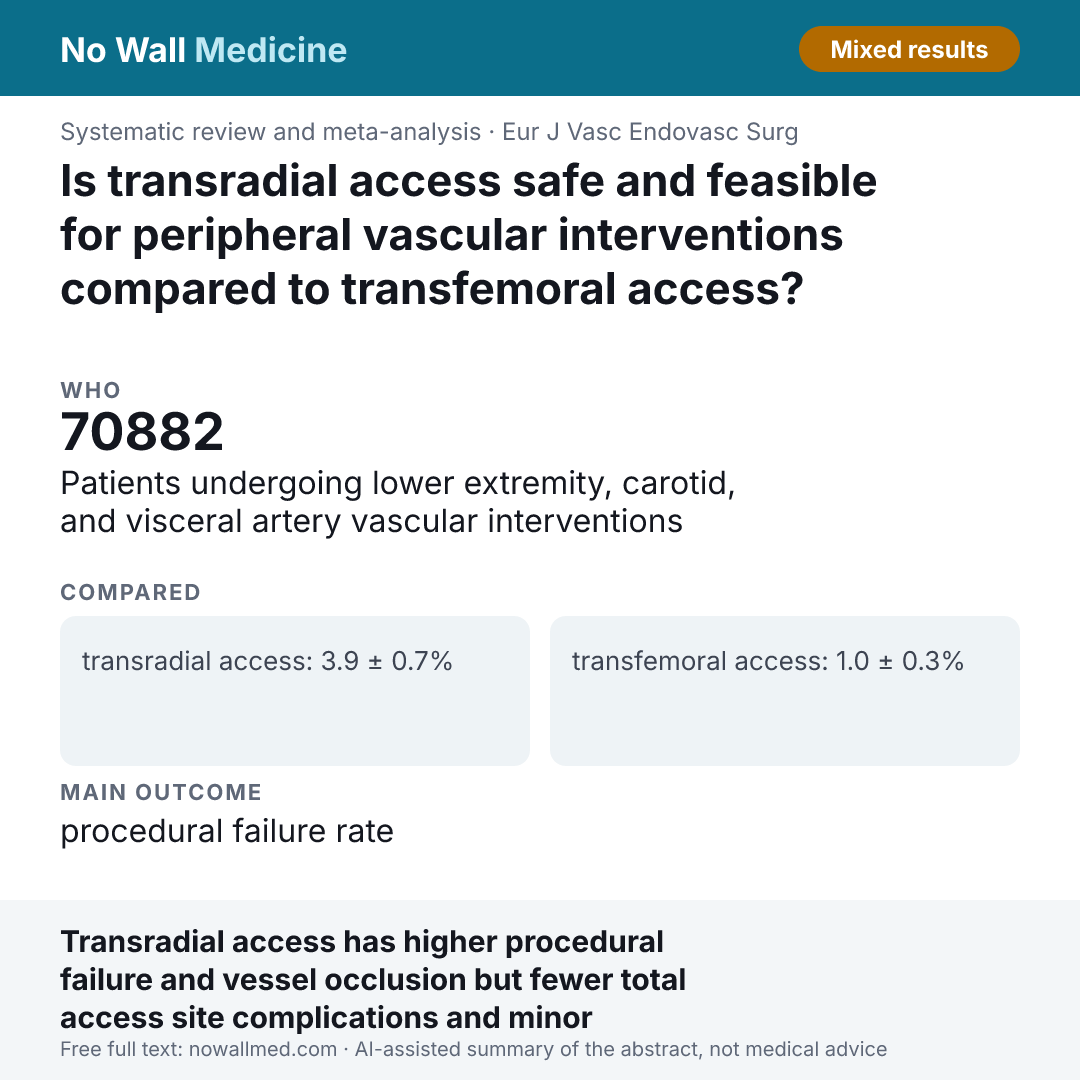
- Researchers analyzed 70,882 patients from eight randomized controlled trials and 29 observational studies comparing wrist-based access to groin-based access for vascular procedures.
- The transradial approach had a higher procedural failure rate of 3.9 ± 0.7% compared to 1.0 ± 0.3% for the transfemoral approach.
- Transradial access was associated with fewer total access site complications and less minor bleeding, but more frequent access vessel occlusion at 1.9% ± 0.5%.
Limitation the authors note: The GRADE certainty was low to moderate in most outcomes.
Discussion prompts
- Would these patients look like yours? Who was left out?
- Is the main outcome one that matters to patients?
- Is the difference large enough to change what you do?
Cite: Tsukagoshi J, Bhuyan A, Secemsky EA, et al. Procedural Feasibility and Peri-procedural Outcomes of Peripheral Endovascular Therapy via Transradial versus Transfemoral Access: A Systematic Review and Meta-Analysis. Eur J Vasc Endovasc Surg. 2024;68(5):605-616. doi:10.1016/j.ejvs.2024.07.036
Free full text: Eur J Vasc Endovasc Surg website · Summary and visual abstract: nowallmed.com/a/procedural-feasibility-and-peri-procedural-outcomes-of-peripheral-148ad6r/ (AI-assisted from the abstract; check the paper before relying on it).