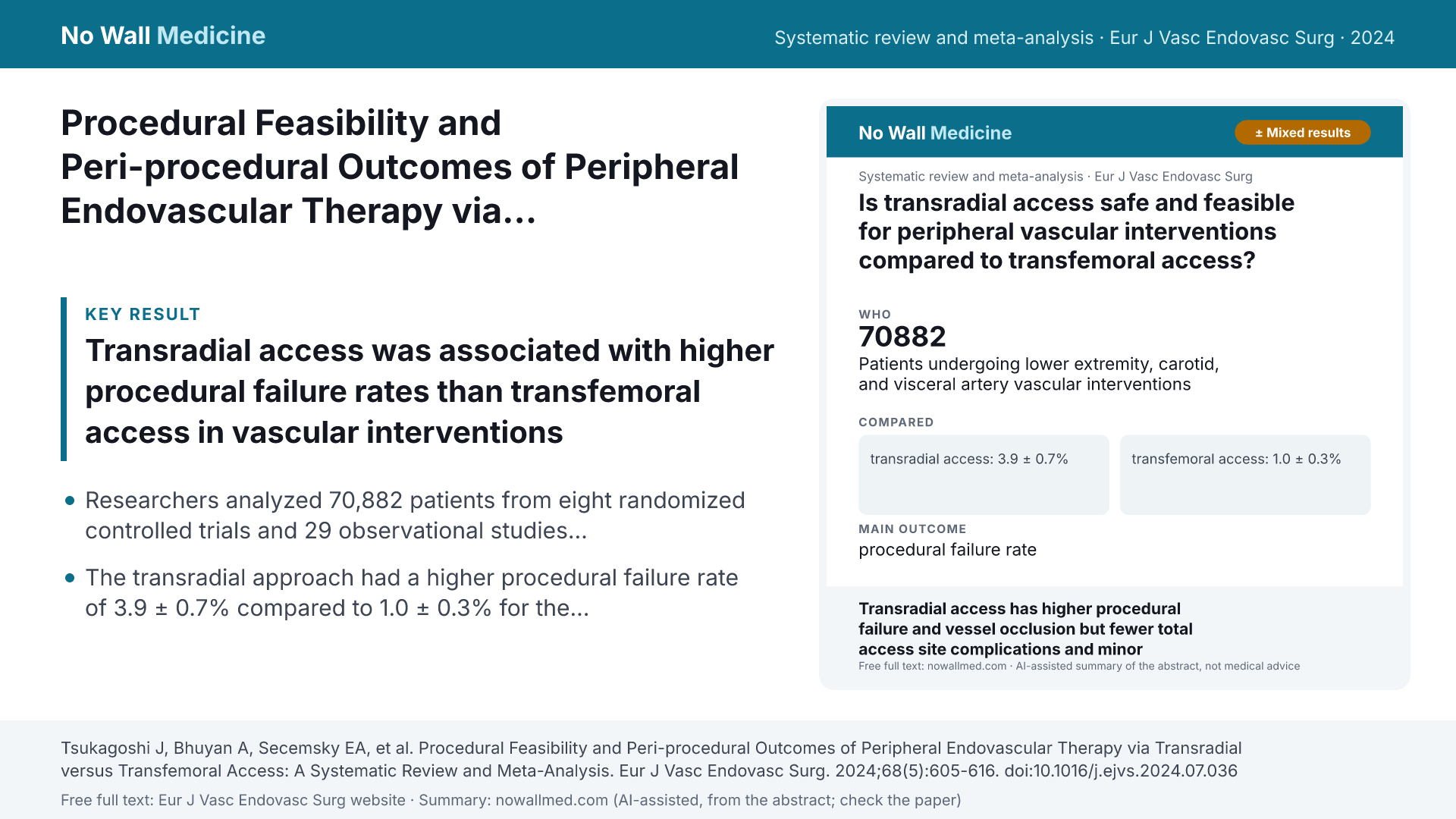
Transradial access was associated with higher procedural failure rates than transfemoral access in vascular interventions
Procedural Feasibility and Peri-procedural Outcomes of Peripheral Endovascular Therapy via Transradial versus Transfemoral Access: A Systematic Review and Meta-Analysis
Systematic review and meta-analysisMixed results
Is transradial access safe and feasible for peripheral vascular interventions compared to transfemoral access?
Who
70882
Patients undergoing lower extremity, carotid, and visceral artery vascular interventions
Compared
transradial access: 3.9 ± 0.7%
transfemoral access: 1.0 ± 0.3%
Main outcome
procedural failure rate
Result: odds ratio 3.07 (95% CI 1.84 - 5.12)
Bottom line: Transradial access has higher procedural failure and vessel occlusion but fewer total access site complications and minor bleeding.
Limitation: GRADE certainty was low to moderate in most outcomes.
Eur J Vasc Endovasc Surg · 2024-08-05Download image
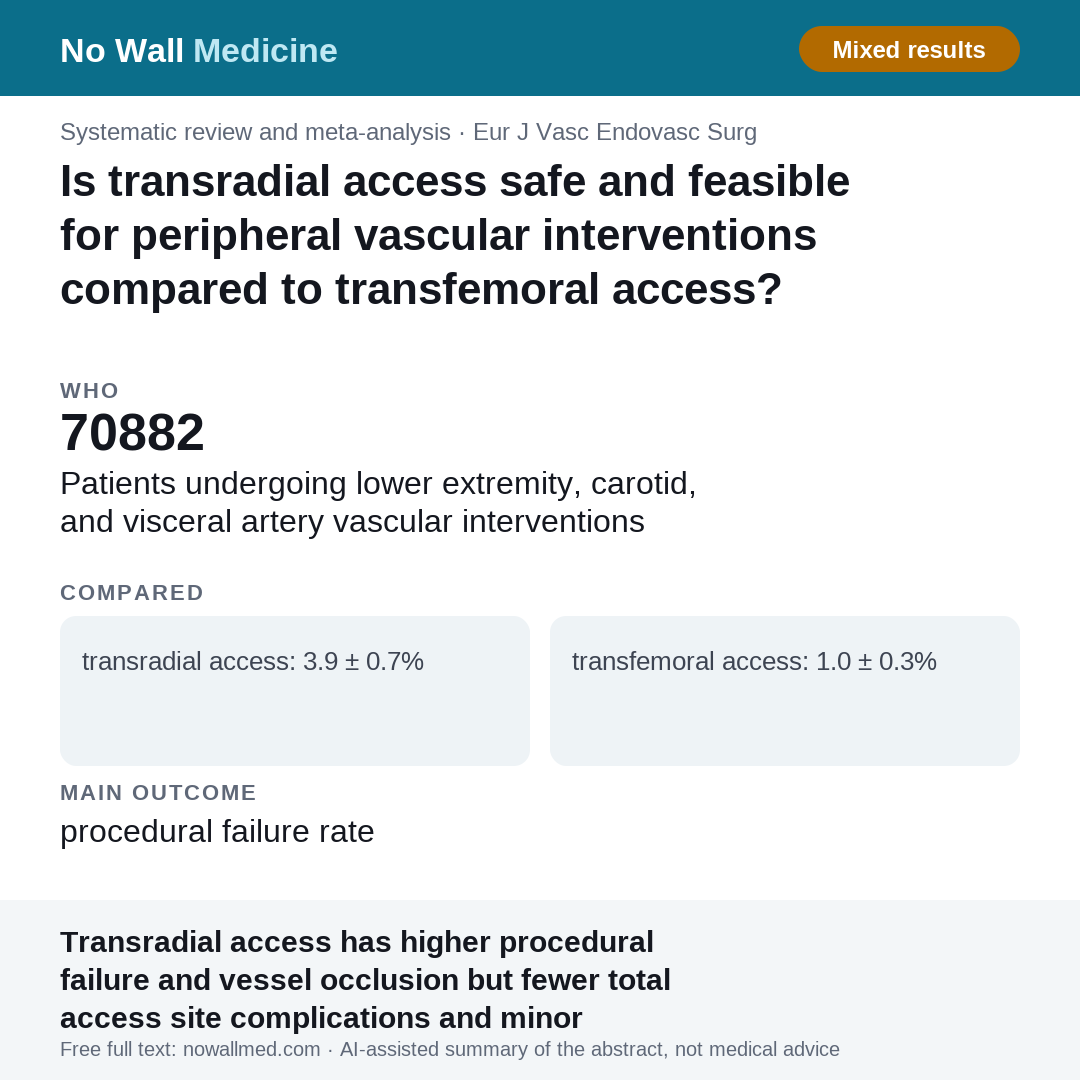
Clinical question: Is transradial access safe and feasible for peripheral vascular interventions compared to transfemoral access?
Why it matters: It is unknown if using the radial artery in the wrist is as safe or effective as using the femoral artery in the groin for peripheral vascular interventions.
Key points
- Researchers analyzed 70,882 patients from eight randomized controlled trials and 29 observational studies comparing wrist-based access to groin-based access for vascular procedures.
- The transradial approach had a higher procedural failure rate of 3.9 ± 0.7% compared to 1.0 ± 0.3% for the transfemoral approach.
- Transradial access was associated with fewer total access site complications and less minor bleeding, but more frequent access vessel occlusion at 1.9% ± 0.5%.
Limitation the authors note: The GRADE certainty was low to moderate in most outcomes.
Headline and key points written with AI from the paper’s abstract, with every number checked against it. Read the paper before relying on them.
Was this summary helpful?
Subject terms
Cite this article
Tsukagoshi J, Bhuyan A, Secemsky EA, Shirasu T, Nakama T, Jujo K. Procedural Feasibility and Peri-procedural Outcomes of Peripheral Endovascular Therapy via Transradial versus Transfemoral Access: A Systematic Review and Meta-Analysis. Eur J Vasc Endovasc Surg. 2024. doi:10.1016/j.ejvs.2024.07.036
Spotted a mistake? Suggest a correction
Top studies every Monday
The week’s key trials and guidelines in your specialties, plus any topics you follow. By email, free.
Get the weekly digest