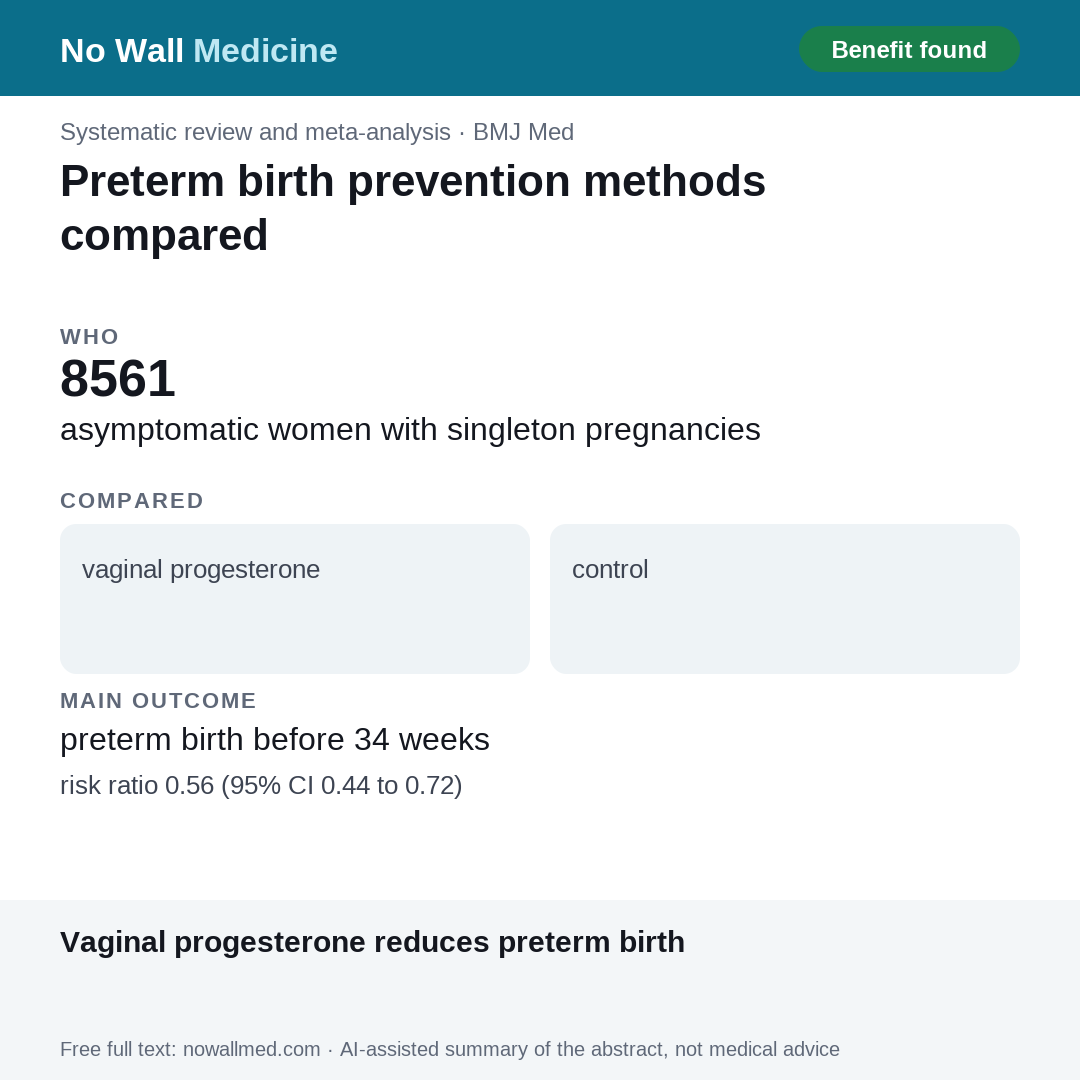
Vaginal progesterone reduces preterm birth before 34 weeks gestation
Progestogens, cervical cerclage, and cervical pessary for preventing preterm birth in asymptomatic singleton pregnancies with a sonographic short cervix and no previous history of spontaneous preterm birth: systematic review and bayesian network meta-analysis
Wu H, Yu L, Zhang J, Goya M, Otsuki K, Cruz-Melguizo S, et al
Objective
To compare the efficacy of different interventions to prevent preterm birth in asymptomatic singleton pregnancies with a sonographic short cervix and no previous history of spontaneous preterm birth. Design
Systematic review and bayesian network meta-analysis. Data sources
Ovid Medline, Cochrane Library, Embase, ClinicalTrials.gov, Google Scholar, and Chinese databases, from inception to 13 March 2025, updated 3 February 2026. Eligibility criteria for selecting studies
Randomised controlled trials comparing two or more active interventions or comparing an active intervention with a control (placebo, expectant management, or usual care) to prevent preterm birth in asymptomatic women with singleton pregnancies and a sonographic short cervix, but no previous history of spontaneous preterm birth. Results
The primary outcomes were preterm birth before 34 and 37 weeks' gestation. 26 randomised controlled trials (8561 women) were identified, with 6004 participants included in the network meta-analysis. In direct pairwise comparisons, vaginal progesterone monotherapy was supported by high certainty evidence as a highly effective intervention for reducing preterm birth before 34 weeks' gestation (risk ratio 0.56, 95% confidence interval (CI) 0.44 to 0.72). In the network meta-analysis for preterm birth before 34 weeks' gestation (24 randomised controlled trials, 5738 women), vaginal progesterone monotherapy maintained a high efficacy ranking (mean rank 3.3, probability of risk ratio Conclusions
The results showed that vaginal progesterone monotherapy remains the benchmark standard of care for the prevention of preterm birth, uniquely combining high certainty direct evidence, strong efficacy rankings, and excellent maternal safety. Although combination treatments showed high efficacy rankings, their routine clinical adoption should be restricted to research settings given the safety concerns and lower certainty evidence. A cervical pessary might be an alternative to vaginal progesterone in selected populations. Systematic review registration
PROSPERO CRD420251004808.
Abstract reproduced under the article’s CC BY NC licence.
Effect of intrapartum hyoscine butylbromide and sodium bicarbonate on spontaneous vaginal birth in nulliparous women after induction of labour (SAINT): multicentre randomised placebo controlled factorial trial