Mortality prediction models for patients on life support show moderate performance and low quality
Prognostic models for mortality risk in patients requiring ECMO
Systematic literature search and meta-analysisMixed results
How well do mortality prediction models perform for patients requiring extracorporeal membrane oxygenation?
Who
Adults requiring veno-arterial or veno-venous extracorporeal membrane oxygenation
Compared
ECMO specific models: pooled c-statistics between 0.66 and 0.70
General intensive care models: pooled c-statistics varying between 0.66 and 0.69
Main outcome
All-cause mortality prediction performance
Bottom line: Extracorporeal membrane oxygenation mortality models show moderate performance, poor methodological quality, and tend to underestimate mortality.
Limitation: Models were developed after extracorporeal membrane oxygenation initiation, reducing applicability for patient selection.
Intensive Care Med · 2023-01-04Download image
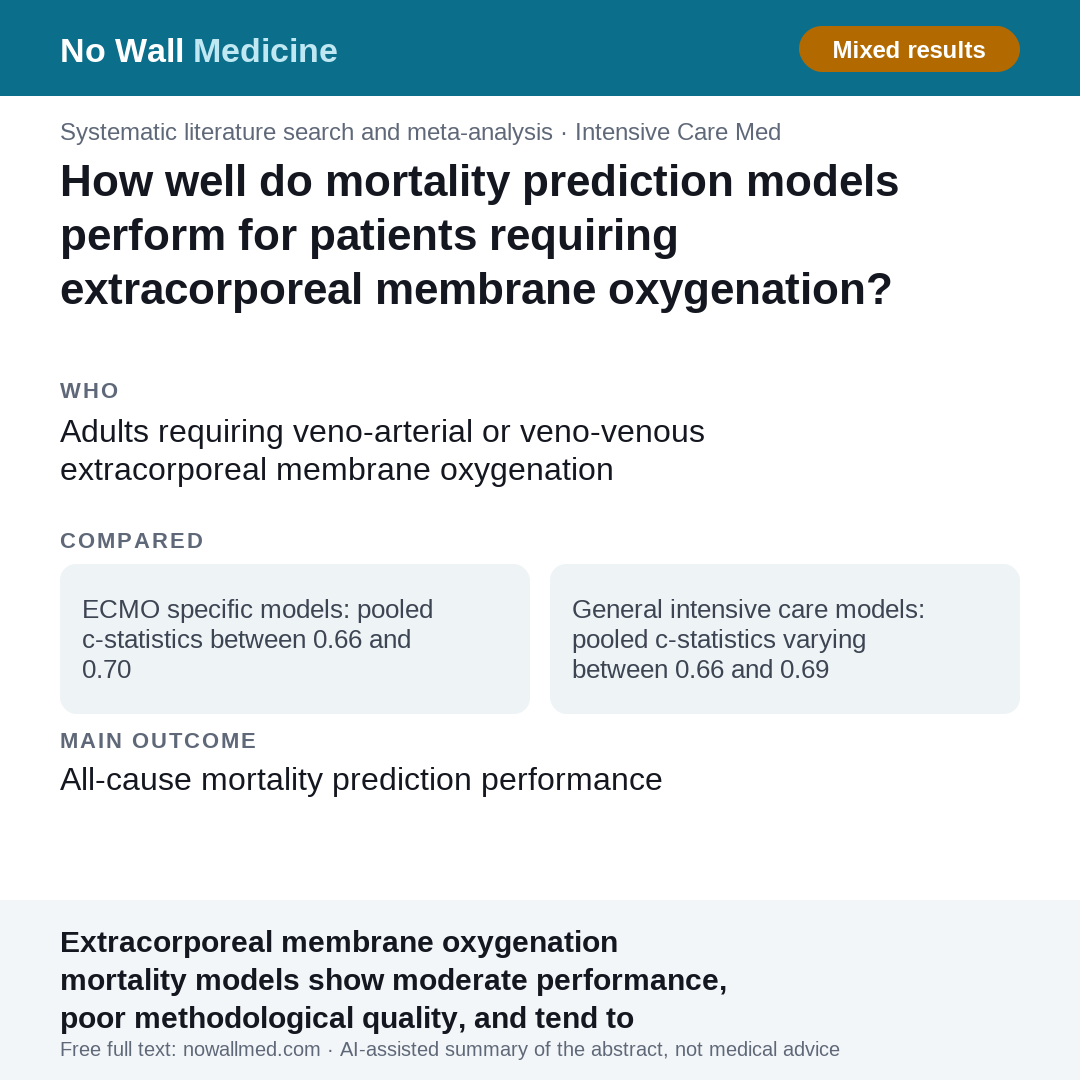
Clinical question: How well do mortality prediction models perform for patients requiring extracorporeal membrane oxygenation?
Why it matters: It is unknown how accurately existing mortality prediction models perform for patients requiring extracorporeal membrane oxygenation and whether they can assist in clinical decision-making.
Key points
- Researchers analyzed 96 studies containing 58 models and 225 external validations for patients requiring extracorporeal membrane oxygenation, a machine that provides respiratory or circulatory support.
- The 58 models developed specifically for these patients had moderate discriminatory ability with pooled c-statistics between 0.66 and 0.70, and nearly all tended to underestimate mortality.
- Only 1 of the 58 models met the criteria for good quality according to the Prediction model Risk Of BiAS Tool.
Limitation the authors note: All predicted outcomes were conditional on the fact that extracorporeal membrane oxygenation support had already been initiated, reducing their applicability for patient selection.
Headline and key points written with AI from the paper’s abstract, with every number checked against it. Read the paper before relying on them.
Was this summary helpful?
Subject terms
Cite this article
Pladet LCA, Barten JMM, Vernooij LM, Kraemer CVE, Bunge JJH, Scholten E. Prognostic models for mortality risk in patients requiring ECMO. Intensive Care Med. 2023. doi:10.1007/s00134-022-06947-z
Spotted a mistake? Suggest a correction
Top studies every Monday
The week’s key trials and guidelines in your specialties, plus any topics you follow. By email, free.
Get the weekly digest