Program of Rehabilitative Exercise and Education to Avert Vascular Events After Non-Disabling Stroke or Transient Ischemic Attack (PREVENT Trial): A Randomized Controlled Trial
Single-blinded, randomized controlled trialBenefit found
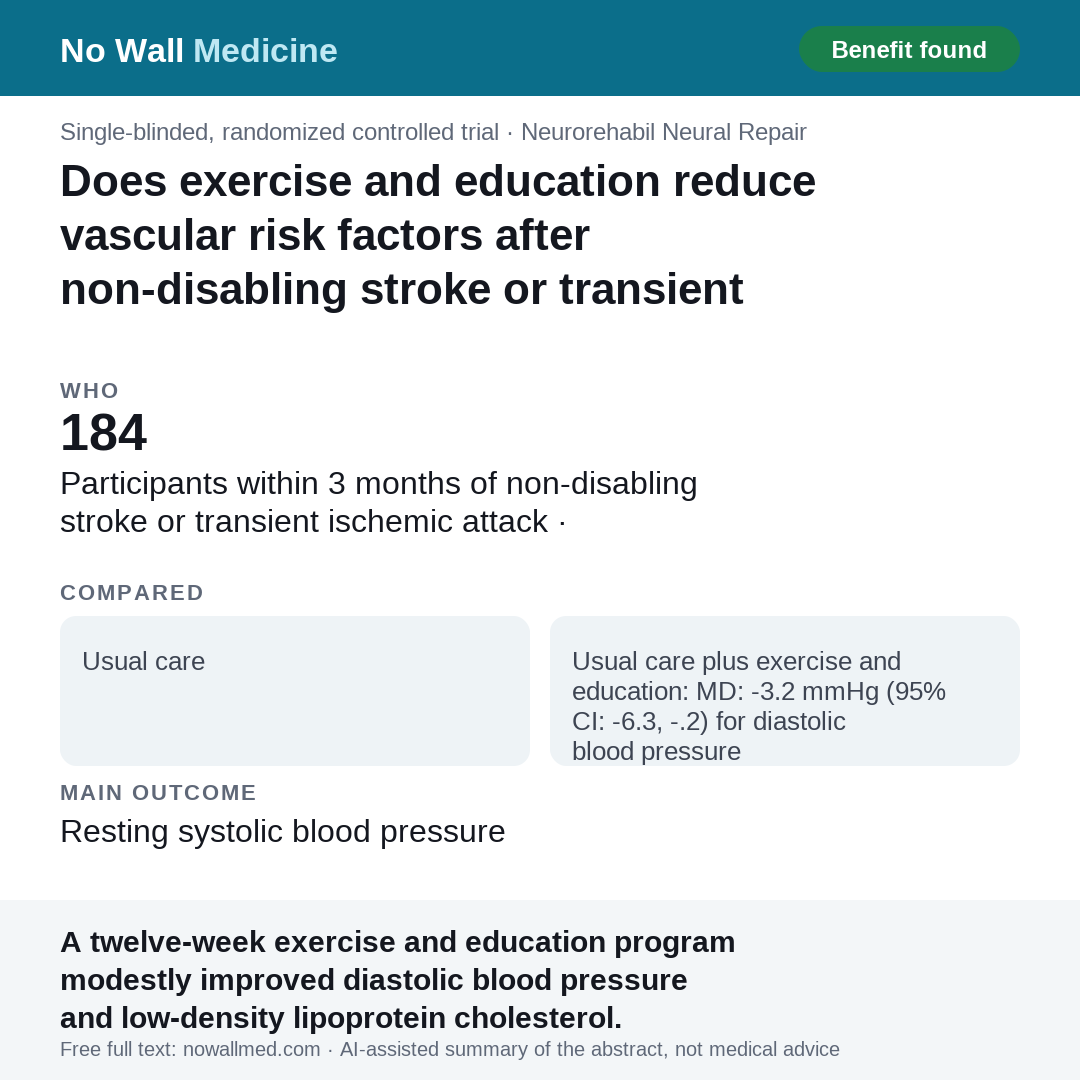
Does exercise and education reduce vascular risk factors after non-disabling stroke or transient ischemic attack?
Who
184
Participants within 3 months of non-disabling stroke or transient ischemic attack · Three-site
Compared
Usual care
Usual care plus exercise and education: MD: -3.2 mmHg (95% CI: -6.3, -.2) for diastolic blood pressure
Main outcome
Resting systolic blood pressure
Result: MD: -3.2 mmHg (95% CI: -6.3, -.2) for diastolic blood pressure
Bottom line: A twelve-week exercise and education program modestly improved diastolic blood pressure and low-density lipoprotein cholesterol.
Neurorehabil Neural Repair · 2021-11-17Download image
Clinical question: Does exercise and education reduce vascular risk factors after non-disabling stroke or transient ischemic attack?
Abstract
Background
Non-disabling stroke (NDS) and transient ischemic attack (TIA) herald the possibility of future, more debilitating vascular events. Evidence is conflicting about potency of exercise and education in reducing risk factors for second stroke. Methods
Three-site, single-blinded, randomized controlled trial with 184 participants <3 months of NDS or TIA (mean age, 65 years; 66% male) randomized to usual care (UC) or UC + 12-week program of exercise and education (PREVENT). Primary (resting systolic blood pressure) and secondary outcomes (diastolic blood pressure [DBPrest], high-density lipoprotein cholesterol [HDL-C], low-density lipoprotein cholesterol [LDL-C], total cholesterol [TC], TC/HDL, triglycerides, fasting glucose, and body mass index) were assessed at baseline, post-intervention, and 6- and 12-month follow-up. Peak oxygen consumption (VO2peak) was measured at baseline, post-intervention, 12-month assessments. Results
Significant between-group differences at post-intervention favored PREVENT group over UC: DBPrest (mean difference [MD]: -3.2 mmHg, 95% confidence interval [CI]: -6.3, -.2, P = .04) and LDL-C (MD: -.31 mmol/L, 95% CI: -.42, -.20, P = .02). Trends of improvement in PREVENT group were noted in several variables between baseline and 6-month follow-up but not sustained at 12-month follow-up. Of note, VO2 peak did not change over time in either group. Conclusion
Impact of PREVENT on vascular risk factor reduction was more modest than anticipated, possibly because several outcome variables approximated normative values at baseline and training intensity may have been sub-optimal. Further investigation is warranted to determine when exercise and education programs are viable adjuncts to pharmaceutical management for reduction of risk factors for second stroke.Clinical Trial Registration-URL: http://www.clinicaltrials.gov. Unique identifier: #NCT00885456.
Subject terms
Cite this article
MacKay-Lyons M, Gubitz G, Phillips S, Giacomantonio N, Firth W, Thompson K. Program of Rehabilitative Exercise and Education to Avert Vascular Events After Non-Disabling Stroke or Transient Ischemic Attack (PREVENT Trial): A Randomized Controlled Trial. Neurorehabil Neural Repair. 2021. doi:10.1177/15459683211060345
Spotted a mistake? Suggest a correction
Top studies every Monday
The week’s key trials and guidelines in your specialties, plus any topics you follow. By email, free.
Get the weekly digest