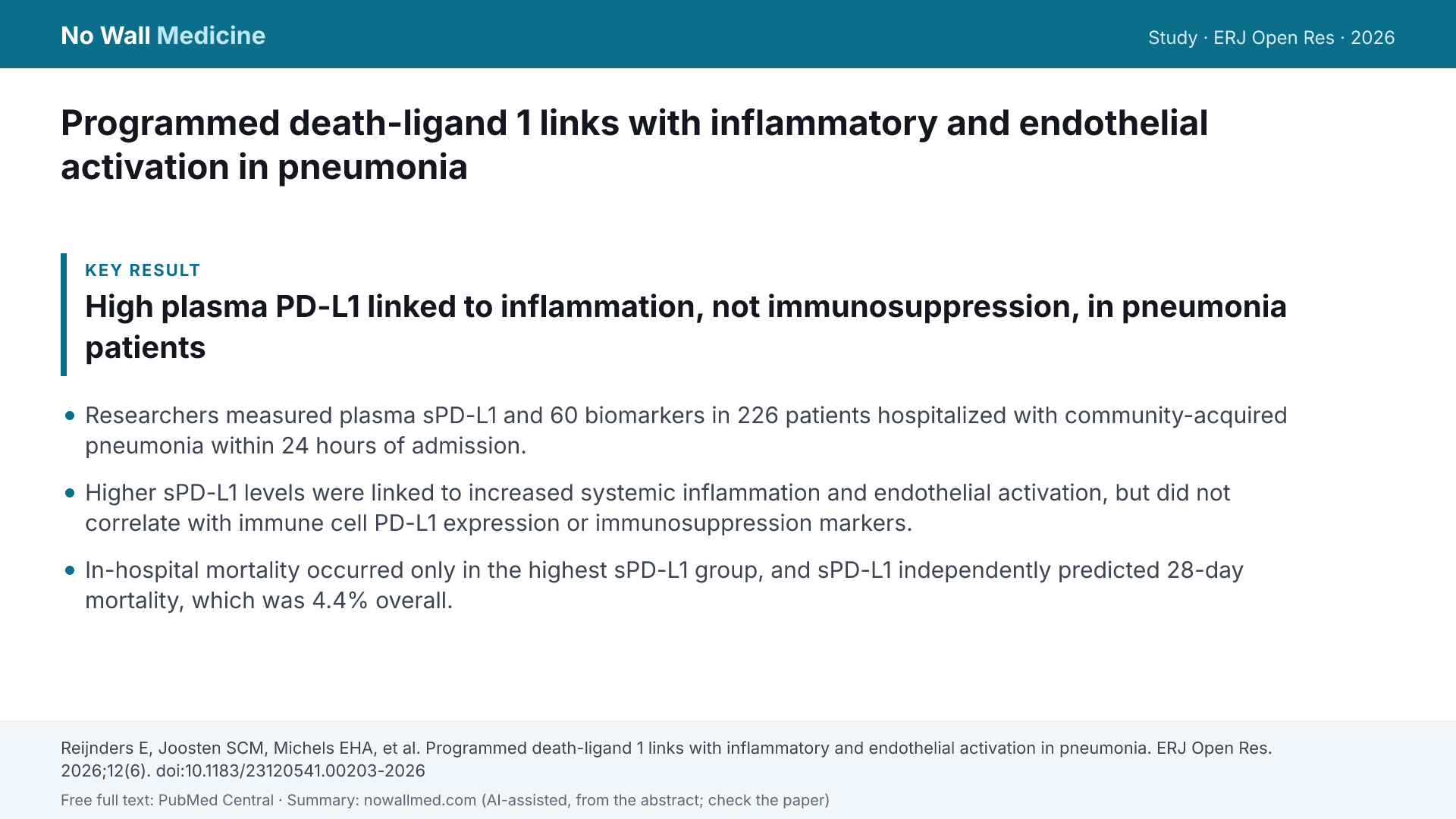
High plasma PD-L1 linked to inflammation, not immunosuppression, in pneumonia patients
Programmed death-ligand 1 links with inflammatory and endothelial activation in pneumonia
Why it matters: Applies to adults hospitalized with community-acquired pneumonia; suggests plasma sPD-L1 reflects systemic inflammation and endothelial activation rather than immunosuppression.
Key points
- Researchers measured plasma sPD-L1 and 60 biomarkers in 226 patients hospitalized with community-acquired pneumonia within 24 hours of admission.
- Higher sPD-L1 levels were linked to increased systemic inflammation and endothelial activation, but did not correlate with immune cell PD-L1 expression or immunosuppression markers.
- In-hospital mortality occurred only in the highest sPD-L1 group, and sPD-L1 independently predicted 28-day mortality, which was 4.4% overall.
Study type: Observational study: it can show a link, but not prove that one thing causes another.
Headline and key points written with AI from the paper’s abstract, with every number checked against it. Read the paper before relying on them.
Was this summary helpful?
Headline, design, result, key points, caveat and citation as plain text.
Cite this article
Reijnders E, Joosten SCM, Michels EHA, et al. Programmed death-ligand 1 links with inflammatory and endothelial activation in pneumonia. ERJ Open Res. 2026;12(6). doi:10.1183/23120541.00203-2026
Spotted a mistake? Suggest a correction