Programmed death-ligand 1 links with inflammatory and endothelial activation in pneumonia
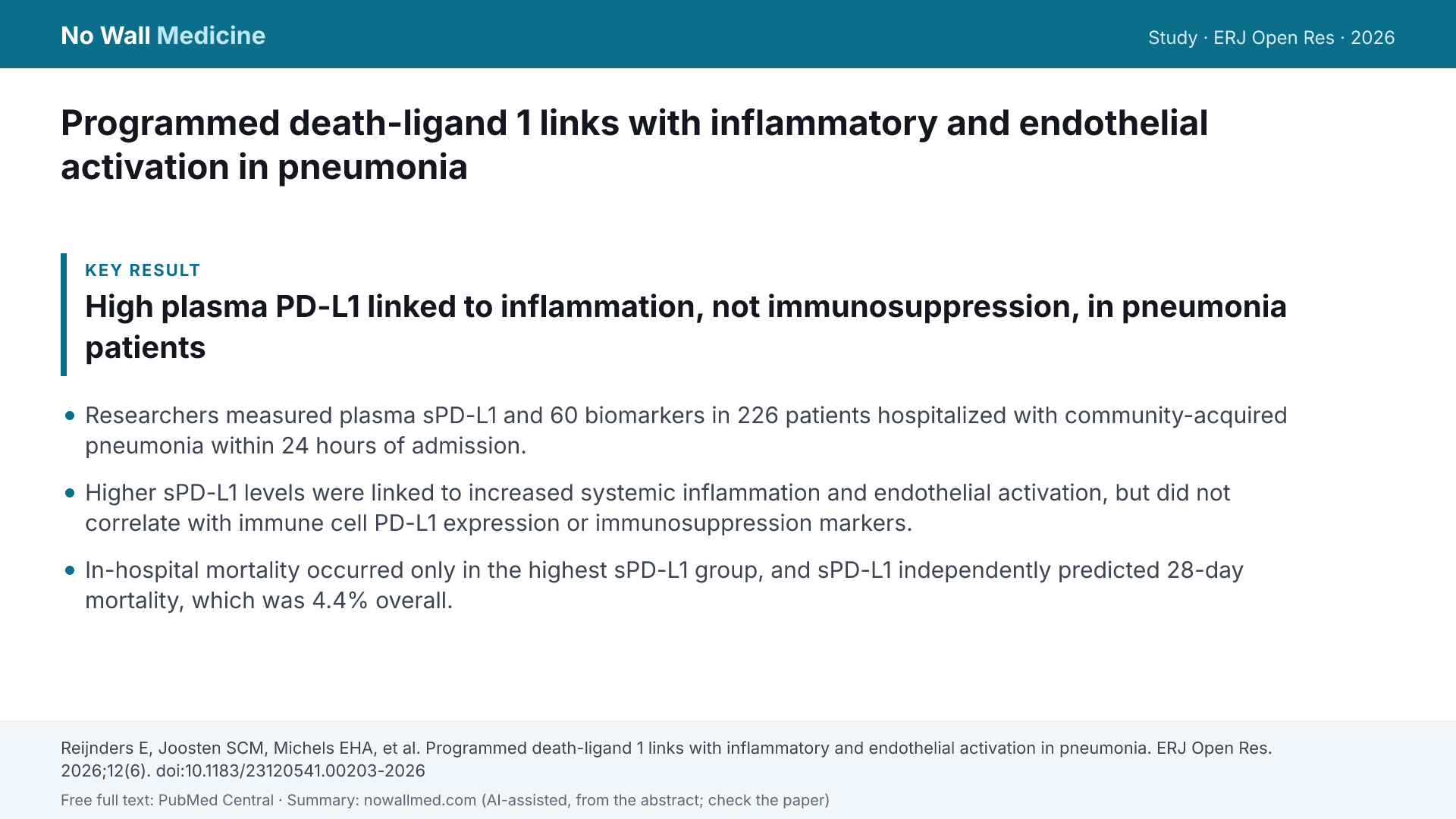
Key result: High plasma PD-L1 linked to inflammation, not immunosuppression, in pneumonia patients
Key points
- Researchers measured plasma sPD-L1 and 60 biomarkers in 226 patients hospitalized with community-acquired pneumonia within 24 hours of admission.
- Higher sPD-L1 levels were linked to increased systemic inflammation and endothelial activation, but did not correlate with immune cell PD-L1 expression or immunosuppression markers.
- In-hospital mortality occurred only in the highest sPD-L1 group, and sPD-L1 independently predicted 28-day mortality, which was 4.4% overall.
Why it matters: Applies to adults hospitalized with community-acquired pneumonia; suggests plasma sPD-L1 reflects systemic inflammation and endothelial activation rather than immunosuppression.
Discussion prompts
- Would these patients look like yours? Who was left out?
- Is the main outcome one that matters to patients?
- Is the difference large enough to change what you do?
Cite: Reijnders E, Joosten SCM, Michels EHA, et al. Programmed death-ligand 1 links with inflammatory and endothelial activation in pneumonia. ERJ Open Res. 2026;12(6). doi:10.1183/23120541.00203-2026
Free full text: PubMed Central · Summary and visual abstract: nowallmed.com/a/programmed-death-ligand-1-links-with-inflammatory-and-endothelial-l6u3us/ (AI-assisted from the abstract; check the paper before relying on it).