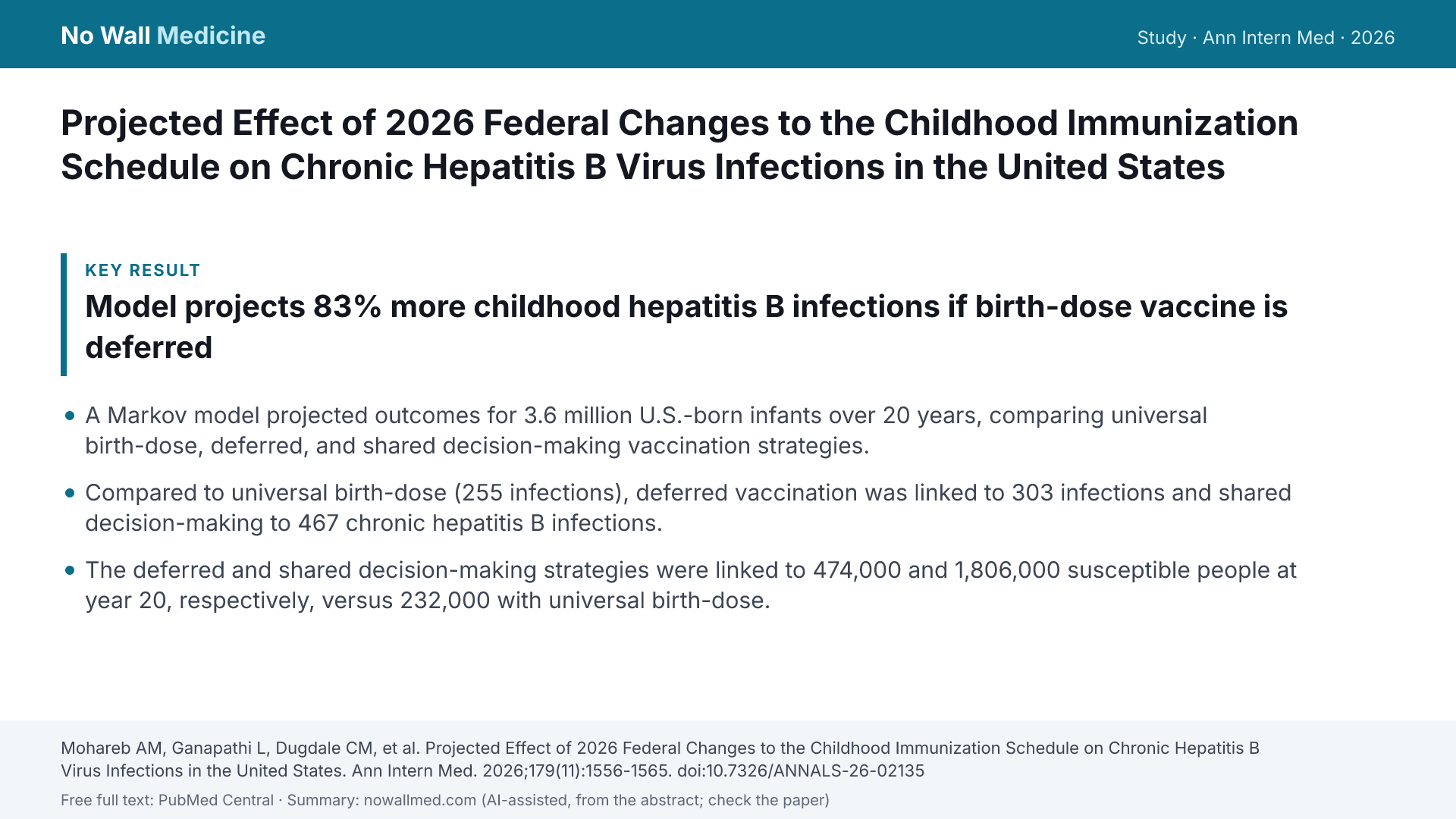
Model projects 83% more childhood hepatitis B infections if birth-dose vaccine is deferred
Projected Effect of 2026 Federal Changes to the Childhood Immunization Schedule on Chronic Hepatitis B Virus Infections in the United States
Why it matters: Applies to U.S. policymakers considering 2026 schedule changes; projects that deferring the birth dose is linked to substantially higher chronic infection and susceptibility rates.
Key points
- A Markov model projected outcomes for 3.6 million U.S.-born infants over 20 years, comparing universal birth-dose, deferred, and shared decision-making vaccination strategies.
- Compared to universal birth-dose (255 infections), deferred vaccination was linked to 303 infections and shared decision-making to 467 chronic hepatitis B infections.
- The deferred and shared decision-making strategies were linked to 474,000 and 1,806,000 susceptible people at year 20, respectively, versus 232,000 with universal birth-dose.
Limitation the authors note: The authors state uncertainty in horizontal hepatitis B virus infection risk as a limitation.
Study type: Observational study: it can show a link, but not prove that one thing causes another.
Headline and key points written with AI from the paper’s abstract, with every number checked against it. Read the paper before relying on them.
Was this summary helpful?
Subject terms
Headline, design, result, key points, caveat and citation as plain text.
Cite this article
Mohareb AM, Ganapathi L, Dugdale CM, et al. Projected Effect of 2026 Federal Changes to the Childhood Immunization Schedule on Chronic Hepatitis B Virus Infections in the United States. Ann Intern Med. 2026;179(11):1556-1565. doi:10.7326/ANNALS-26-02135
Spotted a mistake? Suggest a correction