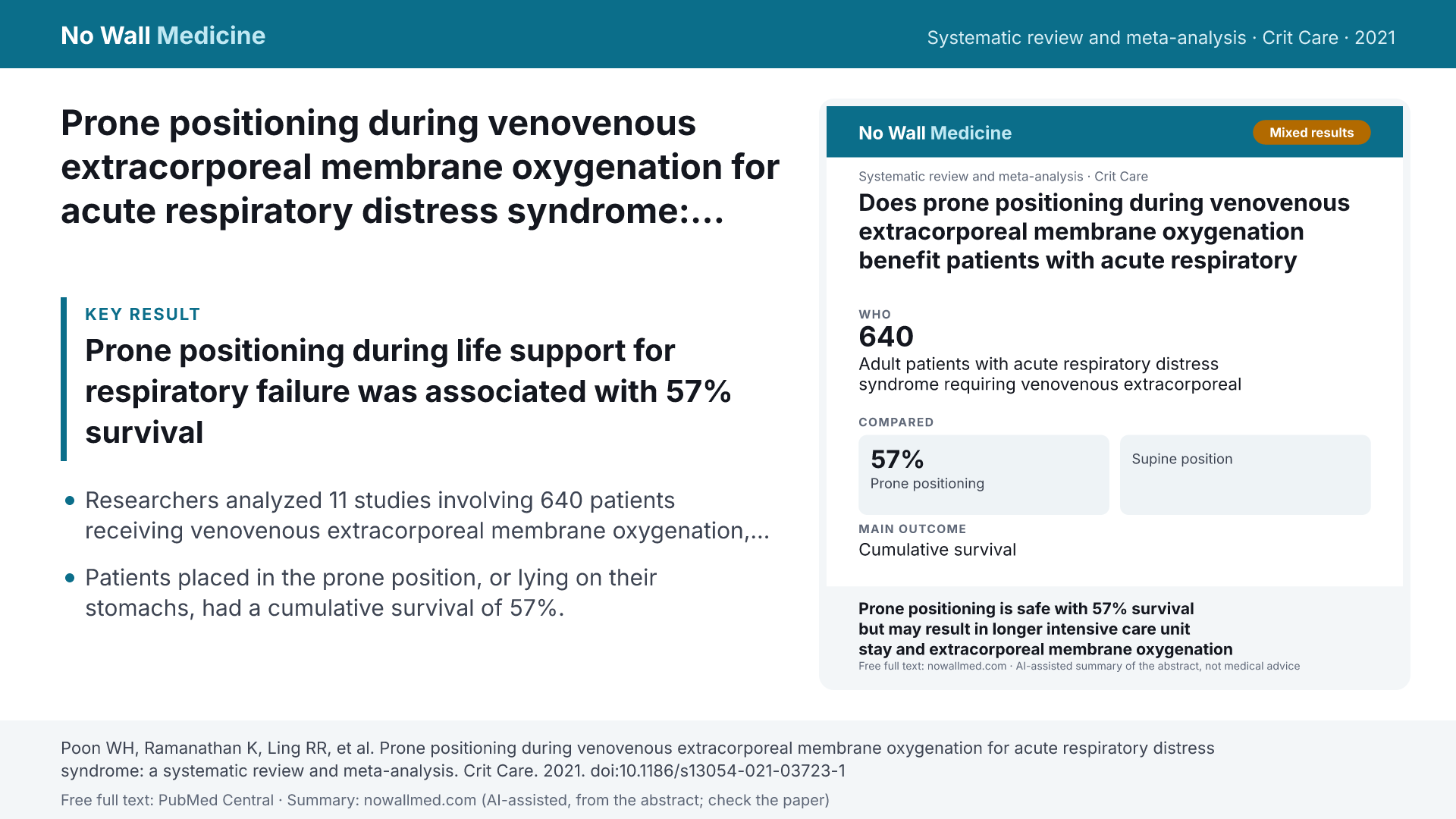
Prone positioning during life support for respiratory failure was associated with 57% survival
Prone positioning during venovenous extracorporeal membrane oxygenation for acute respiratory distress syndrome: a systematic review and meta-analysis
Systematic review and meta-analysisMixed results
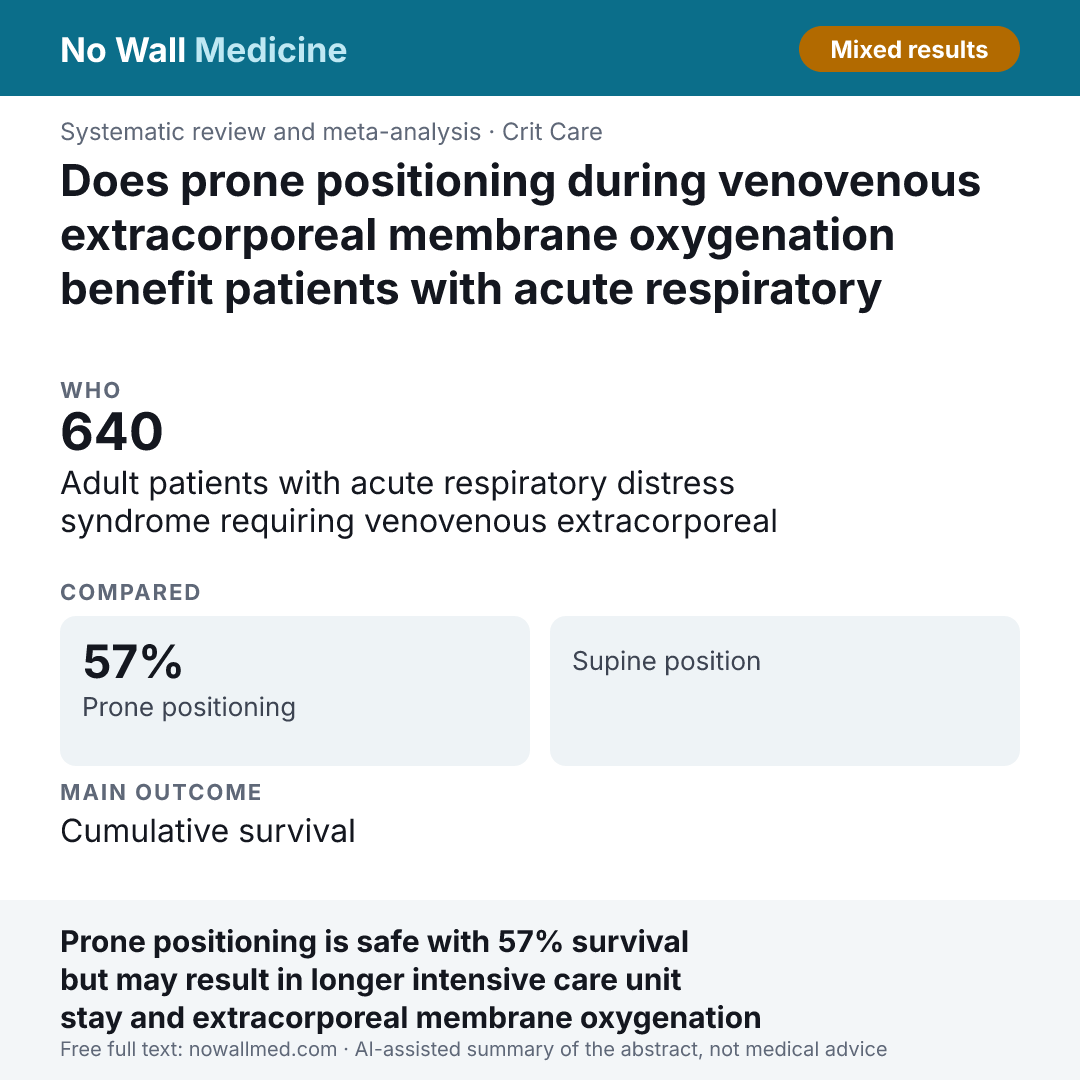
Does prone positioning during venovenous extracorporeal membrane oxygenation benefit patients with acute respiratory distress syndrome?
Who
640
Adult patients with acute respiratory distress syndrome requiring venovenous extracorporeal membrane oxygenation
Compared
57%Prone positioning (95% CI 41.9-71.4)
Supine position
Main outcome
Cumulative survival
Bottom line: Prone positioning is safe with 57% survival but may result in longer intensive care unit stay and extracorporeal membrane oxygenation duration.
Limitation: Evidence from appropriately designed randomized trials is needed prior to widespread adoption.
Crit Care · 2021-08-12 · Save PNG
Clinical question: Does prone positioning during venovenous extracorporeal membrane oxygenation benefit patients with acute respiratory distress syndrome?
Key points
- Researchers analyzed 11 studies involving 640 patients receiving venovenous extracorporeal membrane oxygenation, a machine that assists breathing and circulation, for acute respiratory distress syndrome.
- Patients placed in the prone position, or lying on their stomachs, had a cumulative survival of 57%.
- Prone positioning was associated with an intensive care unit stay that was 14.5 days longer and extracorporeal membrane oxygenation duration that was 9.6 days longer.
Headline and key points written with AI from the paper’s abstract, with every number checked against it. Read the paper before relying on them.
Was this summary helpful?
Abstract
Background
Prone positioning (PP) improves oxygenation and respiratory mechanics and is associated with lower mortality in patients with moderate to severe acute respiratory distress syndrome (ARDS). Despite this, some patients develop refractory hypoxemia and hypercapnia requiring venovenous extracorporeal membrane oxygenation (VV ECMO) support and are usually cared for in supine position. The physiologic and outcome benefits of routine PP of patients during VV ECMO remains unclear. Hence, we conducted the systematic review and meta-analysis to evaluate the outcome benefits of PP for patients with ARDS being treated with VV ECMO. Methods
After registration with PROSPERO (CRD42020199723), MEDLINE, EMBASE, Scopus and Cochrane databases were searched for relevant studies that reported PP in more than 10 adult patients supported with VV ECMO from origin to 1 March 2021. Studies were reviewed for quality using appropriate Joanna Briggs Institute (JBI) checklists, and certainty of evidence was assessed using the GRADE approach. The random-effects model (DerSimonian and Laird) was used. The primary outcome of interest was cumulative survival. Secondary outcomes were intensive care unit length of stay (ICU LOS) and ECMO duration. Changes in arterial blood gas (ABG) values, ventilator mechanics and complication rates were also studied. Results
Of 812 potentially relevant publications, 12 studies (640 patients) met our inclusion criteria. Due to overlapping study populations, 11 studies were included in the final meta-analysis. Cumulative survival in patients that underwent PP was 57% (95% CI 41.9-71.4, high certainty). Patients that underwent PP had longer ICU LOS (+ 14.5 days, 95% CI 3.4-25.7, p = 0.01) and ECMO duration (+ 9.6 days, 95% CI 5.5-13.7, p < 0.0001). After PP, patients had significantly higher PaO2/FiO2 ratio, lower PaCO2 and reduced ventilator driving pressure, and no major complications were reported. Conclusions
PP during VV ECMO appears safe with a cumulative survival of 57% and may result in longer ECMO runs and ICU LOS. However, evidence from appropriately designed randomized trials is needed prior to widespread adoption of PP on VV ECMO.
Abstract reproduced under the article’s CC BY licence.
Subject terms
Headline, design, result, key points, caveat and citation as plain text.
Cite this article
Poon WH, Ramanathan K, Ling RR, et al. Prone positioning during venovenous extracorporeal membrane oxygenation for acute respiratory distress syndrome: a systematic review and meta-analysis. Crit Care. 2021. doi:10.1186/s13054-021-03723-1
Spotted a mistake? Suggest a correction