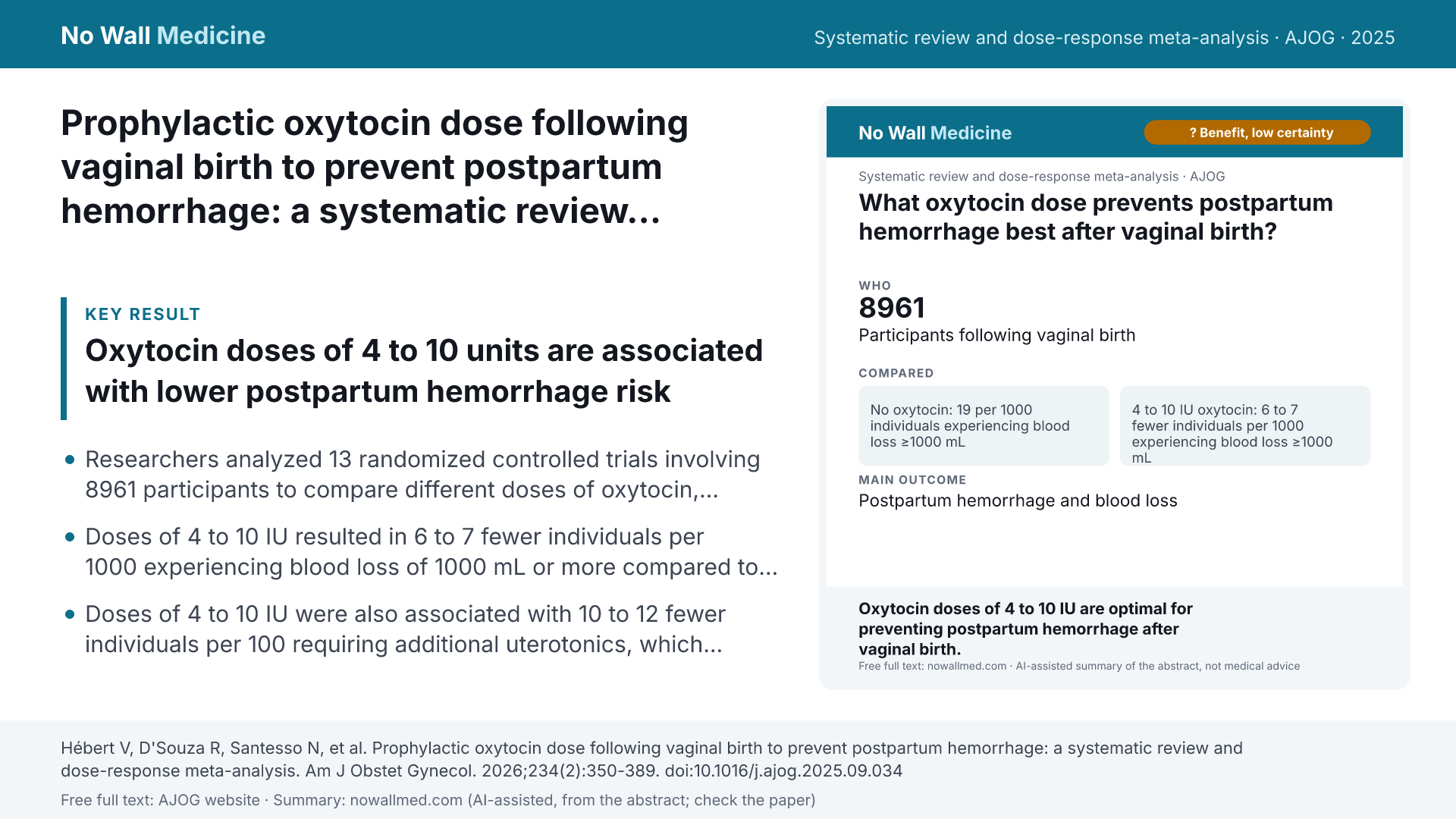
Oxytocin doses of 4 to 10 units are associated with lower postpartum hemorrhage risk
Prophylactic oxytocin dose following vaginal birth to prevent postpartum hemorrhage: a systematic review and dose-response meta-analysis
Systematic review and dose-response meta-analysisBenefit found
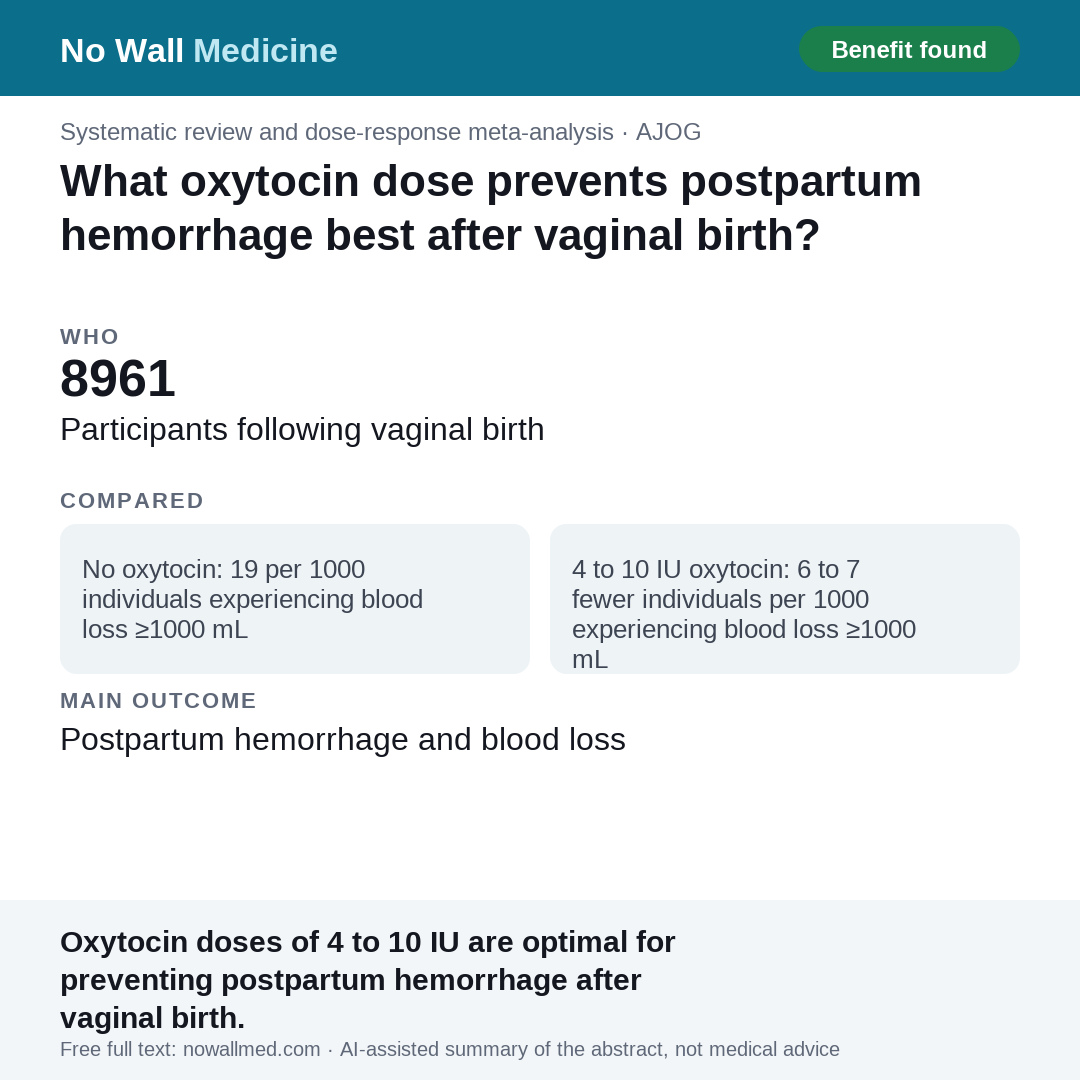
What oxytocin dose prevents postpartum hemorrhage best after vaginal birth?
Who
8961
Participants following vaginal birth
Compared
No oxytocin: 19 per 1000 individuals experiencing blood loss ≥1000 mL
4 to 10 IU oxytocin: 6 to 7 fewer individuals per 1000 experiencing blood loss ≥1000 mL
Main outcome
Postpartum hemorrhage and blood loss
Bottom line: Oxytocin doses of 4 to 10 IU are optimal for preventing postpartum hemorrhage after vaginal birth.
Limitation: Narrow dose ranges, under-representation of high-risk populations, and inconsistent reporting of safety outcomes.
AJOG · 2025-09-24Download image
Clinical question: What oxytocin dose prevents postpartum hemorrhage best after vaginal birth?
Why it matters: The optimal dose of oxytocin to prevent heavy bleeding after vaginal birth remains unclear.
Key points
- Researchers analyzed 13 randomized controlled trials involving 8961 participants to compare different doses of oxytocin, a medication used to cause uterine contractions, after vaginal birth.
- Doses of 4 to 10 IU resulted in 6 to 7 fewer individuals per 1000 experiencing blood loss of 1000 mL or more compared to no oxytocin.
- Doses of 4 to 10 IU were also associated with 10 to 12 fewer individuals per 100 requiring additional uterotonics, which are drugs used to control bleeding.
Limitation the authors note: The authors noted limitations including narrow dose ranges, under-representation of high-risk populations, and inconsistent reporting of safety outcomes.
Headline and key points written with AI from the paper’s abstract, with every number checked against it. Read the paper before relying on them.
Was this summary helpful?
Subject terms
Cite this article
Hébert V, D'Souza R, Santesso N, Zeraatkar D, Oltean I, Furnivall M. Prophylactic oxytocin dose following vaginal birth to prevent postpartum hemorrhage: a systematic review and dose-response meta-analysis. AJOG. 2025. doi:10.1016/j.ajog.2025.09.034
Spotted a mistake? Suggest a correction