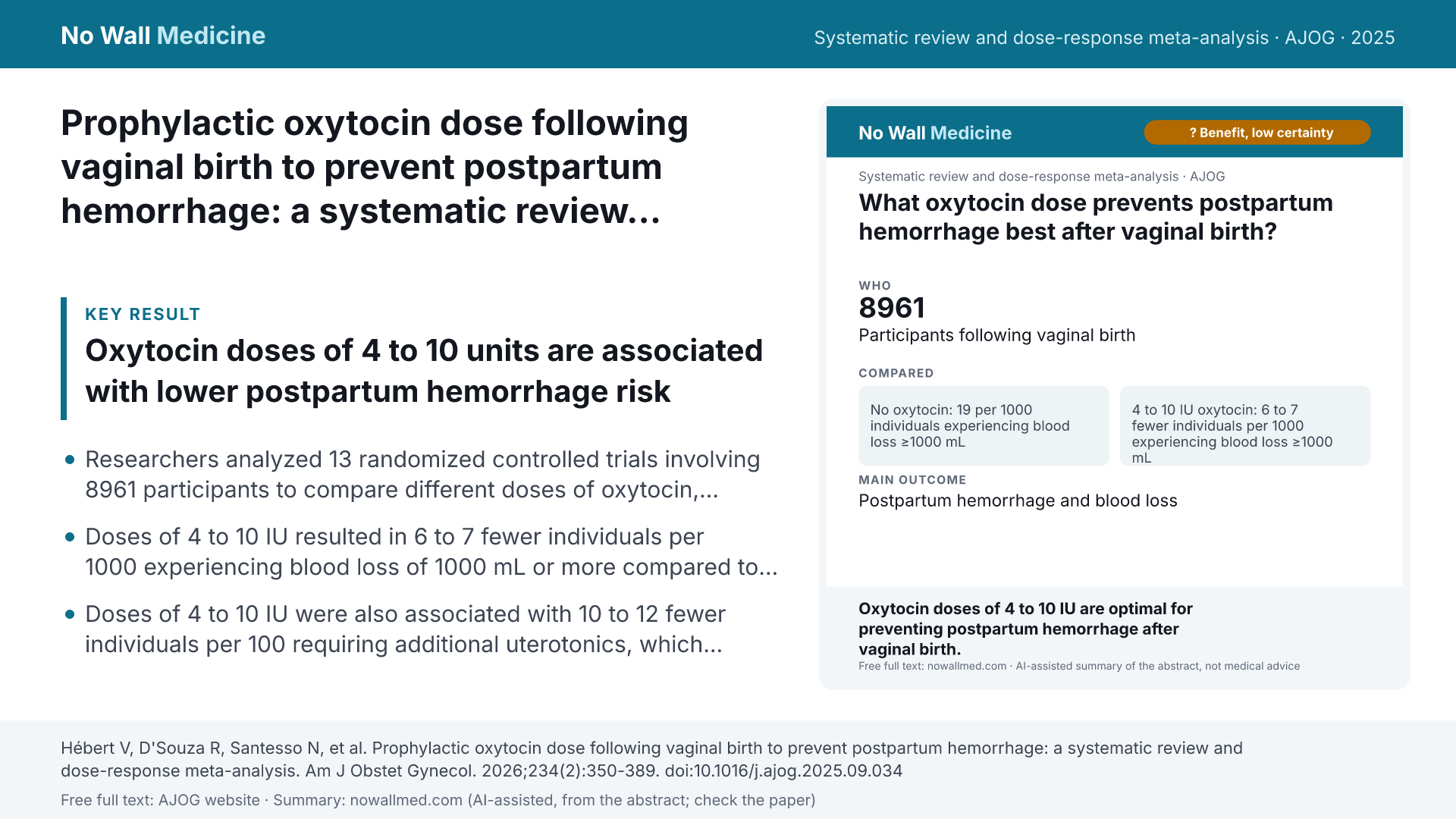
Prophylactic oxytocin dose following vaginal birth to prevent postpartum hemorrhage: a systematic review and dose-response meta-analysis
Key result: Oxytocin doses of 4 to 10 units are associated with lower postpartum hemorrhage risk
Key points
- Researchers analyzed 13 randomized controlled trials involving 8961 participants to compare different doses of oxytocin, a medication used to cause uterine contractions, after vaginal birth.
- Doses of 4 to 10 IU resulted in 6 to 7 fewer individuals per 1000 experiencing blood loss of 1000 mL or more compared to no oxytocin.
- Doses of 4 to 10 IU were also associated with 10 to 12 fewer individuals per 100 requiring additional uterotonics, which are drugs used to control bleeding.
Limitation the authors note: The authors noted limitations including narrow dose ranges, under-representation of high-risk populations, and inconsistent reporting of safety outcomes.
Discussion prompts
- Would these patients look like yours? Who was left out?
- Is the main outcome one that matters to patients?
- Is the difference large enough to change what you do?
Cite: Hébert V, D'Souza R, Santesso N, et al. Prophylactic oxytocin dose following vaginal birth to prevent postpartum hemorrhage: a systematic review and dose-response meta-analysis. Am J Obstet Gynecol. 2026;234(2):350-389. doi:10.1016/j.ajog.2025.09.034
Free full text: AJOG website · Summary and visual abstract: nowallmed.com/a/prophylactic-oxytocin-dose-following-vaginal-birth-to-prevent-1uj2cj/ (AI-assisted from the abstract; check the paper before relying on it).