No drugs studied provided convincing evidence for preventing SARS-CoV-2 infection or reducing hospital admissions
Prophylaxis against covid-19: living systematic review and network meta-analysis
Living systematic review and network meta-analysisNo clear difference
What are the effects of drug prophylaxis on SARS-CoV-2 infection and covid-19?
Who
25147
People at risk of covid-19
Compared
Prophylactic drugs
Standard care or placebo
Main outcome
SARS-CoV-2 infection, hospital admission, and mortality
Bottom line: No prophylactic drug provided convincing evidence of reducing infection, hospital admission, or mortality compared to standard care.
Limitation: Much of the evidence remains very low certainty.
Funded by: Canadian Institutes of Health Research
BMJ · 2021-04-26Download image
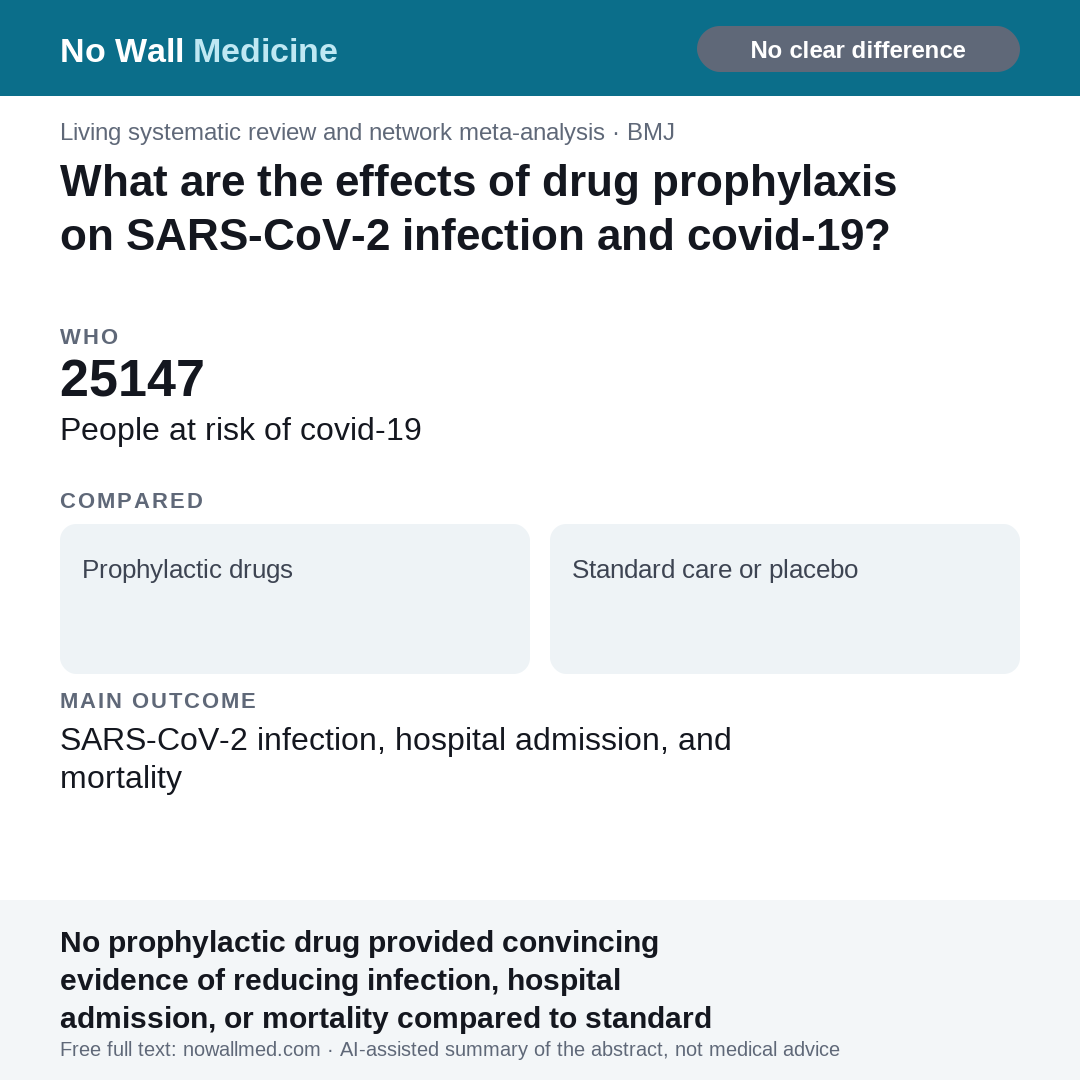
Clinical question: What are the effects of drug prophylaxis on SARS-CoV-2 infection and covid-19?
Why it matters: It was unknown which drugs are effective for preventing SARS-CoV-2 infection, hospitalization, or death.
Key points
- Researchers analyzed 32 randomized trials involving 25,147 participants to compare 21 different drugs used for prevention.
- None of the 16 drugs analyzed showed convincing evidence of reducing laboratory-confirmed SARS-CoV-2 infection, hospital admission, or death.
- Hydroxychloroquine and vitamin C combined with zinc were associated with an increased risk of side effects leading to stopping the medication.
Limitation the authors note: Much of the evidence remains very low certainty.
Headline and key points written with AI from the paper’s abstract, with every number checked against it. Read the paper before relying on them.
Was this summary helpful?
Abstract
Updates
This is the second version (first update) of the living systematic review, replacing the previous version (available as a data supplement). When citing this paper please consider adding the version number and date of access for clarity. Objective
To determine and compare the effects of drug prophylaxis on severe acute respiratory syndrome coronavirus virus 2 (SARS-CoV-2) infection and coronavirus disease 2019 (covid-19). Design
Living systematic review and network meta-analysis (NMA). Data sources
World Health Organization covid-19 database, a comprehensive multilingual source of global covid-19 literature to 4 March 2022. Study selection
Randomised trials in which people at risk of covid-19 were allocated to prophylaxis or no prophylaxis (standard care or placebo). Pairs of reviewers independently screened potentially eligible articles. Methods
After duplicate data abstraction, we conducted random-effects bayesian network meta-analysis. We assessed risk of bias of the included studies using a modification of the Cochrane risk of bias 2.0 tool and assessed the certainty of the evidence using the grading of recommendations assessment, development and evaluation (GRADE) approach. Results
The second iteration of this living NMA includes 32 randomised trials which enrolled 25 147 participants and addressed 21 different prophylactic drugs; adding 21 trials (66%), 18 162 participants (75%) and 16 (76%) prophylactic drugs. Of the 16 prophylactic drugs analysed, none provided convincing evidence of a reduction in the risk of laboratory confirmed SARS-CoV-2 infection. For admission to hospital and mortality outcomes, no prophylactic drug proved different than standard care or placebo. Hydroxychloroquine and vitamin C combined with zinc probably increase the risk of adverse effects leading to drug discontinuation—risk difference for hydroxychloroquine (RD) 6 more per 1000 (95% credible interval (CrI) 2 more to 10 more); for vitamin C combined with zinc, RD 69 more per 1000 (47 more to 90 more), moderate certainty evidence. Conclusions
Much of the evidence remains very low certainty and we therefore anticipate future studies evaluating drugs for prophylaxis may change the results for SARS-CoV-2 infection, admission to hospital and mortality outcomes. Both hydroxychloroquine and vitamin C combined with zinc probably increase adverse effects. Systematic review registration
This review was not registered. The protocol established a priori is included as a supplement. Funding
This study was supported by the Canadian Institutes of Health Research (grant CIHR-IRSC:0579001321).
Abstract reproduced under the article’s CC BY NC licence.
Subject terms
Cite this article
Bartoszko JJ, Siemieniuk RAC, Kum E, Qasim A, Zeraatkar D, Martinez JPD. Prophylaxis against covid-19: living systematic review and network meta-analysis. BMJ. 2021. doi:10.1136/bmj.n949
Spotted a mistake? Suggest a correction
Top studies every Monday
The week’s key trials and guidelines in your specialties, plus any topics you follow. By email, free.
Get the weekly digest