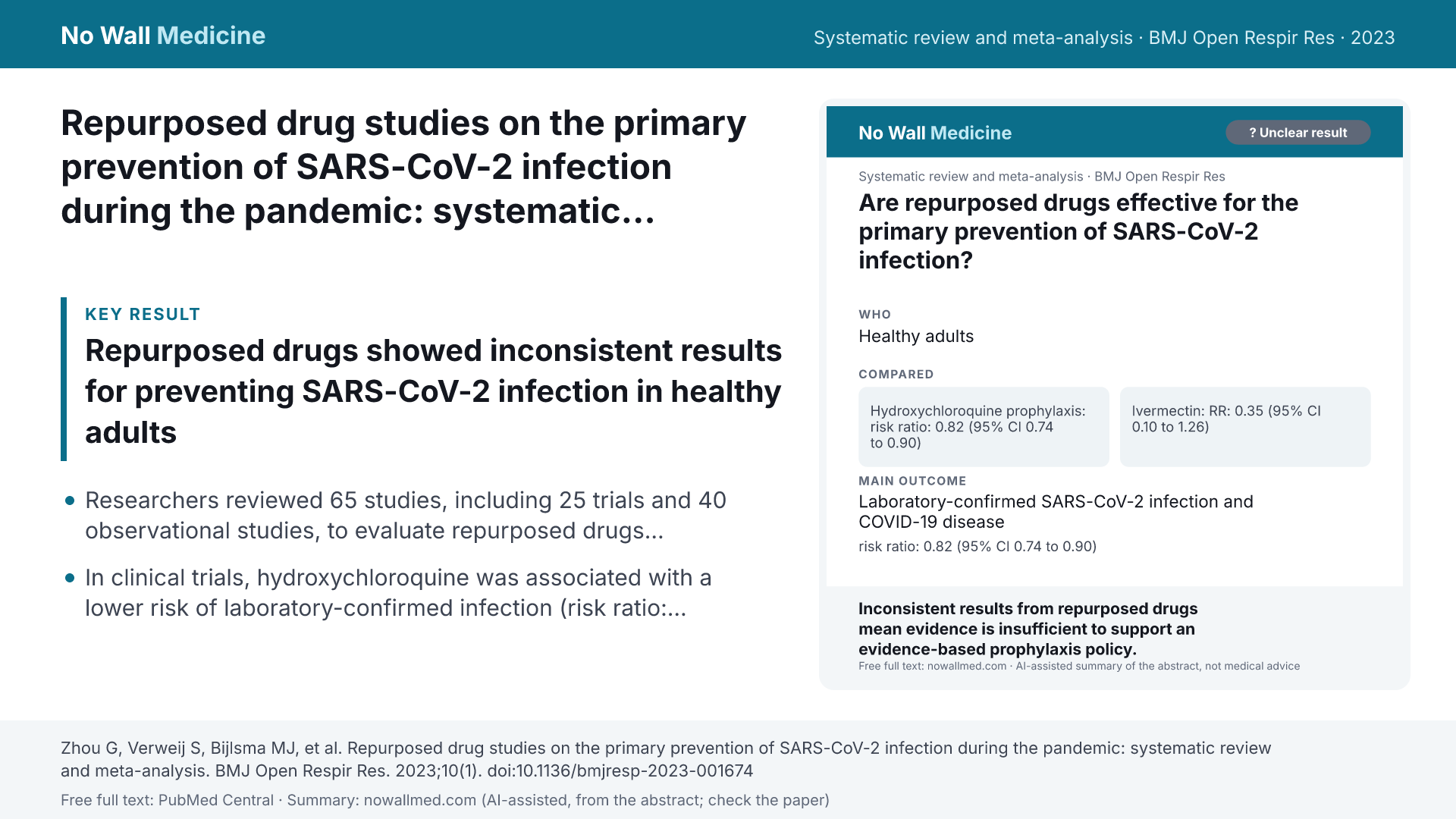
Repurposed drugs showed inconsistent results for preventing SARS-CoV-2 infection in healthy adults
Repurposed drug studies on the primary prevention of SARS-CoV-2 infection during the pandemic: systematic review and meta-analysis
Systematic review and meta-analysisUnclear result
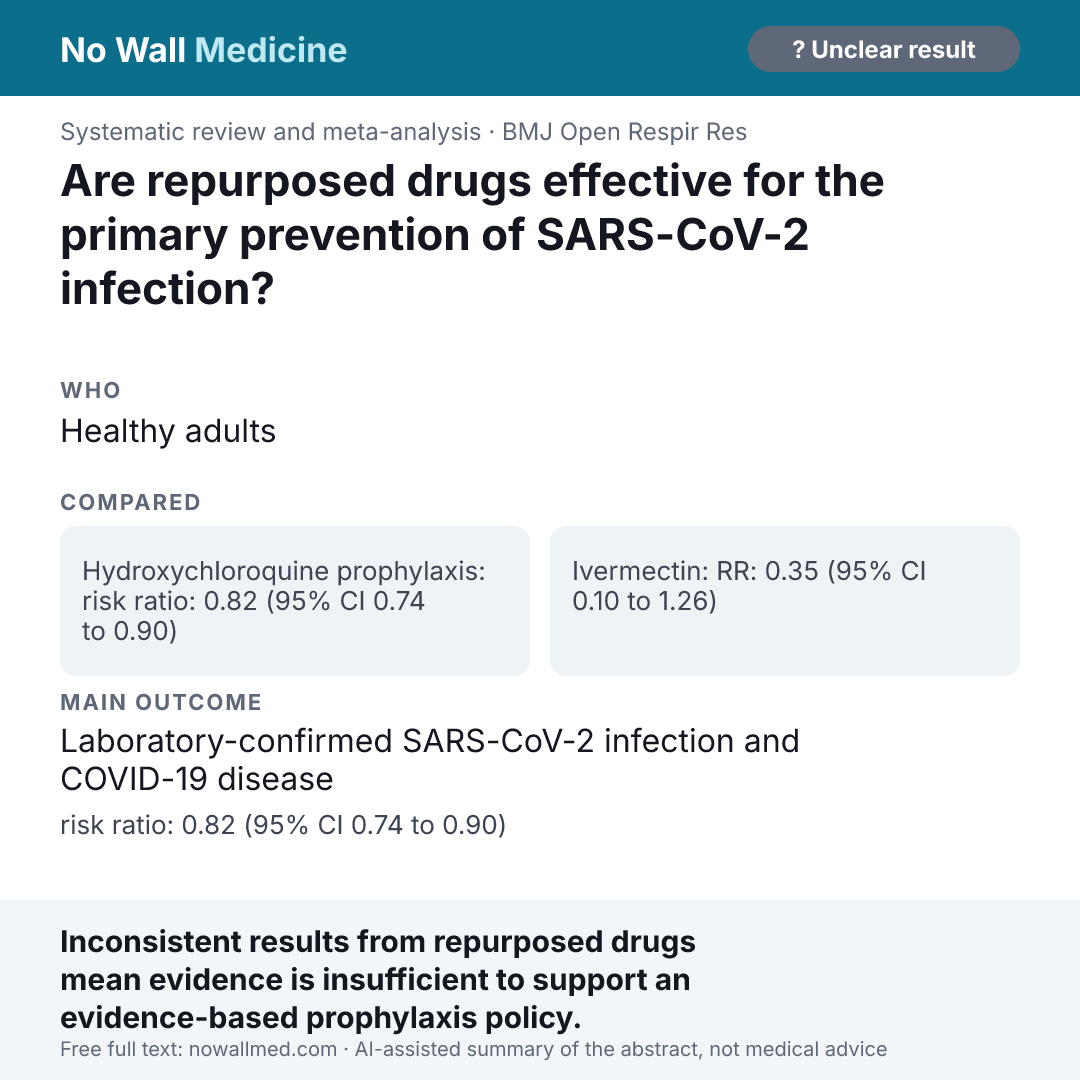
Are repurposed drugs effective for the primary prevention of SARS-CoV-2 infection?
Who
Healthy adults
Compared
Hydroxychloroquine prophylaxis: risk ratio: 0.82 (95% CI 0.74 to 0.90)
Ivermectin: RR: 0.35 (95% CI 0.10 to 1.26)
Main outcome
Laboratory-confirmed SARS-CoV-2 infection and COVID-19 disease
Result: risk ratio: 0.82 (95% CI 0.74 to 0.90)
Bottom line: Inconsistent results from repurposed drugs mean evidence is insufficient to support an evidence-based prophylaxis policy.
Limitation: Most evidence from clinical trials was of moderate quality and observational studies were lower quality.
BMJ Open Respir Res · 2023-08-29 · PROSPERO CRD42021292797
Why it matters: Evidence remains inconclusive regarding which repurposed drugs can effectively prevent laboratory-confirmed SARS-CoV-2 infection or COVID-19 disease.
Headline and visual abstract written with AI from the paper’s abstract, with every number checked against it. Read the paper before relying on them.
Was this summary helpful?
Abstract
Objective
Current evidence on the effectiveness of SARS-CoV-2 prophylaxis is inconclusive. We aimed to systematically evaluate published studies on repurposed drugs for the prevention of laboratory-confirmed SARS-CoV-2 infection and/or COVID-19 among healthy adults. Design
Systematic review. Eligibility
Quantitative experimental and observational intervention studies that evaluated the effectiveness of repurposed drugs for the primary prevention of SARS-CoV-2 infection and/or COVID-19 disease. Data source
PubMed and Embase (1 January 2020-28 September 2022). Risk of bias
Cochrane Risk of Bias 2.0 and Risk of Bias in Non-Randomised Studies of Interventions tools were applied to assess the quality of studies. Data analysis
Meta-analyses for each eligible drug were performed if ≥2 similar study designs were available. Results
In all, 65 (25 trials, 40 observational) and 29 publications were eligible for review and meta-analyses, respectively. Most studies pertained to hydroxychloroquine (32), ACE inhibitor (ACEi) or angiotensin receptor blocker (ARB) (11), statin (8), and ivermectin (8). In trials, hydroxychloroquine prophylaxis reduced laboratory-confirmed SARS-CoV-2 infection (risk ratio: 0.82 (95% CI 0.74 to 0.90), I2=48%), a result largely driven by one clinical trial (weight: 60.5%). Such beneficial effects were not observed in observational studies, nor for prognostic clinical outcomes. Ivermectin did not significantly reduce the risk of SARS-CoV-2 infection (RR: 0.35 (95% CI 0.10 to 1.26), I2=96%) and findings for clinical outcomes were inconsistent. Neither ACEi or ARB were beneficial in reducing SARS-CoV-2 infection. Most of the evidence from clinical trials was of moderate quality and of lower quality in observational studies. Conclusions
Results from our analysis are insufficient to support an evidence-based repurposed drug policy for SARS-CoV-2 prophylaxis because of inconsistency. In the view of scarce supportive evidence on repurposing drugs for COVID-19, alternative strategies such as immunisation of vulnerable people are warranted to prevent the future waves of infection. Prospero registration number
CRD42021292797.
Abstract reproduced under the article’s CC BY NC licence.
Subject terms
Cite this article
Zhou G, Verweij S, Bijlsma MJ, et al. Repurposed drug studies on the primary prevention of SARS-CoV-2 infection during the pandemic: systematic review and meta-analysis. BMJ Open Respir Res. 2023;10(1). doi:10.1136/bmjresp-2023-001674
Spotted a mistake? Suggest a correction