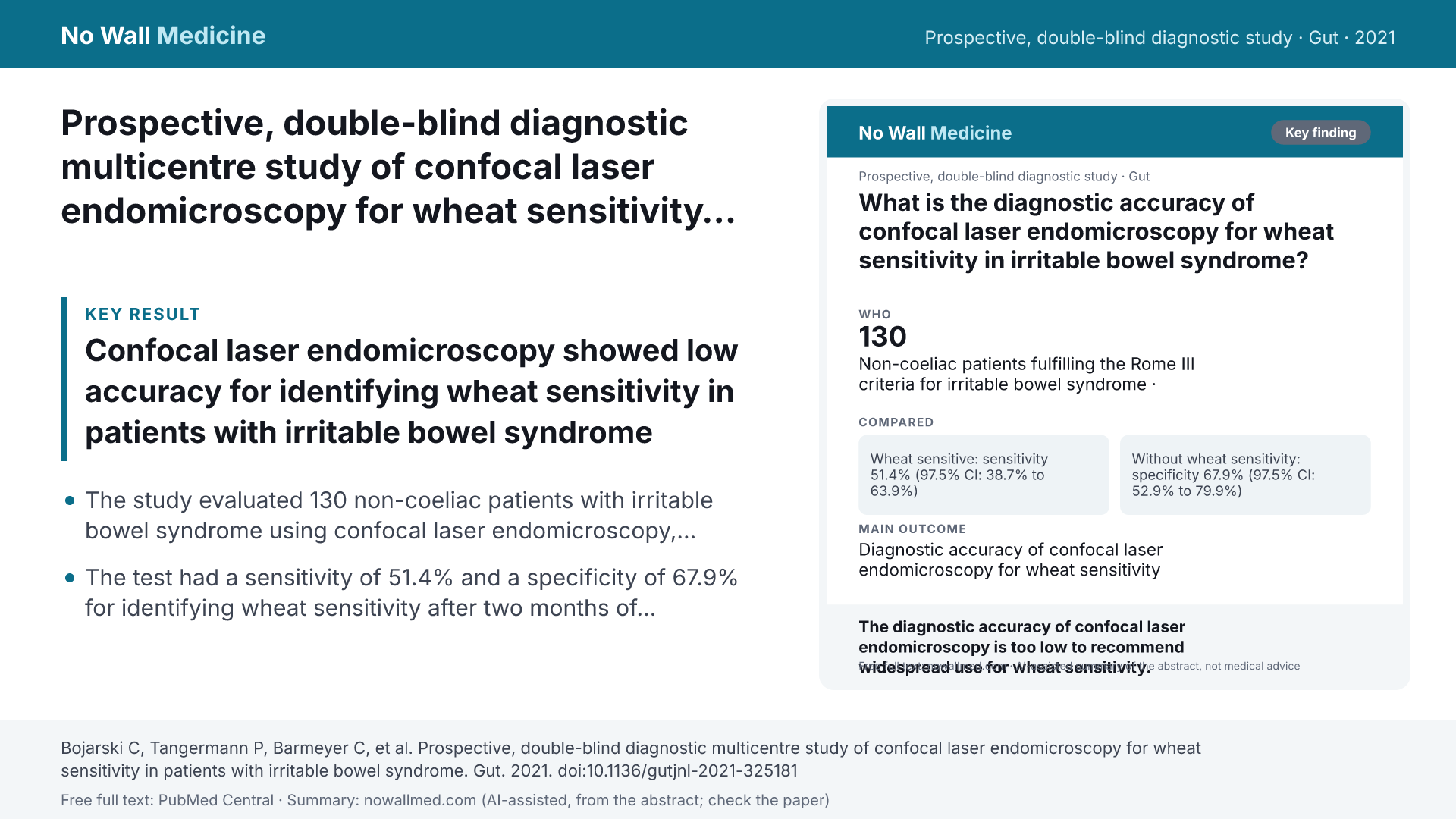
Confocal laser endomicroscopy showed low accuracy for identifying wheat sensitivity in patients with irritable bowel syndrome
Prospective, double-blind diagnostic multicentre study of confocal laser endomicroscopy for wheat sensitivity in patients with irritable bowel syndrome
Prospective, double-blind diagnostic studyKey finding
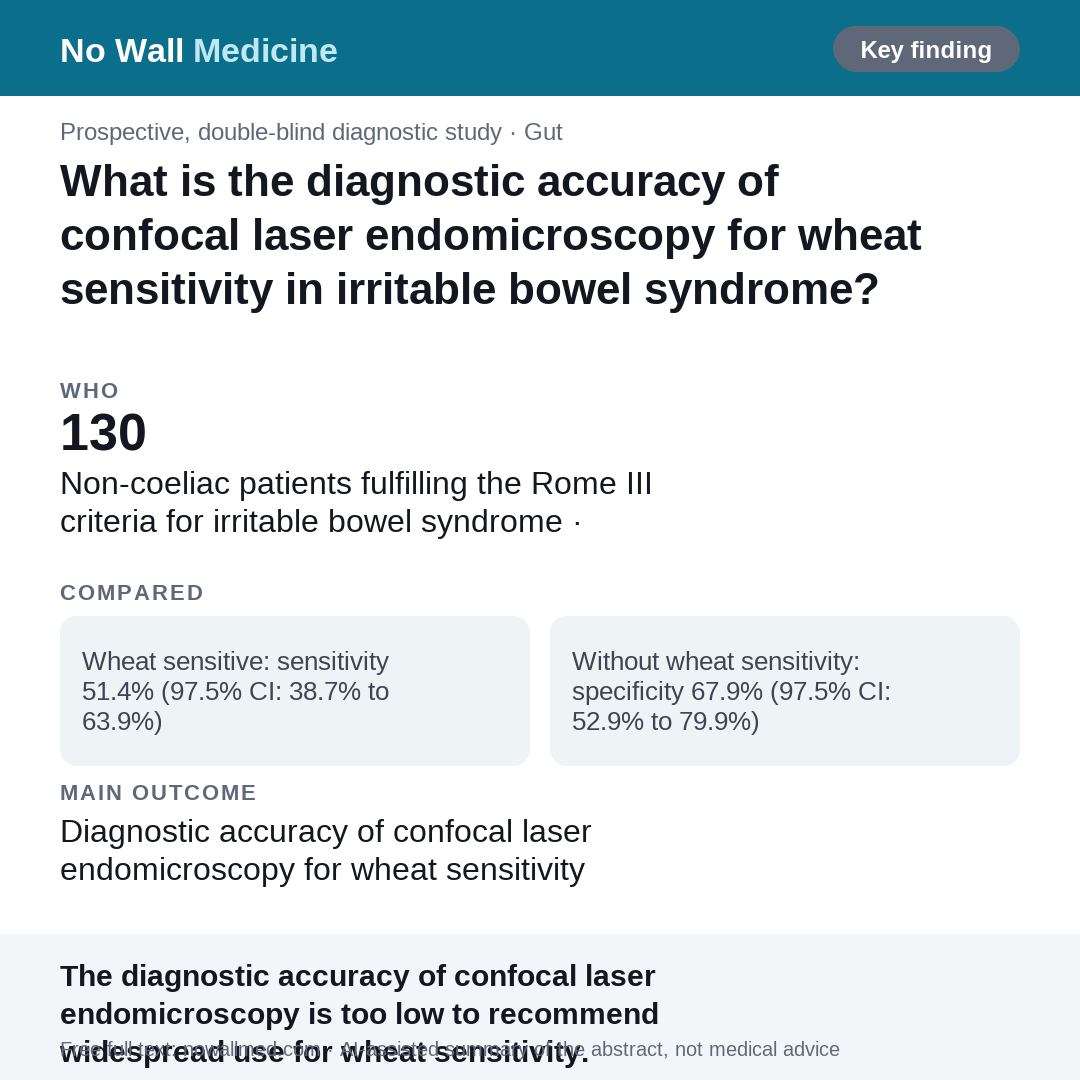
What is the diagnostic accuracy of confocal laser endomicroscopy for wheat sensitivity in irritable bowel syndrome?
Who
130
Non-coeliac patients fulfilling the Rome III criteria for irritable bowel syndrome · Multicentre
Compared
Wheat sensitive: sensitivity 51.4% (97.5% CI: 38.7% to 63.9%)
Without wheat sensitivity: specificity 67.9% (97.5% CI: 52.9% to 79.9%)
Main outcome
Diagnostic accuracy of confocal laser endomicroscopy for wheat sensitivity
Bottom line: The diagnostic accuracy of confocal laser endomicroscopy is too low to recommend widespread use for wheat sensitivity.
Gut · 2021-09-20Download image
Clinical question: What is the diagnostic accuracy of confocal laser endomicroscopy for wheat sensitivity in irritable bowel syndrome?
Why it matters: A diagnostic test for wheat sensitivity is missing for patients with irritable bowel syndrome who respond to a gluten-free diet but do not have coeliac disease.
Key points
- The study evaluated 130 non-coeliac patients with irritable bowel syndrome using confocal laser endomicroscopy, a specialized imaging tool, to detect wheat sensitivity.
- The test had a sensitivity of 51.4% and a specificity of 67.9% for identifying wheat sensitivity after two months of dietary changes.
- At the 6 month follow-up, the sensitivity was 83.1% but the specificity was only 32%.
Headline and key points written with AI from the paper’s abstract, with every number checked against it. Read the paper before relying on them.
Was this summary helpful?
Abstract
Objective
A considerable proportion of patients with irritable bowel syndrome (IBS) may be wheat-sensitive and respond to a gluten-free diet (GFD) although they do not have coeliac disease. However, a diagnostic test for wheat sensitivity (WS) is missing. Our study evaluated the diagnostic accuracy (sensitivity and specificity) of confocal laser endomicroscopy (CLE) for the identification of WS as primary outcome. Design
In this prospective, double-blind diagnostic study 147 non-coeliac patients fulfilling the Rome III criteria for IBS were tested by CLE for duodenal changes after wheat (index test), soy, yeast or milk exposure. Patients with IBS responding to 2 months of GFD were classified as having WS (reference test) using response criteria recommended by regulatory bodies for pharmaceutical trials of patients with IBS. After 2 months, CLE results were unblinded and patients were advised to exclude those food components that had led to a positive CLE reaction. The clinical response was assessed at follow-up after 6 and 12 months. Results
Of 130 patients who completed the study per protocol, 74 (56.9%) responded to GFD and were classified as WS after 2 months, and 38 of these 74 patients were correctly identified by CLE (sensitivity 51.4%; 97.5% CI: 38.7% to 63.9%). A total of 38 of 56 patients without WS were correctly identified by CLE (specificity 67.9%; 97.5% CI: 52.9% to 79.9%). At 6 months follow-up, CLE correctly identified 49 of 59 food-sensitive patients (sensitivity 83.1%; 97.5% CI: 69.9% to 91.3%) but specificity was only 32% (97.5% CI: 15.7% to 54.3%). Conclusion
In light of the high proportion of patients with IBS responding to GFD, the diagnostic accuracy of CLE is too low to recommend widespread use of this invasive procedure. Trail registration number
This study was registered as clinical trial in the German Registry for Clinical Studies (DRKS00010123).
Abstract reproduced under the article’s CC BY NC licence.
Subject terms
Cite this article
Bojarski C, Tangermann P, Barmeyer C, et al. Prospective, double-blind diagnostic multicentre study of confocal laser endomicroscopy for wheat sensitivity in patients with irritable bowel syndrome. Gut. 2021. doi:10.1136/gutjnl-2021-325181
Spotted a mistake? Suggest a correction