Automated ray-tracing-guided LASIK showed similar visual outcomes to wavefront-optimized LASIK in a randomized trial
Prospective Intraindividual Comparison of Automated Customized Ray-Tracing-Guided versus Wavefront-Optimized LASIK
Prospective, randomized, double-blinded, contralateral-eye comparisonBenefit found
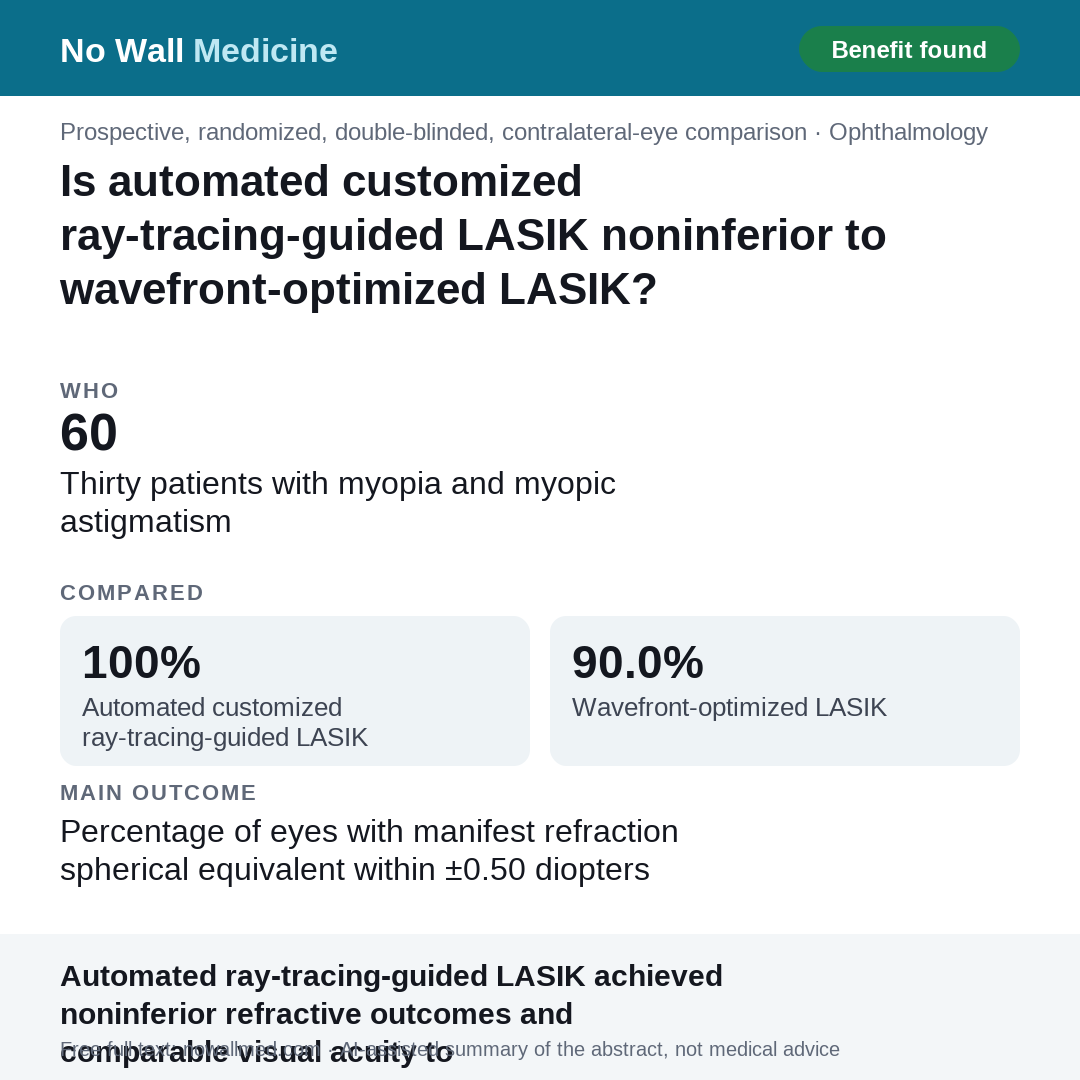
Is automated customized ray-tracing-guided LASIK noninferior to wavefront-optimized LASIK?
Who
60
Thirty patients with myopia and myopic astigmatism
Compared
100%Automated customized ray-tracing-guided LASIK (95% CI, 88.6-100)
90.0%Wavefront-optimized LASIK (95% CI, 74.4-96.5)
Main outcome
Percentage of eyes with manifest refraction spherical equivalent within ±0.50 diopters
Result: noninferior for ±0.50 D, P < 0.001
Bottom line: Automated ray-tracing-guided LASIK achieved noninferior refractive outcomes and comparable visual acuity to wavefront-optimized LASIK.
Ophthalmology · 2025-06-05Download image
Clinical question: Is automated customized ray-tracing-guided LASIK noninferior to wavefront-optimized LASIK?
Why it matters: It is unclear if automated ray-tracing-guided LASIK, which uses only objective measurements, provides similar refractive and visual outcomes to wavefront-optimized LASIK which uses manifest refraction.
Key points
- Thirty patients with myopia and myopic astigmatism, totaling 60 eyes, were compared using ray-tracing-guided LASIK in one eye and wavefront-optimized LASIK in the other.
- At 3 months, 100% of eyes treated with ray-tracing-guided LASIK were within ±0.50 diopters of the target compared to 90.0% for wavefront-optimized LASIK.
- Visual acuity outcomes, including uncorrected distance visual acuity and corrected distance visual acuity, were comparable between the two laser eye surgery methods.
Headline and key points written with AI from the paper’s abstract, with every number checked against it. Read the paper before relying on them.
Was this summary helpful?
Subject terms
Cite this article
Khoramnia R, Naujokaitis T, Blöck L, Fabian K, Kessler LJ, Łabuz G. Prospective Intraindividual Comparison of Automated Customized Ray-Tracing-Guided versus Wavefront-Optimized LASIK. Ophthalmology. 2025. doi:10.1016/j.ophtha.2025.05.025
Spotted a mistake? Suggest a correction
Top studies every Monday
The week’s key trials and guidelines in your specialties, plus any topics you follow. By email, free.
Get the weekly digest