Moses 2.0 laser technology reduced surgeon workload without changing operative times or stone clearance rates
Prospective randomised double-blind trial: holmium laser lithotripsy with vs without Moses™ 2.0
Randomised, double-blind, multicentre clinical trialMixed results
Does Moses 2.0 technology affect operative time, surgeon workload, and retropulsion in renal stone lithotripsy?
Who
153
Patients with renal stones 8-20 mm in diameter · Multicentre
Compared
Standard laser lithotripsy: no significant difference in operative times
Moses 2.0 laser lithotripsy: lower effort, frustration, mental, physical, and temporal workload
Main outcome
Total operative time, surgeon workload, and stone retropulsion
Bottom line: Moses 2.0 reduced surgeon workload but showed no difference in operative times, retropulsion, or clinical outcomes.
BJU Int · 2026-09-13Download image
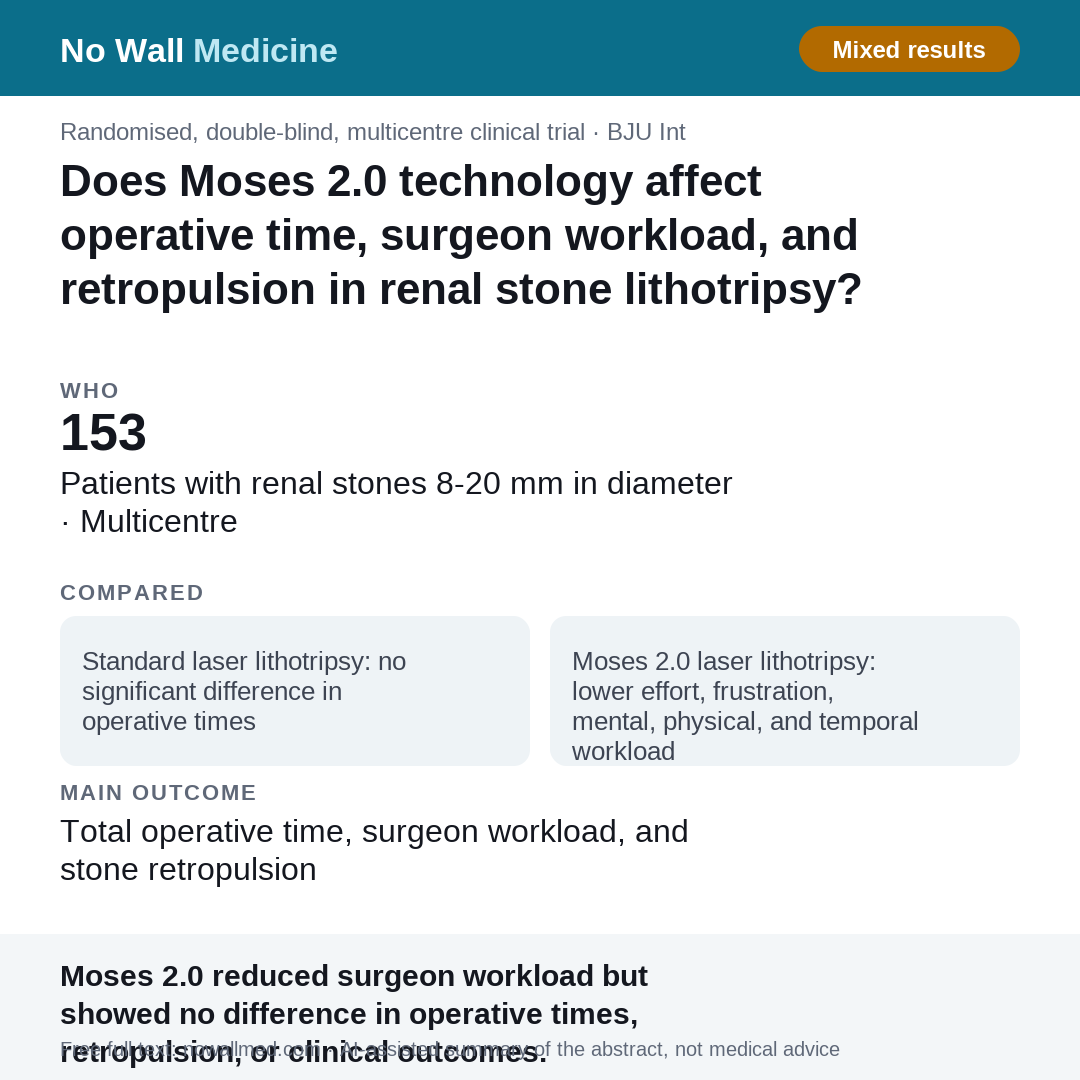
Clinical question: Does Moses 2.0 technology affect operative time, surgeon workload, and retropulsion in renal stone lithotripsy?
Why it matters: Clinicians needed to understand how Moses 2.0 technology affects operative time, surgeon workload, and stone movement during kidney stone removal.
Key points
- Researchers conducted a multicentre trial with 153 patients to compare standard holmium laser lithotripsy with Moses 2.0 technology for breaking up kidney stones.
- Moses 2.0 was associated with lower effort, frustration, mental, physical, and temporal workload, but showed no significant difference in operative times (P = 0.73).
- There were no significant differences in stone retropulsion (P = 0.13), complication rates (Standard: 13%; Moses 2.0: 10%), or stone-free rates (Standard: 51%; Moses 2.0: 55%).
Headline and key points written with AI from the paper’s abstract, with every number checked against it. Read the paper before relying on them.
Topics
Spotted a mistake? Suggest a correction
More in Urology
Checkpoint inhibitor regimens benefit renal cell carcinoma patients with poor prognosis most
Which Patients with Advanced Clear Cell Renal Cell Carcinoma Benefit Most from First-line Checkpoint Inhibitor Combination Regimens: A Meta-analysis of Individual Patient Data and Aggregate Data from Randomised Trials
Male factor infertility is influenced by genetics, environment, and lifestyle choices
Key Determinants and Clinical Impact of Male Factor Infertility: From Etiology to Treatment
Nectin-4-targeted PET/CT compared to FDG PET/CT for urothelial carcinoma staging
Diagnostic Performance of Nectin-4-targeted [68Ga]Ga-DOTA-N188 PET/CT versus [18F]-FDG PET/CT for Staging of Locally Advanced and Metastatic Urothelial Carcinoma: A Prospective, Single-center, Phase 2 Feasibility Trial
Robotic surgery worked as well as open surgery for Wilms tumor in selected cases
Exploring the Limits of Robotic Surgery for Wilms Tumor: A Descriptive Analysis