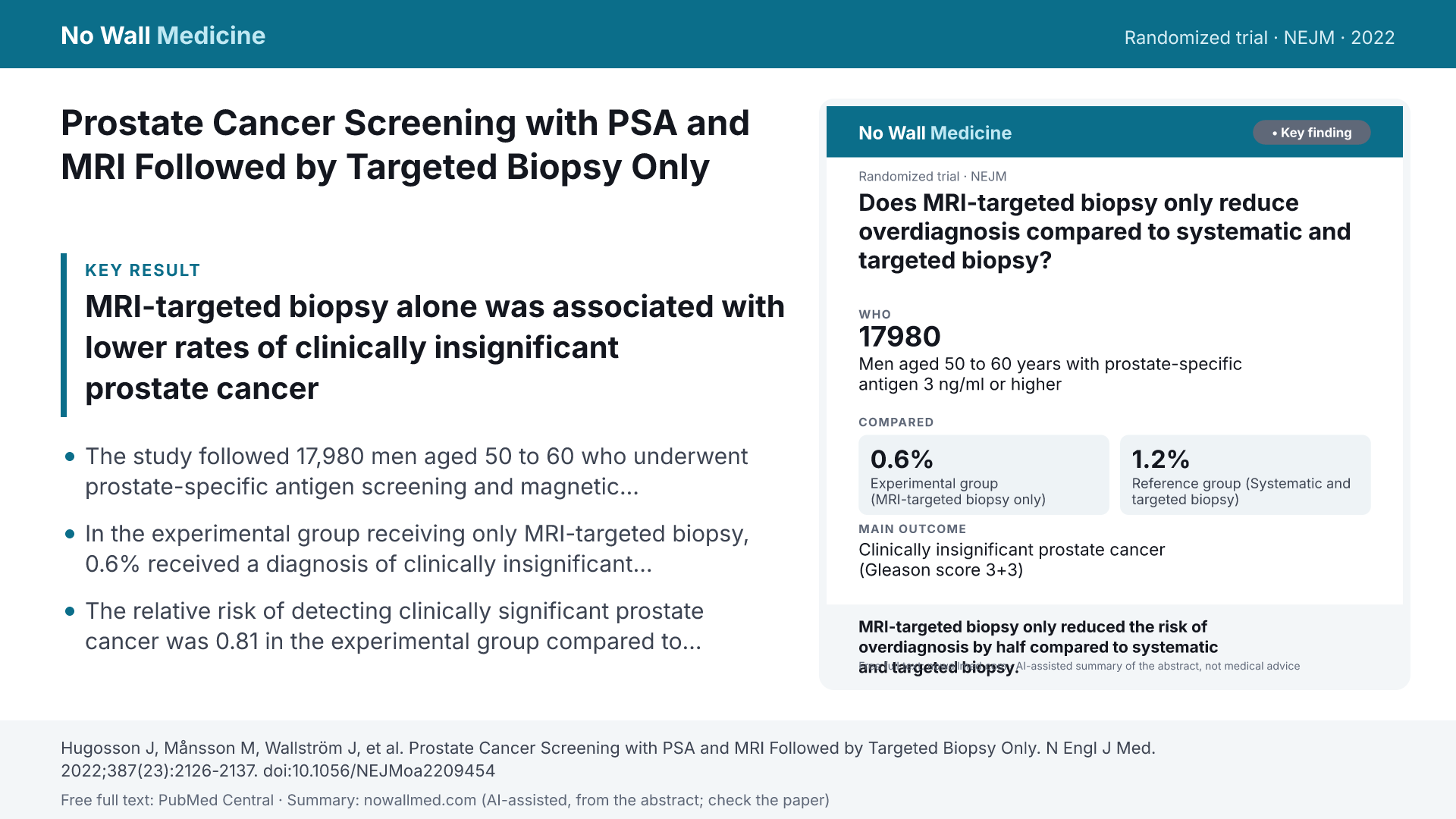
MRI-targeted biopsy alone was associated with lower rates of clinically insignificant prostate cancer
Prostate Cancer Screening with PSA and MRI Followed by Targeted Biopsy Only
Randomized trialBenefit found
Does MRI-targeted biopsy only reduce overdiagnosis compared to systematic and targeted biopsy?
Who
17980
Men aged 50 to 60 years with prostate-specific antigen 3 ng/ml or higher
Compared
0.6%Experimental group (MRI-targeted biopsy only) (66/11986)
1.2%Reference group (Systematic and targeted biopsy) (72/5994)
Main outcome
Clinically insignificant prostate cancer (Gleason score 3+3)
Result: relative risk 0.46 (95% CI 0.33 to 0.64)
Bottom line: MRI-targeted biopsy only reduced the risk of overdiagnosis by half compared to systematic and targeted biopsy.
Funded by: Karin and Christer Johansson's Foundation and others
NEJM · 2022-12-08Download image
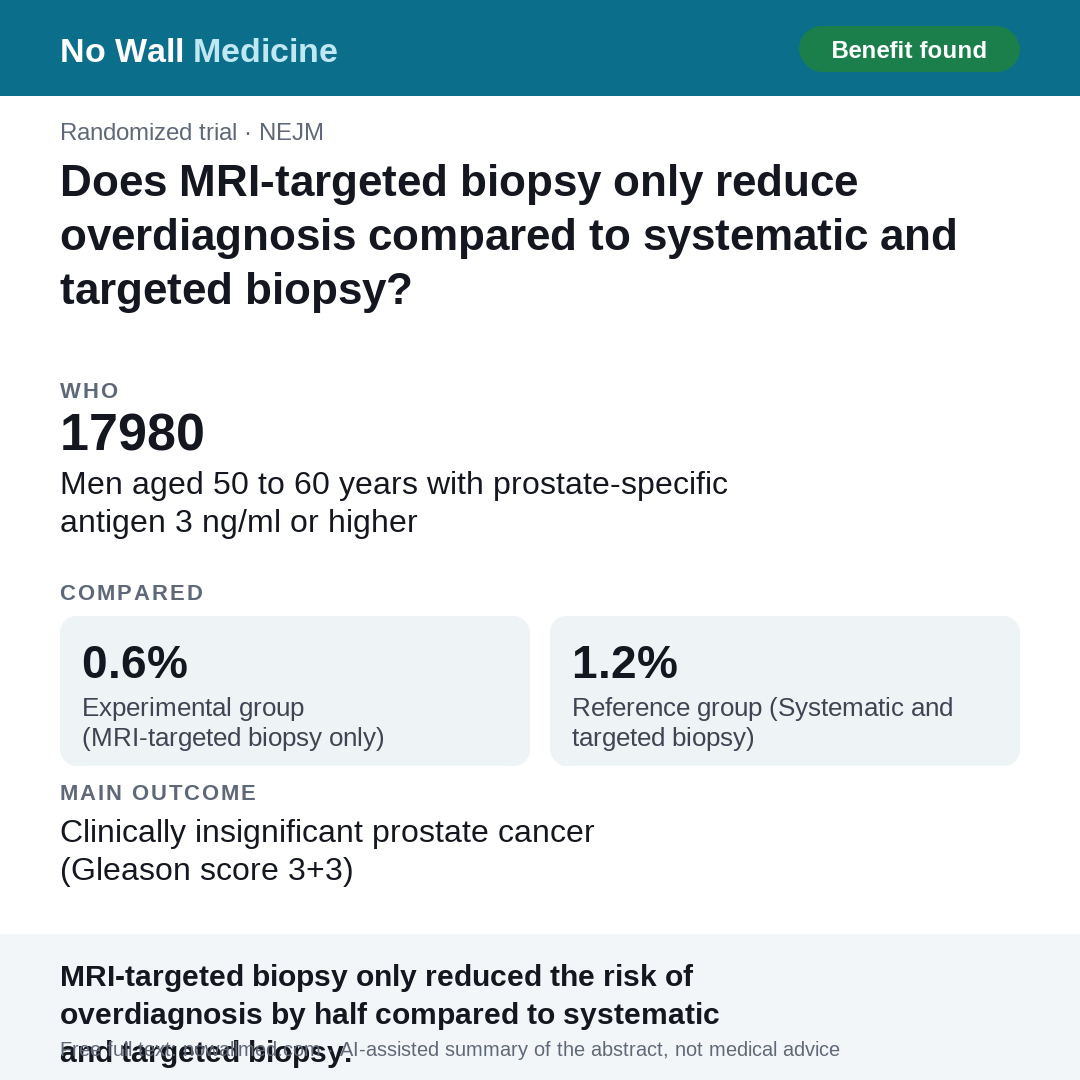
Clinical question: Does MRI-targeted biopsy only reduce overdiagnosis compared to systematic and targeted biopsy?
Why it matters: The most appropriate algorithm for population-based prostate cancer screening is unknown due to high rates of overdiagnosis.
Key points
- The study followed 17,980 men aged 50 to 60 who underwent prostate-specific antigen screening and magnetic resonance imaging.
- In the experimental group receiving only MRI-targeted biopsy, 0.6% received a diagnosis of clinically insignificant prostate cancer compared to 1.2% in the reference group.
- The relative risk of detecting clinically significant prostate cancer was 0.81 in the experimental group compared to the reference group.
Headline and key points written with AI from the paper’s abstract, with every number checked against it. Read the paper before relying on them.
Was this summary helpful?
Subject terms
Cite this article
Hugosson J, Månsson M, Wallström J, et al. Prostate Cancer Screening with PSA and MRI Followed by Targeted Biopsy Only. NEJM. 2022. doi:10.1056/NEJMoa2209454
Spotted a mistake? Suggest a correction