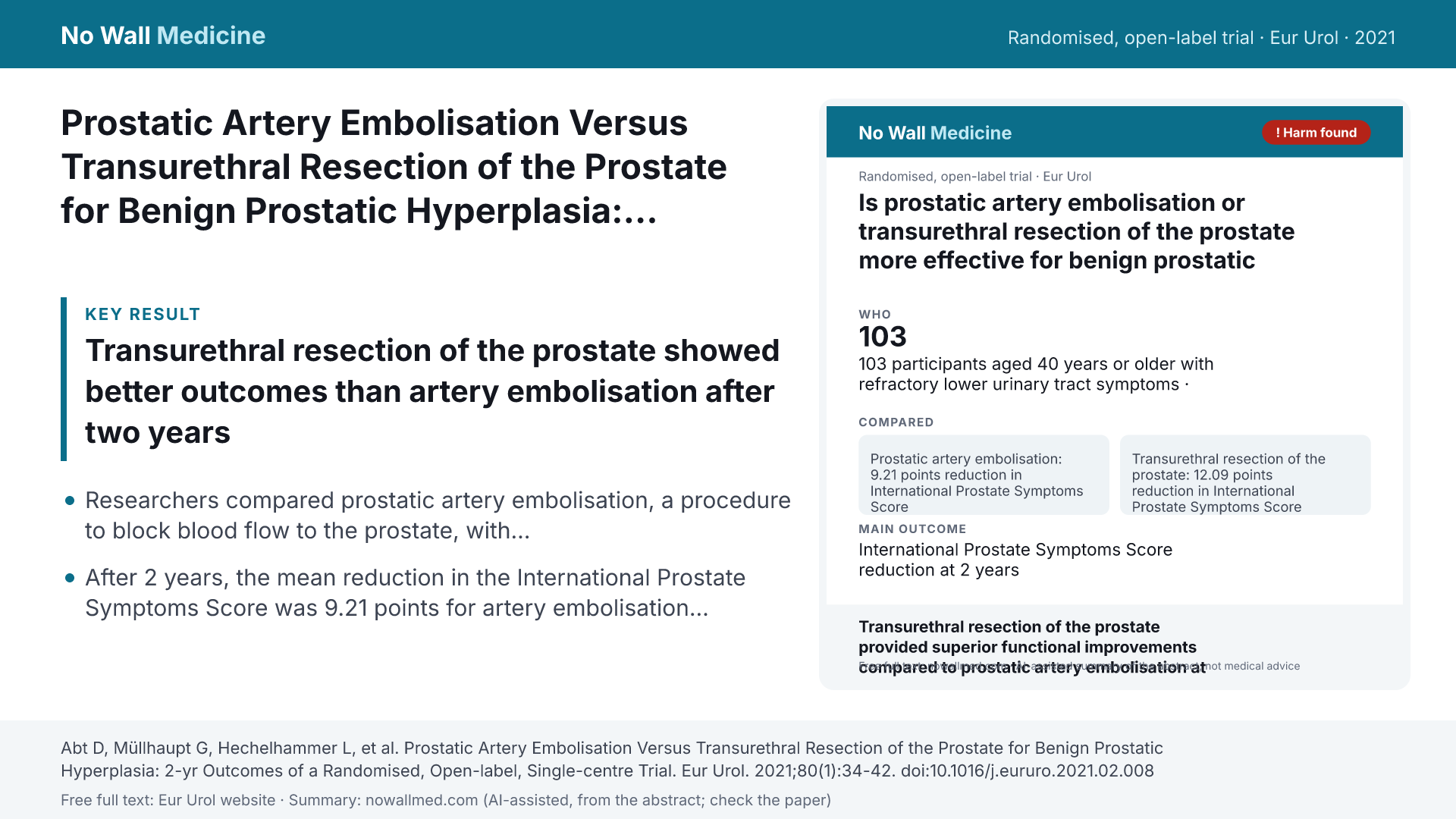
Transurethral resection of the prostate showed better outcomes than artery embolisation after two years
Prostatic Artery Embolisation Versus Transurethral Resection of the Prostate for Benign Prostatic Hyperplasia: 2-yr Outcomes of a Randomised, Open-label, Single-centre Trial
Randomised, open-label trialHarm found
Is prostatic artery embolisation or transurethral resection of the prostate more effective for benign prostatic obstruction?
Who
103
103 participants aged 40 years or older with refractory lower urinary tract symptoms · Single-centre trial
Compared
Prostatic artery embolisation: 9.21 points reduction in International Prostate Symptoms Score
Transurethral resection of the prostate: 12.09 points reduction in International Prostate Symptoms Score
Main outcome
International Prostate Symptoms Score reduction at 2 years
Result: difference of 2.88 (95% confidence interval 0.04-5.72)
Bottom line: Transurethral resection of the prostate provided superior functional improvements compared to prostatic artery embolisation at 2 years.
Limitation: Twenty-one percent of prostatic artery embolisation patients required transurethral resection of the prostate, preventing further outcome assessment.
Eur Urol · 2021-02-19Download image
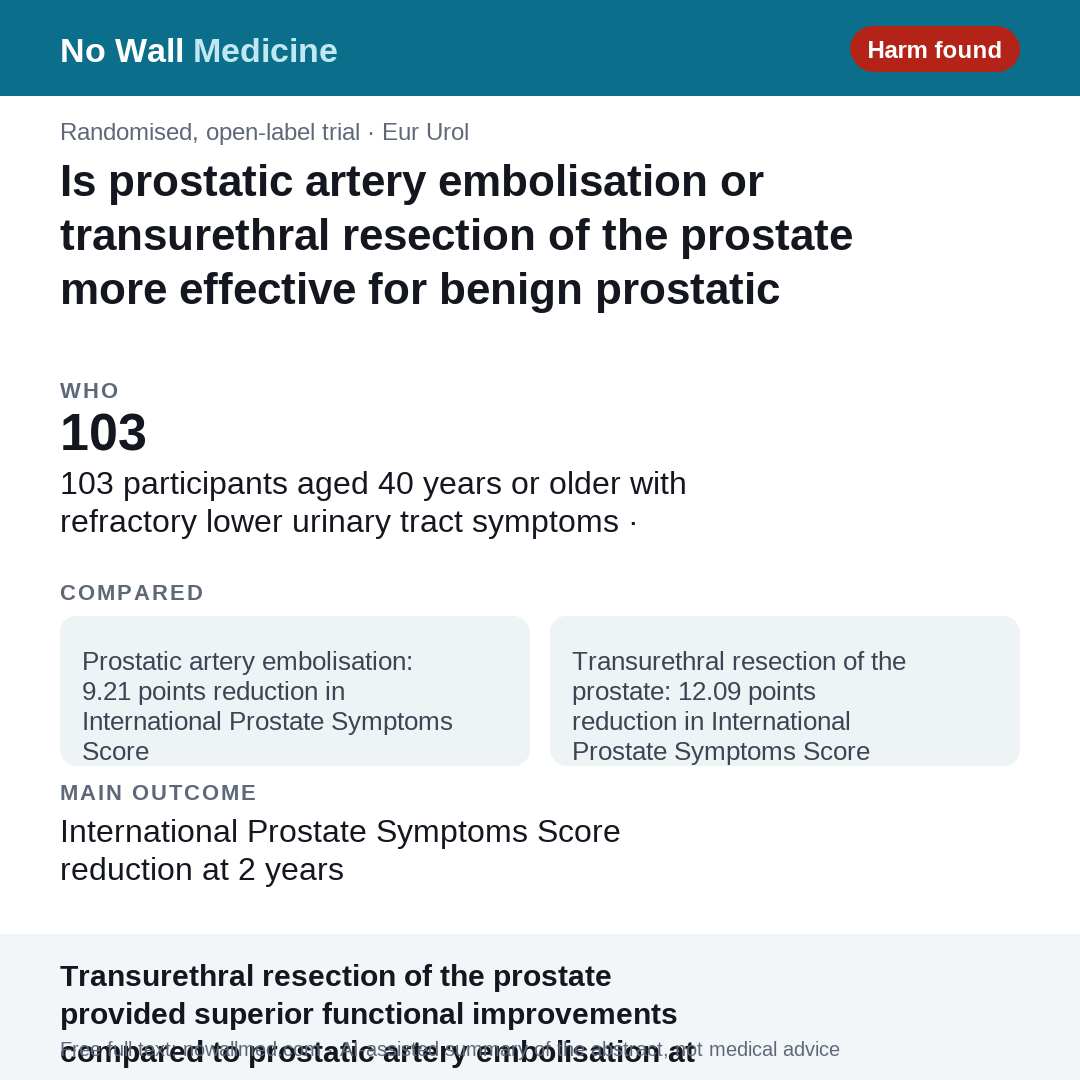
Clinical question: Is prostatic artery embolisation or transurethral resection of the prostate more effective for benign prostatic obstruction?
Why it matters: The efficacy and safety of prostatic artery embolisation for treating lower urinary tract symptoms caused by benign prostatic obstruction remain under investigation.
Key points
- Researchers compared prostatic artery embolisation, a procedure to block blood flow to the prostate, with transurethral resection of the prostate, a surgical removal of prostate tissue, in 103 participants.
- After 2 years, the mean reduction in the International Prostate Symptoms Score was 9.21 points for artery embolisation and 12.09 points for the surgical resection.
- Adverse events were less frequent in the artery embolisation group with 43 total occurrences compared to 78 in the surgical group.
Limitation the authors note: Ten patients who initially underwent prostatic artery embolisation required surgical resection within 2 years due to unsatisfying clinical outcomes, preventing further assessment of their outcomes.
Headline and key points written with AI from the paper’s abstract, with every number checked against it. Read the paper before relying on them.
Was this summary helpful?
Subject terms
Cite this article
Abt D, Müllhaupt G, Hechelhammer L, Markart S, Güsewell S, Schmid HP. Prostatic Artery Embolisation Versus Transurethral Resection of the Prostate for Benign Prostatic Hyperplasia: 2-yr Outcomes of a Randomised, Open-label, Single-centre Trial. Eur Urol. 2021. doi:10.1016/j.eururo.2021.02.008
Spotted a mistake? Suggest a correction
Top studies every Monday
The week’s key trials and guidelines in your specialties, plus any topics you follow. By email, free.
Get the weekly digest