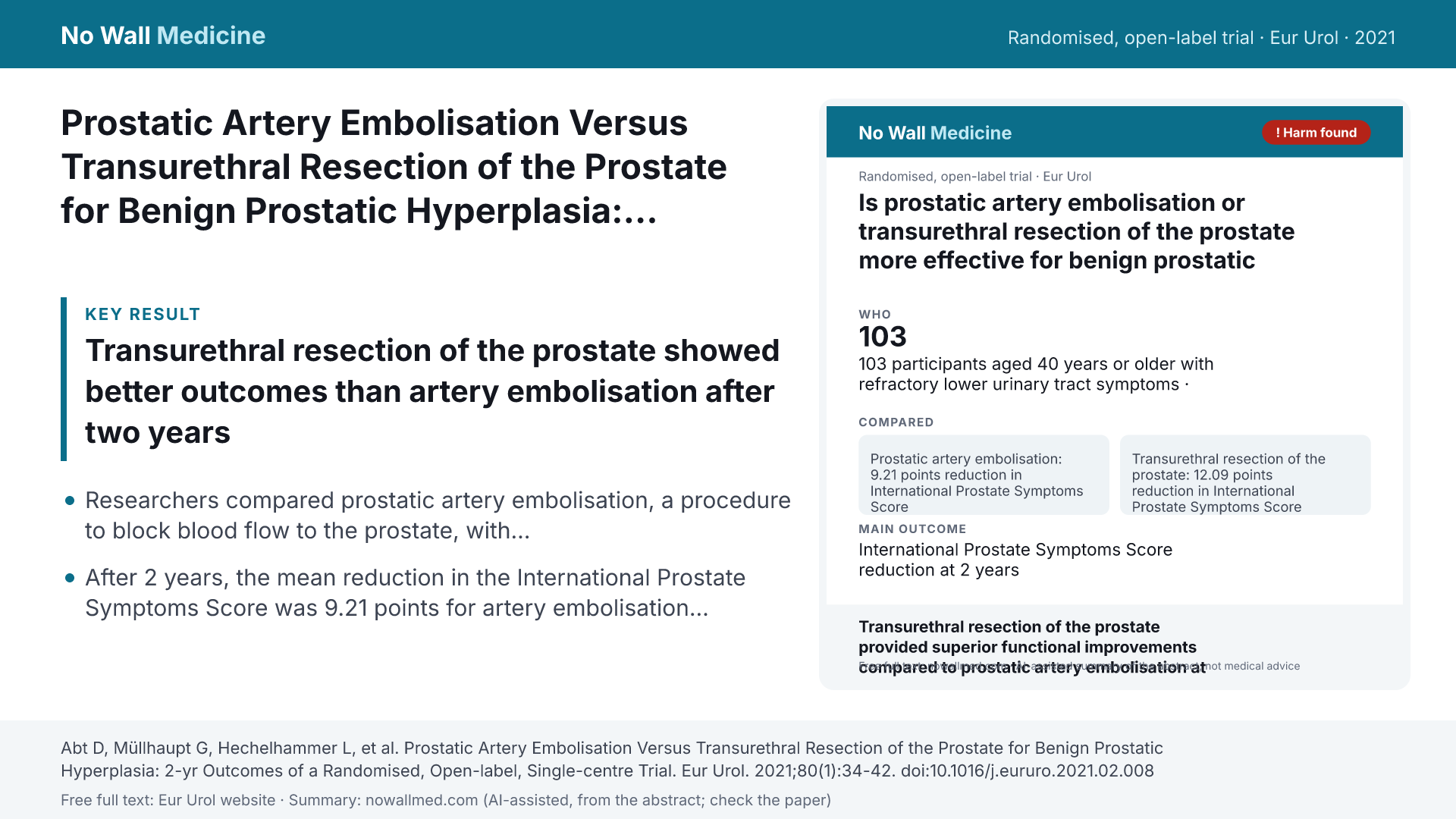
Prostatic Artery Embolisation Versus Transurethral Resection of the Prostate for Benign Prostatic Hyperplasia: 2-yr Outcomes of a Randomised, Open-label, Single-centre Trial
Key result: Transurethral resection of the prostate showed better outcomes than artery embolisation after two years
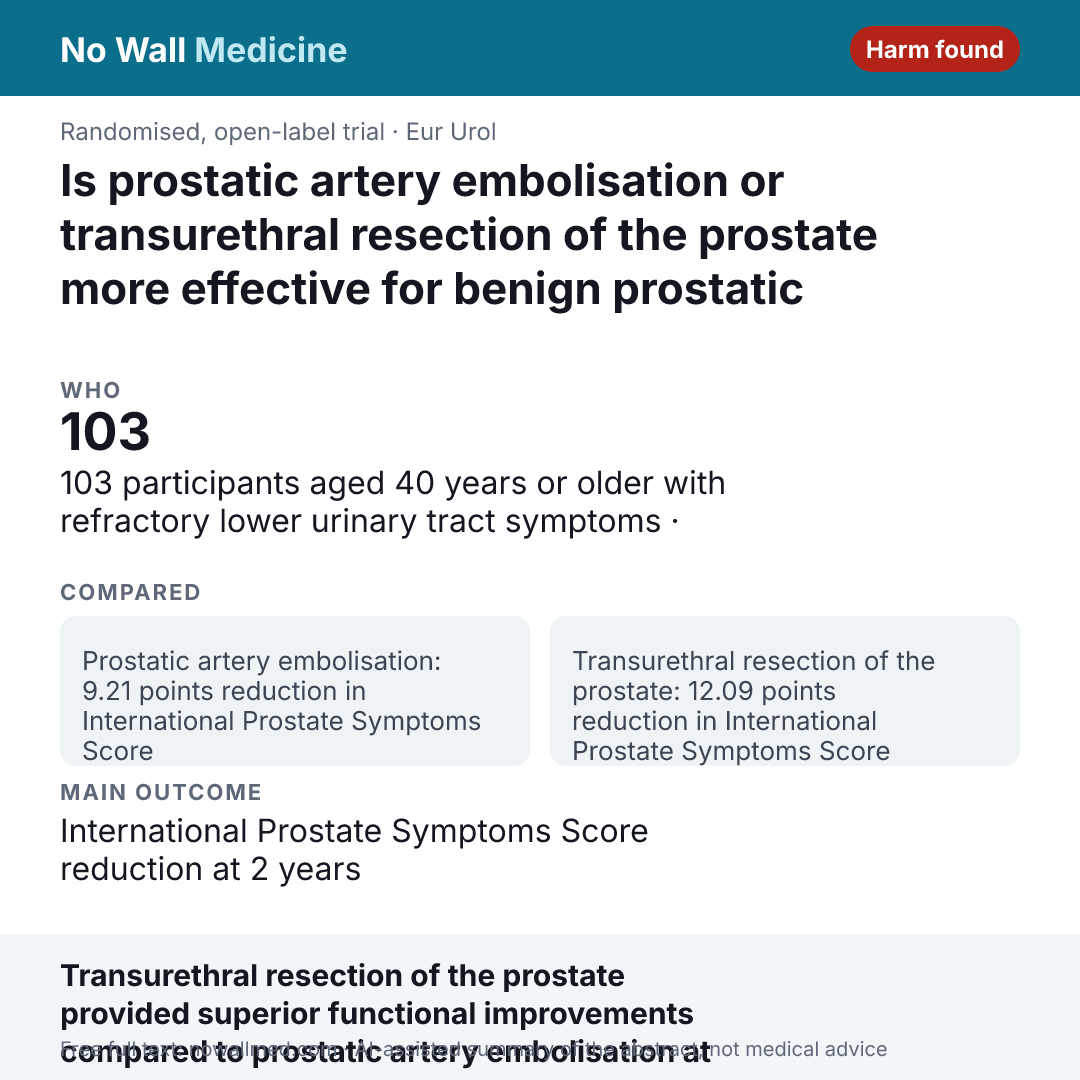
Key points
- Researchers compared prostatic artery embolisation, a procedure to block blood flow to the prostate, with transurethral resection of the prostate, a surgical removal of prostate tissue, in 103 participants.
- After 2 years, the mean reduction in the International Prostate Symptoms Score was 9.21 points for artery embolisation and 12.09 points for the surgical resection.
- Adverse events were less frequent in the artery embolisation group with 43 total occurrences compared to 78 in the surgical group.
Why it matters: The efficacy and safety of prostatic artery embolisation for treating lower urinary tract symptoms caused by benign prostatic obstruction remain under investigation.
Limitation the authors note: Ten patients who initially underwent prostatic artery embolisation required surgical resection within 2 years due to unsatisfying clinical outcomes, preventing further assessment of their outcomes.
Discussion prompts
- Would these patients look like yours? Who was left out?
- Is the main outcome one that matters to patients?
- Is the difference large enough to change what you do?
Cite: Abt D, Müllhaupt G, Hechelhammer L, et al. Prostatic Artery Embolisation Versus Transurethral Resection of the Prostate for Benign Prostatic Hyperplasia: 2-yr Outcomes of a Randomised, Open-label, Single-centre Trial. Eur Urol. 2021;80(1):34-42. doi:10.1016/j.eururo.2021.02.008
Free full text: Eur Urol website · Summary and visual abstract: nowallmed.com/a/prostatic-artery-embolisation-versus-transurethral-resection-of-the-6iasak/ (AI-assisted from the abstract; check the paper before relying on it).