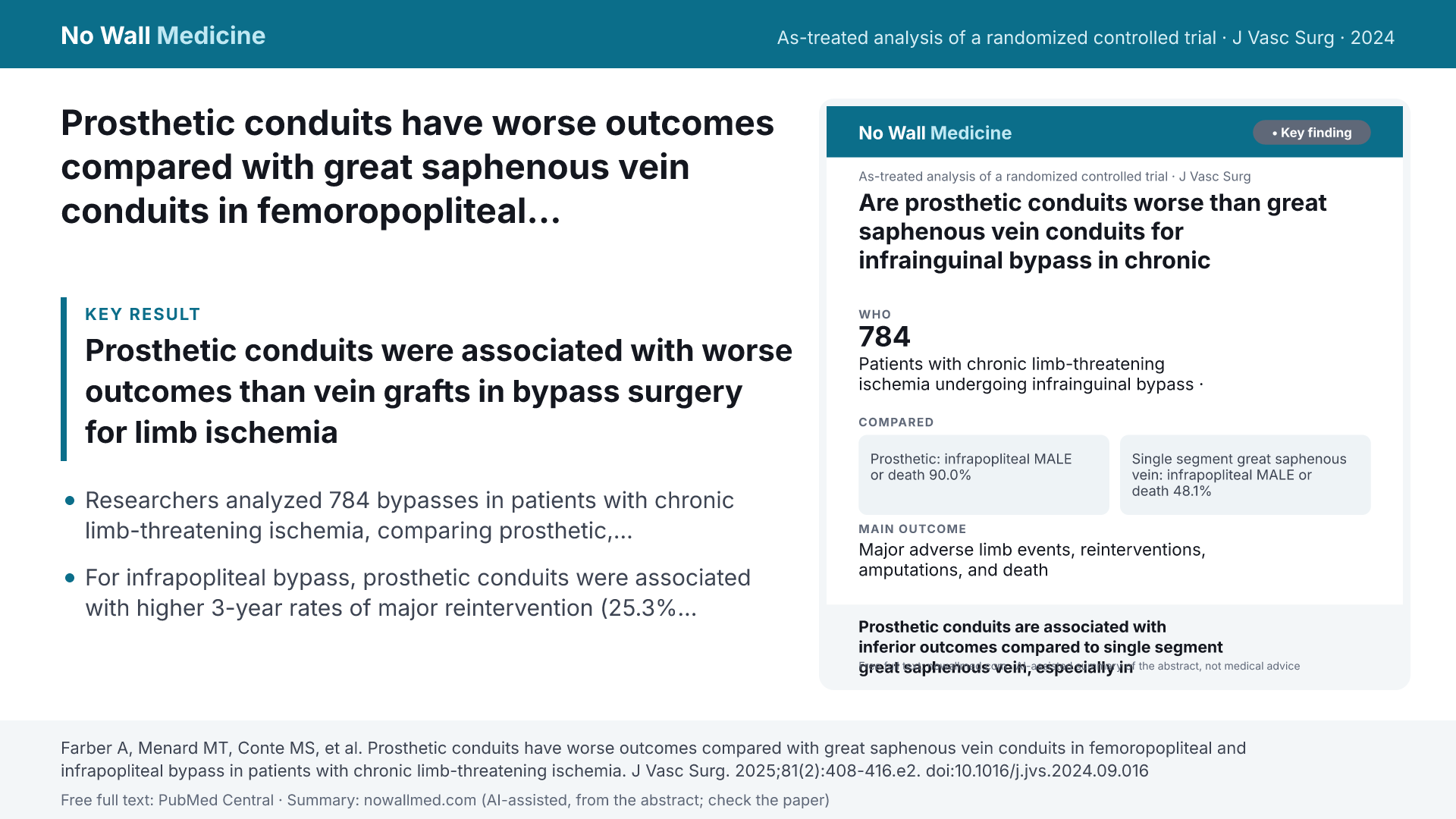
Prosthetic conduits were associated with worse outcomes than vein grafts in bypass surgery for limb ischemia
Prosthetic conduits have worse outcomes compared with great saphenous vein conduits in femoropopliteal and infrapopliteal bypass in patients with chronic limb-threatening ischemia
As-treated analysis of a randomized controlled trialKey finding
Are prosthetic conduits worse than great saphenous vein conduits for infrainguinal bypass in chronic limb-threatening ischemia?
Who
784
Patients with chronic limb-threatening ischemia undergoing infrainguinal bypass · Multicenter
Compared
Prosthetic: infrapopliteal MALE or death 90.0%
Single segment great saphenous vein: infrapopliteal MALE or death 48.1%
Main outcome
Major adverse limb events, reinterventions, amputations, and death
Result: hazard ratio 3.59 (95% CI 1.64 to 7.86)
Bottom line: Prosthetic conduits are associated with inferior outcomes compared to single segment great saphenous vein, especially in infrapopliteal bypass.
J Vasc Surg · 2024-09-23 · Save PNG
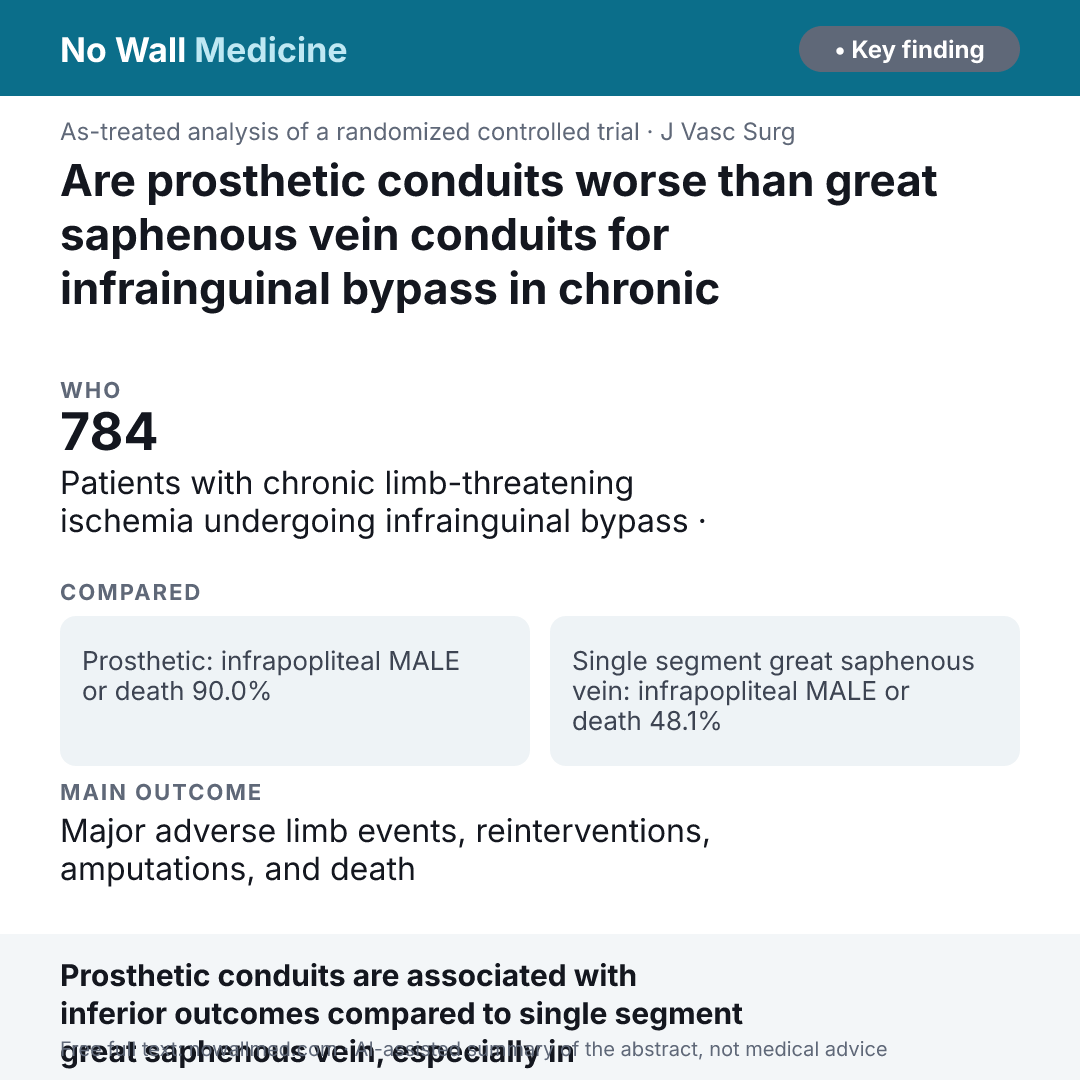
Clinical question: Are prosthetic conduits worse than great saphenous vein conduits for infrainguinal bypass in chronic limb-threatening ischemia?
Key points
- Researchers analyzed 784 bypasses in patients with chronic limb-threatening ischemia, comparing prosthetic, alternative autogenous vein, cryopreserved vein, and single segment great saphenous vein conduits.
- For infrapopliteal bypass, prosthetic conduits were associated with higher 3-year rates of major reintervention (25.3% vs 10.3%), death (68.6% vs 34.8%), and major adverse limb events or death (90.0% vs 48.1%).
- In femoropopliteal bypass, prosthetic use was associated with increased major reinterventions at 3 years on risk-adjusted analysis (hazard ratio 2.13) but showed no significant differences in death or amputations.
Headline and key points written with AI from the paper’s abstract, with every number checked against it. Read the paper before relying on them.
Was this summary helpful?
Subject terms
Headline, design, result, key points, caveat and citation as plain text.
Cite this article
Farber A, Menard MT, Conte MS, et al. Prosthetic conduits have worse outcomes compared with great saphenous vein conduits in femoropopliteal and infrapopliteal bypass in patients with chronic limb-threatening ischemia. J Vasc Surg. 2025;81(2):408-416.e2. doi:10.1016/j.jvs.2024.09.016
Spotted a mistake? Suggest a correction