Systematic review identifies ownership and agency as key components of prosthetic embodiment
Prosthetic embodiment: systematic review on definitions, measures, and experimental paradigms
Systematic reviewUnclear result
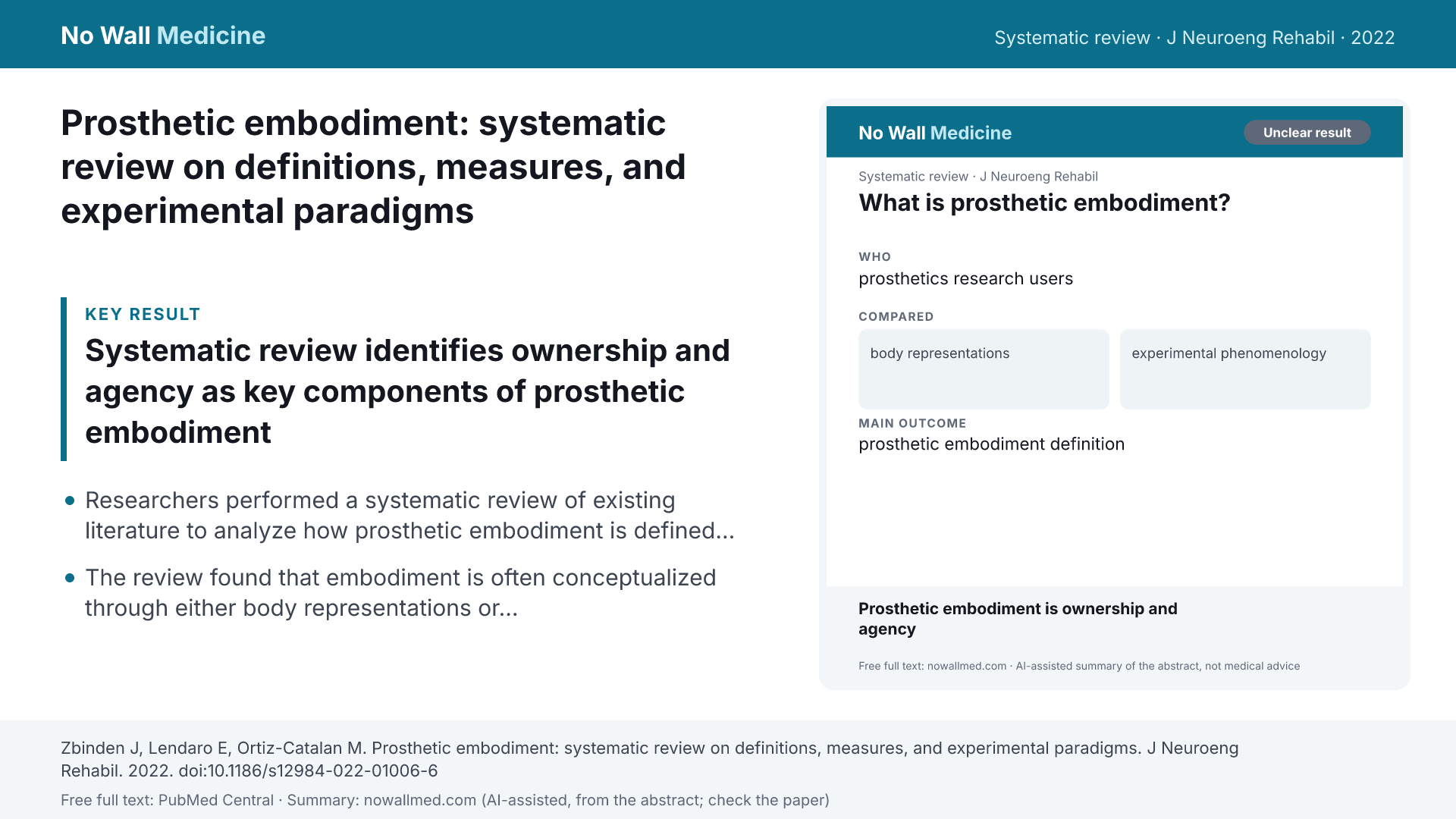
What is prosthetic embodiment?
Who
prosthetics research users
Compared
body representations
experimental phenomenology
Main outcome
prosthetic embodiment definition
Bottom line: Prosthetic embodiment is ownership and agency
Limitation: terminological ambiguity
J Neuroeng Rehabil · 2022-03-28Download image

Clinical question: What is prosthetic embodiment?
Why it matters: The lack of consistent definitions and measurements for prosthetic embodiment makes it difficult to compare results across different research studies.
Key points
- Researchers performed a systematic review of existing literature to analyze how prosthetic embodiment is defined and measured in scientific studies.
- The review found that embodiment is often conceptualized through either body representations or experimental phenomenology, which are frameworks for understanding how a person perceives a limb.
- The authors propose that defining embodiment as the combination of ownership and agency allows it to be used as a quantifiable metric.
Headline and key points written with AI from the paper’s abstract, with every number checked against it. Read the paper before relying on them.
Was this summary helpful?
Subject terms
Cite this article
Zbinden J, Lendaro E, Ortiz-Catalan M. Prosthetic embodiment: systematic review on definitions, measures, and experimental paradigms. J Neuroeng Rehabil. 2022. doi:10.1186/s12984-022-01006-6
Spotted a mistake? Suggest a correction