Prosthetic embodiment: systematic review on definitions, measures, and experimental paradigms
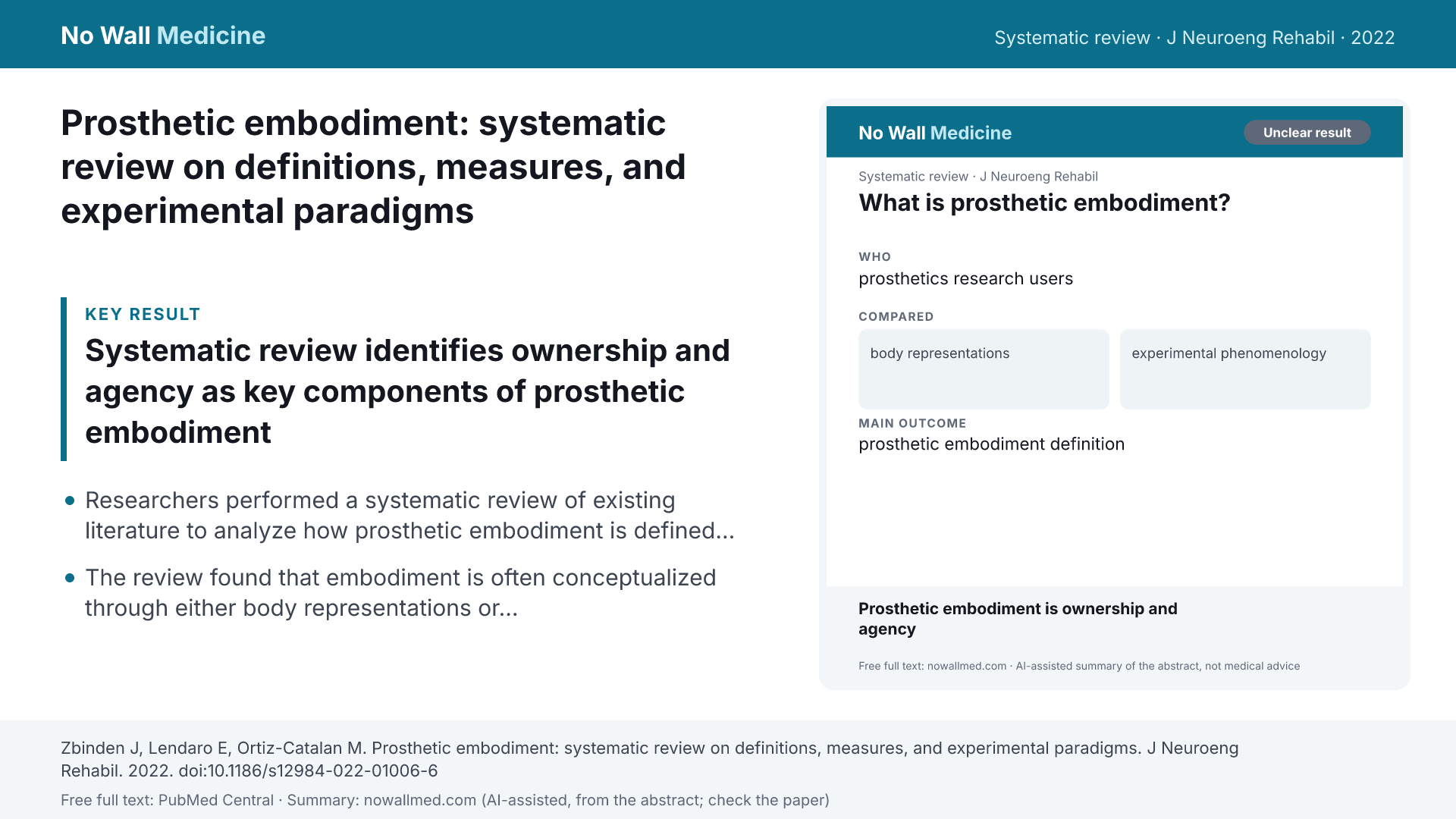
Key result: Systematic review identifies ownership and agency as key components of prosthetic embodiment
Systematic reviewUnclear result
What is prosthetic embodiment?
Who
prosthetics research users
Compared
body representations
experimental phenomenology
Main outcome
prosthetic embodiment definition
Bottom line: Prosthetic embodiment is ownership and agency
Limitation: terminological ambiguity
J Neuroeng Rehabil · 2022-03-28Download image

Key points
- Researchers performed a systematic review of existing literature to analyze how prosthetic embodiment is defined and measured in scientific studies.
- The review found that embodiment is often conceptualized through either body representations or experimental phenomenology, which are frameworks for understanding how a person perceives a limb.
- The authors propose that defining embodiment as the combination of ownership and agency allows it to be used as a quantifiable metric.
Why it matters: The lack of consistent definitions and measurements for prosthetic embodiment makes it difficult to compare results across different research studies.
Discussion prompts
- Would these patients look like yours? Who was left out?
- Is the main outcome one that matters to patients?
- Is the difference large enough to change what you do?
Cite: Zbinden J, Lendaro E, Ortiz-Catalan M. Prosthetic embodiment: systematic review on definitions, measures, and experimental paradigms. J Neuroeng Rehabil. 2022. doi:10.1186/s12984-022-01006-6
Free full text: PubMed Central · Summary and visual abstract: nowallmed.com/a/prosthetic-embodiment-systematic-review-on-definitions-measures-and-mhhpa2/ (AI-assisted from the abstract; check the paper before relying on it).