Two doses of killed whole-cell cholera vaccine provides protection for at least 4 years
Protection from killed whole-cell cholera vaccines: a systematic review and meta-analysis
Systematic review and meta-analysisBenefit found
What is the protection conferred by killed whole-cell oral cholera vaccines?
Who
People receiving killed whole-cell oral cholera vaccines
Compared
55%Two doses efficacy 12 months (95% CI 46-62)
44%Two doses efficacy 48 months (25-59)
69%Two doses effectiveness 12 months (58-78)
47%Two doses effectiveness 48 months (9-70)
Main outcome
Protection against medically attended, confirmed cholera
Bottom line: Two doses provide protection for at least 4 years, while one dose provides protection for at least 2 years.
Funded by: Bill & Melinda Gates Foundation
Lancet Glob Health · 2025-07-01Download image
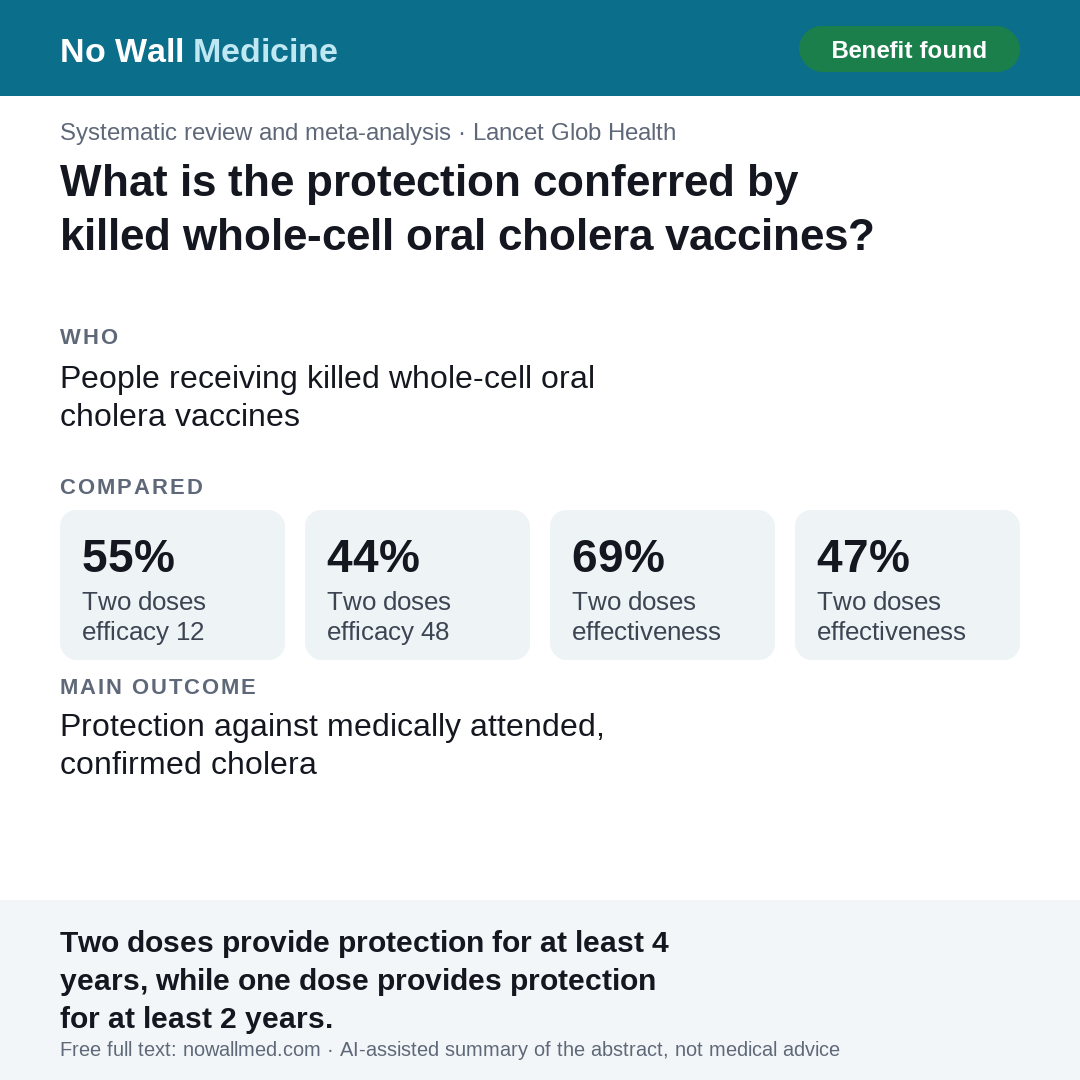
Clinical question: What is the protection conferred by killed whole-cell oral cholera vaccines?
Why it matters: Guidelines need updated evidence on killed whole-cell cholera vaccine protection duration
Key points
- 53 studies including 5 randomized trials were analyzed for vaccine protection.
- Two-dose efficacy was 55% 12 months after vaccination, declining to 44% by 48 months.
- One-dose efficacy was 57% at 24 months in individuals 5 years and older.
Limitation the authors note: Children younger than 5 years were less protected by the vaccine than older individuals
Headline and key points written with AI from the paper’s abstract, with every number checked against it. Read the paper before relying on them.
Abstract
Background
Killed whole-cell oral cholera vaccines (kOCVs) are a standard prevention and control measure in cholera-endemic areas and during outbreaks and humanitarian emergencies. New evidence has emerged and the ways in which the vaccines are used have changed. We aimed to provide an updated synthesis of evidence on protection conferred by kOCV. Methods
In this systematic review and meta-analysis, we used the same search procedure as a previous systematic review to identify randomised clinical trials (RCTs) and observational studies that reported estimates of protection conferred by kOCVs against medically attended, confirmed cholera. Eligible studies in English, French, Spanish, or Chinese published up until March 8, 2024, including those identified in the previous review, were included. Data on efficacy and effectiveness were extracted, as were the number of doses, duration of follow-up, and age group. Efficacy and effectiveness estimates were summarised separately using random-effect models to estimate protection by time since vaccination; meta-regression models were used to estimate protection, by dose, as a function of time since vaccination. This updated study is registered along with the original review with PROSPERO (CRD42016048232). Findings
We identified 8205 records published online up until March 8, 2024, including 6224 articles from the previous review and 1981 articles from our new search (after Jan 1, 2016). Of these, 53 were eligible for full-text review. Five RCTs and ten observational studies from 23 publications were included. Average two-dose efficacy 12 months after vaccination was 55% (95% CI 46-62), declining to 44% (25-59) 48 months after vaccination. Average two-dose effectiveness was 69% (58-78) 12 months after vaccination, declining to 47% (9-70) 48 months after vaccination. Only one RCT assessed one-dose efficacy and found sustained protection for 24 months (57% [42-69]) among those 5 years and older with no significant protection in younger children. Average one-dose effectiveness 12 months after vaccination was 60% (51-68) and after 24 months was 47% (34-58). Using age group-specific meta-analysis, we found that average two-dose efficacy in children younger than 5 years was half that of older individuals. Interpretation
Two doses of kOCV provide protection against medically attended cholera for at least 4 years after vaccination. One dose of kOCV provides protection for at least 2 years after vaccination, but wanes faster than that of two doses. Children younger than 5 years are less protected by kOCVs than those aged 5 years and older, regardless of the number of doses received. Funding
Bill & Melinda Gates Foundation.
Abstract reproduced under the article’s CC BY licence.
Topics
Cite this article
Xu H, Tiffany A, Luquero FJ, Kanungo S, Bwire G, Qadri F. Protection from killed whole-cell cholera vaccines: a systematic review and meta-analysis. Lancet Glob Health. 2025. doi:10.1016/S2214-109X(25)00107-X
Spotted a mistake? Suggest a correction
Top studies every Monday
The week’s key trials and guidelines in your specialties, by email. Free.
Get the weekly digest