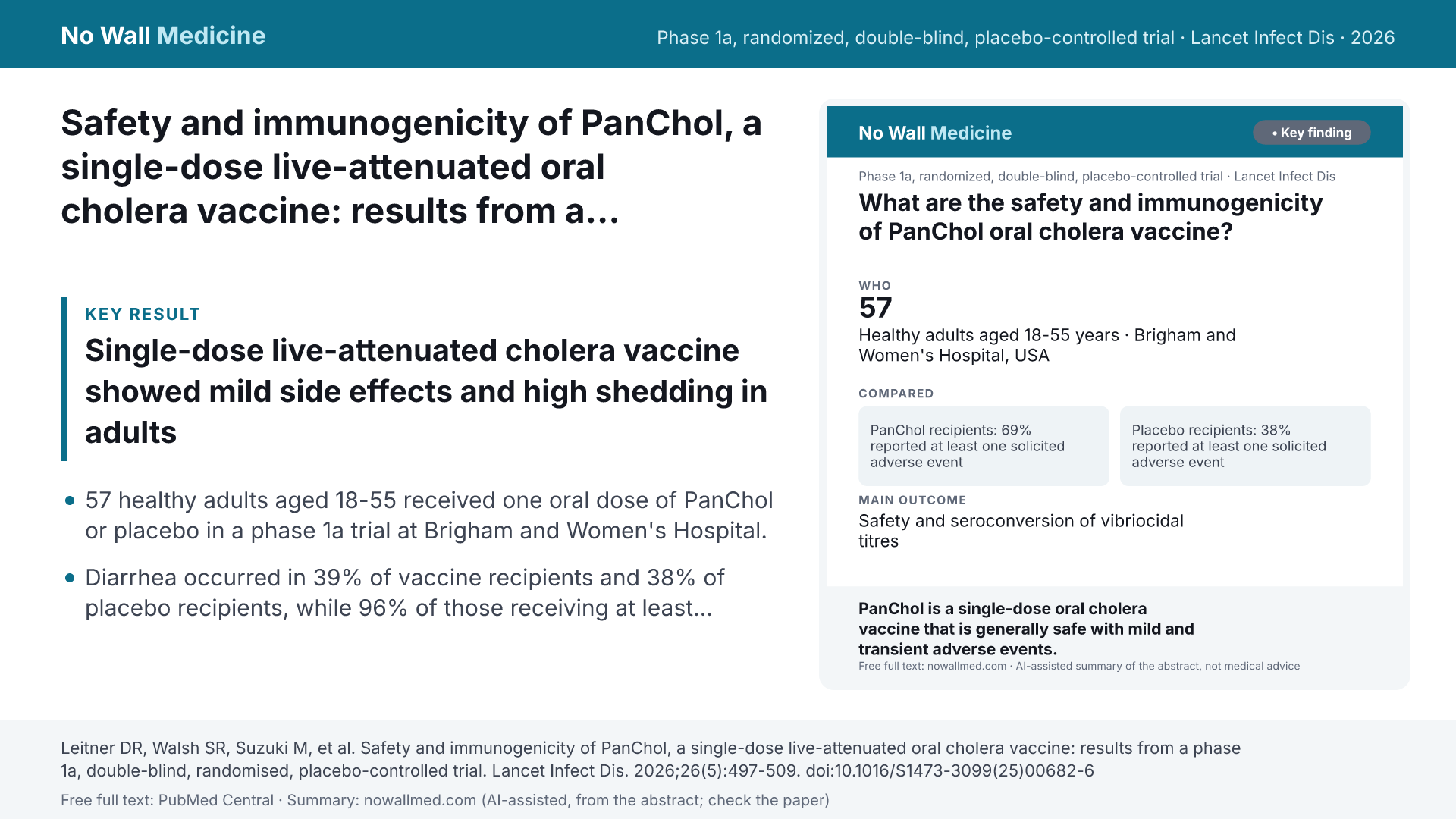
Single-dose live-attenuated cholera vaccine showed mild side effects and high shedding in adults
Safety and immunogenicity of PanChol, a single-dose live-attenuated oral cholera vaccine: results from a phase 1a, double-blind, randomised, placebo-controlled trial
Phase 1a, randomized, double-blind, placebo-controlled trialKey finding
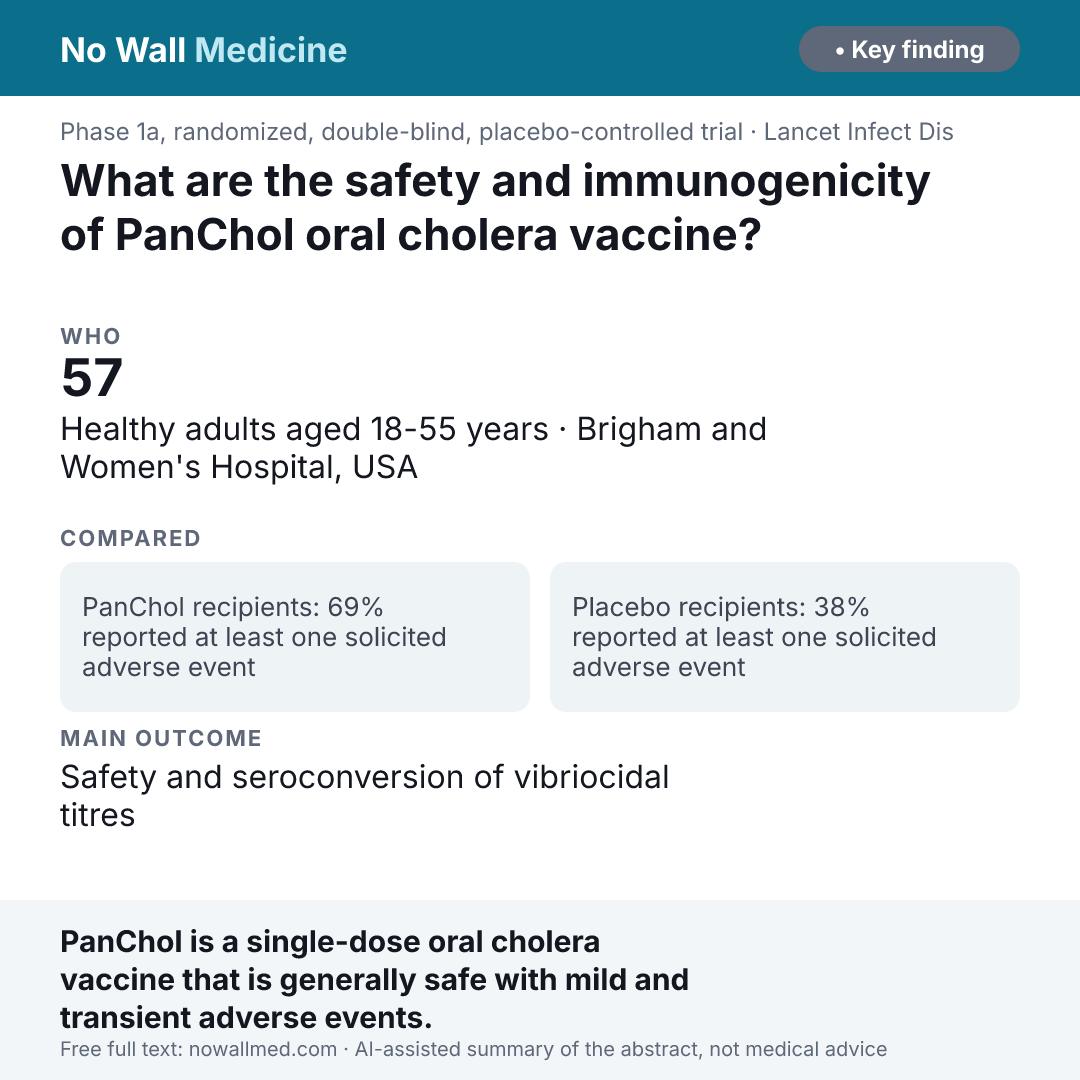
What are the safety and immunogenicity of PanChol oral cholera vaccine?
Who
57
Healthy adults aged 18-55 years · Brigham and Women's Hospital, USA
Compared
PanChol recipients: 69% reported at least one solicited adverse event
Placebo recipients: 38% reported at least one solicited adverse event
Main outcome
Safety and seroconversion of vibriocidal titres
Bottom line: PanChol is a single-dose oral cholera vaccine that is generally safe with mild and transient adverse events.
Limitation: This was a small phase 1a first-in-human trial.
Lancet Infect Dis · 2026-01-07 · Save PNG
Clinical question: What are the safety and immunogenicity of PanChol oral cholera vaccine?
Why it matters: Current killed cholera vaccines require multiple doses and have limited efficacy in young children, prompting development of single-dose alternatives.
Key points
- 57 healthy adults aged 18-55 received one oral dose of PanChol or placebo in a phase 1a trial at Brigham and Women's Hospital.
- Diarrhea occurred in 39% of vaccine recipients and 38% of placebo recipients, while 96% of those receiving at least 105 CFU shed the vaccine organism.
- Most adverse events were mild and transient, with only one unsolicited event deemed related to vaccination in the randomized group.
Limitation the authors note: The study enrolled only 57 healthy adults aged 18-55 years, limiting generalizability to other populations.
Headline and key points written with AI from the paper’s abstract, with every number checked against it. Read the paper before relying on them.
Was this summary helpful?
Abstract
Background
Killed whole-cell oral cholera vaccines can be used to prevent cholera but require multiple doses and have limited efficacy in young children. PanChol is a single-dose, live-attenuated, oral cholera vaccine derived from a current seventh pandemic Vibrio cholerae O1 strain. It co-expresses Inaba and Ogawa antigens, over-expresses the non-toxic cholera toxin B subunit, and is designed to minimise reactogenicity and be incapable of toxigenic reversion. We aimed to assess safety and immunogenicity of PanChol in a first-in-human trial. Methods
This phase 1a trial was conducted at the Brigham and Women's Hospital (Boston, MA, USA) and involved an open-label fixed dose-escalation module, followed by a randomised, double-blind, placebo-controlled dose-expansion module. Eligible participants were healthy adults aged 18-55 years without a previous V cholerae infection or cholera vaccination or a history of gastrointestinal disorders. In the open-label dose-escalation phase, eligible participants were enrolled into one of five cohorts receiving one dose of oral 106-1010 colony-forming units (CFU) of PanChol. A dose de-escalation (104 CFU and 105 CFU) module was added after protocol amendment. In the subsequent randomised, double-blind module, participants were randomly assigned (7:7:4) to one of two dosing groups of one oral dose of PanChol (2 × 10⁷ CFU or 2 × 10⁸ CFU) or one oral dose of placebo (matching diluent). The list of assignments was generated from a custom program written by the statistician using blocked random assignments with a hidden block size (two blocks of 18). The co-primary outcomes were safety, including solicited, unsolicited, and serious adverse events following a single-dose of PanChol, and seroconversion (four-fold rise in titre over baseline) of vibriocidal titres to both Inaba and Ogawa V cholerae at 14 days post-vaccination (day 15). Safety was assessed in all participants who received the study product, and immunogenicity was assessed in all vaccine recipients who had samples available past day 7. Stool shedding of PanChol organisms was assessed as a secondary outcome in all participants. This trial is registered with ClinicalTrials.gov, NCT05657782, and is ongoing. Findings
Between Dec 13, 2022, and Feb 7, 2025, 57 healthy adults were enrolled, including 15 in the dose-escalation module (three in each group), six in the dose de-escalation module (three in each group), and 36 in the dose-expansion module (14 assigned to 107 CFU PanChol, 14 to 108 CFU PanChol, and eight to placebo); all participants received the allocated intervention. 27 (47%) of 57 participants were male, 30 (53%) were female, and the median age was 30·6 years (IQR 25·1-45·1); the majority were White (35 [61%]) and not Hispanic or Latino (51 [89%]). 34 (69%) of 49 PanChol recipients reported at least one solicited adverse event, compared with three (38%) of eight placebo recipients. Most solicited adverse events in PanChol recipients were mild and transient. The most common solicited adverse event was diarrhoea, reported in 19 (39%) of 49 PanChol recipients (15 mild and four moderate) and in three (38%) of eight recipients of placebo (one severe and two mild). In the dose-escalation and dose de-escalation modules, 18 (86%) of 21 participants had 39 unsolicited adverse events. In the randomised module, at least one unsolicited adverse event occurred in ten (71%) of 14 participants given 107 CFU, in 12 (86%) of 14 participants given 108 CFU, and in seven (88%) of eight placebo recipients. Most unsolicited adverse events were mild and only four were higher than grade 2, all of which were deemed unrelated to vaccination. One unsolicited adverse event was deemed related to vaccination (mild gassy sensation on day 3 in a 107 CFU recipient). Shedding was detected in no placebo recipients, in one (33%) of three recipients of 104 CFU PanChol, and in 44 (96%) of 46 recipients of at least 105 CFU (two recipients of 108 CFU did not shed PanChol). All 45 vaccinees given at least 105 CFU PanChol who had samples available past day 7 seroconverted vibriocidal antibodies to both serotypes. Interpretation
A single oral dose of PanChol was safe and well tolerated at all doses and induced 100% vibriocidal seroconversion over a 100 000-fold dose range. These findings support the progression of PanChol into later phase clinical trials, including studies in endemic settings and in children. Funding
Wellcome Trust.
Abstract reproduced under the article’s CC BY licence.
Subject terms
Headline, design, result, key points, caveat and citation as plain text.
Cite this article
Leitner DR, Walsh SR, Suzuki M, et al. Safety and immunogenicity of PanChol, a single-dose live-attenuated oral cholera vaccine: results from a phase 1a, double-blind, randomised, placebo-controlled trial. Lancet Infect Dis. 2026;26(5):497-509. doi:10.1016/S1473-3099(25)00682-6
Spotted a mistake? Suggest a correction